The Nixon Shock, Oil Crises, Stagflation, and Deindustrialization
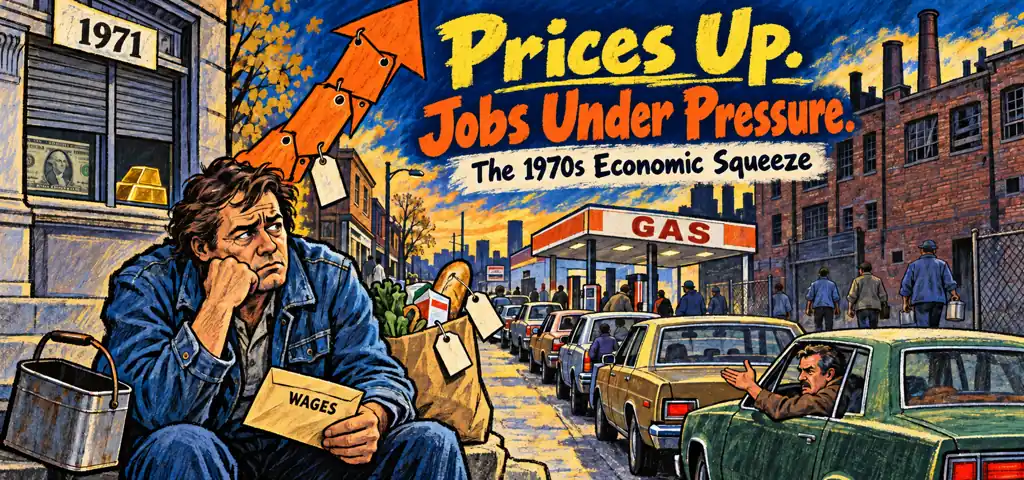
Chapter 15 of the CLEP History of the United States II study guide on Effortless Math covers The Nixon Shock, Oil Crises, Stagflation, and Deindustrialization: the key terms, the core ideas, and worked examples showing how this topic is tested on the exam.
CLEP History of the United States II, Chapter 15
Bretton Woods tied currencies to a dollar convertible into gold
After World War II, foreign governments could exchange dollars for American gold at thirty-five dollars an ounce, while currencies maintained fixed but adjustable exchange rates. American overseas spending and trade deficits placed more dollars abroad than the gold stock could comfortably support. By the late 1960s, inflation and conversion pressure made the promise increasingly costly. The problem concerned international monetary confidence, not a shortage of paper currency at home.
The Nixon Shock combined distinct policies
On August 15, 1971, Nixon suspended dollar-to-gold convertibility, imposed a temporary import surcharge, and announced ninety-day wage and price controls. The administration sought to stop a run on gold, improve trade competitiveness, and restrain inflation before the 1972 election. Exchange rates moved toward floating. Controls suppressed some price increases temporarily but produced shortages and distortions when costs changed faster than legal prices.
The 1973 oil embargo magnified an existing vulnerability
Arab members of OPEC embargoed the United States and reduced production during the Yom Kippur War. Oil prices rose sharply. American import dependence, gasoline-intensive transport, and price controls made adjustment difficult. Long lines reflected both real supply reduction and domestic allocation rules. The embargo did not create every inflationary pressure; food prices, Vietnam-era demand, productivity change, and the monetary transition already mattered.
Stagflation challenged a simple policy tradeoff
The economy experienced high unemployment and inflation together, especially after energy shocks. A conventional expectation that policymakers could choose a stable tradeoff between inflation and unemployment became less useful when supply costs and expectations shifted. Stimulus risked more inflation; restraint risked deeper unemployment. The term stagflation describes the combination, not a single cause or one administration's entire record.
Vietnam finance differed from the Korean War tax effort
Truman paired the Korean War buildup with tax increases in 1950 and 1951, including an excess-profits tax, and restrained some civilian spending. Deficits therefore stayed comparatively small. Johnson tried to fund Vietnam escalation and the Great Society together without an immediate wartime tax increase. Congress did not enact the ten-percent income-tax surcharge until June 1968, after borrowing and demand had already added inflationary pressure. The difference was not that either war had a national bond drive comparable to the world wars; it was the timing and scale of taxation relative to spending.
Energy regulation created winners, shortages, and later reversal
Federal price controls held "old" domestic oil below market prices while newer production received higher prices, encouraging complicated classifications and limiting incentives. Carter proposed conservation, alternative energy, and gradual decontrol and created the Department of Energy. Reagan completed decontrol in 1981. Falling demand, new supply, conservation, and global production contributed to the 1986 price collapse; no one policy alone explains it.
Efficiency improved after the shock
Fuel-economy standards, smaller automobiles, industrial change, insulation, and shifts toward services reduced energy use per dollar of output. This does not mean total energy use always fell or that regulation alone caused efficiency. It means the economy produced more value for a given quantity of energy. American automakers faced growing Japanese and European competition as consumers valued fuel economy and quality.
Deindustrialization was regional and sectoral
Steel, automobiles, machinery, textiles, and other industries shed jobs in the Northeast and Midwest. Automation, older plants, foreign competition, corporate investment choices, suburbanization, energy costs, and relocation to the South or abroad all contributed. The Rust Belt label captured factory closure, population loss, and fiscal strain. Manufacturing output did not vanish nationally; fewer workers and different locations could produce substantial goods.
Coal and extraction reorganized landscapes
Surface mining expanded in western states where thick seams allowed large machinery, while Appalachian production often relied on underground mines and faced different labor and environmental costs. Federal leasing, rail transport, reclamation rules, and energy demand shaped the change. Extraction policy linked jobs and regional development to land disturbance, water, and boom-bust finance.
Tax revolts reframed the fiscal crisis
California's Proposition 13 in 1978 capped property-tax rates, limited assessment growth, and required supermajorities for some tax increases. Rising assessments, inflation, distrust of government, and uneven service benefits fueled support. The measure reduced local revenue and shifted power toward the state. It was not the same as California's 1979 limit on government spending, and it did not abolish all property taxes.
decompose a price shock
Gasoline lines appear while world oil supply falls and domestic prices are controlled.
Monetary restraint eventually attacked inflation through employment
Federal Reserve chair Paul Volcker sharply tightened monetary policy beginning in 1979. Interest rates rose, credit-sensitive sectors contracted, and the 1981-1982 recession drove unemployment above ten percent. Inflation then fell. The episode clarifies the cost of restoring price stability when expectations have become embedded in wages, contracts, and lending. A central bank can reduce demand and signal resolve, but it cannot produce more oil or reopen a closed factory directly. The policy's success on inflation and its severe distributional costs are both part of the result.
Imports and investment changed the geography of production
Japanese and European manufacturers gained American market share in automobiles, steel, and consumer goods while American firms moved plants, automated, or reorganized supply chains. Exchange rates, fuel efficiency, management, product quality, labor costs, and older capital stock all mattered. Some foreign companies later built plants in the South and Midwest, creating jobs outside older union centers. "Foreign competition" therefore did not mean all production simply left the country. Deindustrialization joined international competition to technology, corporate strategy, public policy, and regional investment; evidence should identify which mechanism affected the place or industry in question.
Watch the history in motion
This short lesson adds voices, images, and chronology to the ideas you just studied.
Video: Ford, Carter, and the Economic Malaise: Crash Course US History #42, CrashCourse.
Try four CLEP-style questions
- What did Nixon's suspension of gold convertibility end?
- The requirement that private banks insure deposits through a federal corporation
- The legal ability of American households to hold checking accounts denominated in dollars
- The right of foreign monetary authorities to exchange dollars for American gold at the fixed rate
- The practice of states collecting property taxes from homes and commercial buildings
- The federal government's authority to issue bonds to domestic and foreign investors
- Why did stagflation complicate economic policy?
- Inflation and unemployment rose together, making simple demand management less reliable.
- Prices fell rapidly while labor shortages made unemployment disappear.
- Fixed exchange rates prevented Congress from changing domestic tax policy.
- Oil prices remained constant while manufacturing output doubled in every region.
- The Federal Reserve lacked legal authority to influence interest rates or credit.
- Which conclusion about deindustrialization is most accurate?
- Automation increased the number of workers needed for each unit of industrial output.
- The United States ceased producing steel, automobiles, machinery, and textiles after 1973.
- Every lost northern factory moved abroad rather than to another American region.
- Foreign competition was irrelevant to automobiles because imports remained negligible.
- Factory employment could fall sharply even while national manufacturing output continued.
- What did Proposition 13 directly constrain?
- Congressional appropriations for oil imports and strategic weapons
- California property-tax rates and assessment growth, with supermajority rules for some taxes
- The Federal Reserve's authority to raise interest rates during inflation
- National wage bargaining between manufacturers and industrial unions
- Federal environmental permits for western surface-coal mines
Check your answers and reasoning
Independent preparation. CLEP is a registered trademark of the College Board, which does not endorse this lesson.

Related to This Article
More math articles
- Best Calculator for the PSAT: Bluebook and 5 Handheld Options
- Congressional caucuses
- How to Fall in Love with Math and Studying?
- Betting Odds Made Simple: Probability and Payouts
- Website Speed: How to Build Better Word Games
- Adding and Subtracting Matrices: Examples and Free Practice
- Free Grade 4 English Worksheets for North Dakota Students
- Traffic Control, One-Way Workflow, and Ergonomics
- Top 10 Free Websites for ACCUPLACER Math Preparation
- Eisenhower’s New Look, Suez, and the Space Race





















What people say about "The Nixon Shock, Oil Crises and Stagflation"?
No one replied yet.