Modern Environmentalism, the EPA, and the Regulatory State
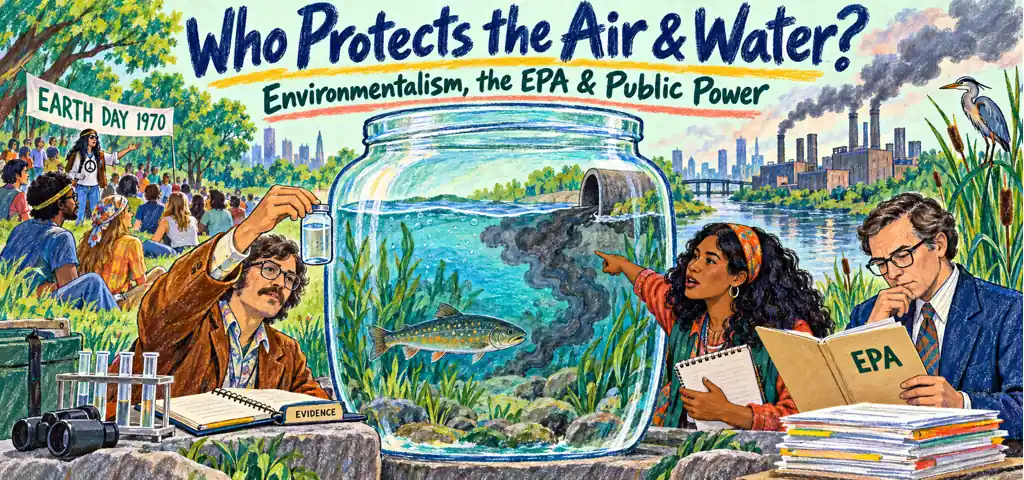
Chapter 14 of the CLEP History of the United States II study guide on Effortless Math covers Modern Environmentalism, the EPA, and the Regulatory State: the key terms, the core ideas, and worked examples showing how this topic is tested on the exam.
CLEP History of the United States II, Chapter 14
Modern environmentalism joined conservation to public health
Earlier conservation debated efficient use, preservation, parks, wildlife, and public lands. Postwar environmentalism added pesticides, radiation, smog, toxic waste, consumer chemicals, workplace exposure, and ecological systems. Aldo Leopold's land ethic had argued that humans belonged to a community including soils, waters, plants, and animals. The newer movement connected that ecological perspective to mass consumption, suburban growth, industrial risk, and federal regulation.
Wilderness advocates made roadlessness a policy goal
The Wilderness Society, organized in 1935 by Bob Marshall, Robert Sterling Yard, and others, sought to keep large federal areas free of roads, vehicles, and permanent development. Ansel Adams's Sierra Nevada photographs strengthened the campaign for Kings Canyon National Park, while Marjory Stoneman Douglas's 1947 River of Grass recast the Everglades as a slow freshwater system rather than a worthless swamp. Edward Abbey later attacked "industrial tourism," especially roads and facilities built to move crowds of cars through parks.
Silent Spring made pesticide effects legible
Rachel Carson's 1962 book explained how persistent chemicals such as DDT accumulated through food chains, harmed birds and other species, and could threaten human health. Chemical companies attacked Carson, but scientific debate and public concern led to investigation and restrictions; the EPA banned most American uses of DDT in 1972. Carson did not demand an end to all pest control. She challenged indiscriminate chemical use and weak public accounting of long-term effects.
Earth Day converted diffuse concern into a national event
Senator Gaylord Nelson promoted a nationwide environmental teach-in, and Denis Hayes coordinated the first Earth Day on April 22, 1970. Millions participated in schools, communities, and demonstrations. The event did not create environmental concern from nothing, nor did it enact one specific statute. It revealed a broad constituency that lawmakers and presidents could address through institutions and legislation.
Pollution science and public images widened the constituency
Arie Haagen-Smit showed that Los Angeles's brown haze formed when sunlight acted on hydrocarbons and nitrogen oxides, especially from automobile exhaust. The St. Louis Baby Tooth Survey found strontium-90 from nuclear fallout in children's teeth, strengthening demands for a test ban. Apollo 8's 1968 Earthrise photograph gave the finite, fragile planet a memorable image. Lady Bird Johnson's beautification campaign focused more on the visible landscape, while Carson emphasized chemicals moving invisibly through living systems.
The crises of 1969 made federal action easier to imagine
The Santa Barbara oil spill and the burning Cuyahoga River oil slick in 1969 helped build support for Earth Day and stronger pollution laws. The Sierra Club's earlier campaign against proposed Grand Canyon dams showed that national advertising could change a congressional project decision, even as the IRS punished the organization by withdrawing the tax deductibility of contributions. These episodes did not create environmentalism, but they translated technical or distant harms into visible political events.
The EPA consolidated administrative authority
Richard Nixon created the Environmental Protection Agency in 1970 by executive reorganization. The agency combined functions previously scattered across departments, including pollution control, pesticides, and standard setting. It did not own every public land or replace state government. Its central role was to set, administer, and enforce federal environmental rules under statutes enacted by Congress.
Vietnam herbicides widened the idea of environmental harm
Under Operation Ranch Hand, American aircraft sprayed roughly twenty million gallons of herbicides over South Vietnam from 1962 to 1971 to remove vegetation and destroy crops. Critics described the deliberate ecological destruction as "ecocide," while scientists documented damaged forests and disputed long-term health effects associated especially with dioxin contamination. The campaign did not cause Rachel Carson's earlier pesticide warning, the domestic DDT ban, or the National Environmental Policy Act by itself. It supplied a wartime case that connected environmental damage to military policy and moral responsibility.
The Clean Air Act divided federal and state tasks
The 1970 Clean Air Act directed the EPA to set national ambient air-quality standards for pollutants harmful to health and welfare. States prepared implementation plans to meet those standards. The law also addressed emissions from new stationary sources and automobiles. This design combined national targets and federal oversight with state implementation; it was neither purely local control nor day-to-day federal operation of every factory.
Water law changed from grants to enforceable limits
Earlier federal water policy emphasized assistance and limited authority. The 1972 Federal Water Pollution Control Act Amendments, commonly called the Clean Water Act, established permit-based limits on pollutant discharges, funded sewage treatment, and set ambitious goals. Congress overrode Nixon's veto. The law targeted point sources more directly than diffuse runoff, leaving important pollution outside its strongest permitting mechanism.
Wildlife, wilderness, and historic places gained procedural protection
The Wilderness Act of 1964 created a national preservation system. The National Historic Preservation Act of 1966 required federal agencies to consider effects on historic properties through Section 106 review. The National Environmental Policy Act of 1969 required environmental impact statements for major federal actions significantly affecting the environment. NEPA is primarily procedural: it requires analysis and disclosure, not selection of the least harmful option in every case.
Federal environmental law grew from research to enforceable duties
The 1955 Air Pollution Control Act chiefly funded research, training, and technical assistance while treating control at the source as a state and local task. The 1970 Clean Air Act instead required enforceable national standards implemented through state plans. The Land and Water Conservation Fund, created in 1964, drew most of its credited revenue from federal offshore oil and gas receipts. Together these measures show distinct federal tools: knowledge, regulation, and dedicated conservation finance.
The Endangered Species Act used a powerful substantive rule
The 1973 Endangered Species Act protected listed species and critical habitat and required federal agencies to avoid actions likely to jeopardize them. In the Tellico Dam controversy, the Supreme Court applied the statute to the snail darter in Tennessee Valley Authority v. Hill. Congress later created an exemption process. The dispute revealed how a broad statutory command could constrain projects already receiving public investment.
Environmental thought disagreed about cause and scale
Paul Ehrlich emphasized population growth; Barry Commoner emphasized production technologies and corporate choices. E. F. Schumacher's Small Is Beautiful argued for human-scale, less resource-intensive technology. The Club of Rome's Limits to Growth modeled interactions among population, resources, pollution, and production. These works shared concern about ecological limits but assigned responsibility differently and proposed different levels of intervention.
Toxic exposure made environmental justice unavoidable
Love Canal residents led by Lois Gibbs documented illnesses and chemical waste beneath their New York neighborhood, helping spur the 1980 Superfund law. In Warren County, North Carolina, a predominantly Black community protested a PCB landfill in 1982; the campaign became a landmark in environmental justice. Navajo uranium miners suffered high lung-cancer risks after working amid radon exposure without adequate warning or protection. Environmental harm followed patterns of race, labor, land, and political power.
Energy conflict challenged regulatory confidence
The 1979 Three Mile Island accident caused a partial reactor meltdown and released limited radiation. No new American reactor orders had been placed since 1978, so the accident did not single-handedly start the halt. It reinforced public doubt, increased costs and cancellations, and hardened opposition. The Sagebrush Rebellion meanwhile attacked federal control of western lands, showing that environmental regulation could provoke a movement demanding local access and resource use.
Federal policy both subsidized and regulated extraction
Mining, irrigation, roads, dams, grazing, and tax policy promoted development even as later statutes constrained environmental damage. The Federal Land Policy and Management Act of 1976 declared that public lands generally would remain in federal ownership and be managed for multiple use and sustained yield. Alaska's 1980 lands act protected vast areas while accommodating rural subsistence and access. Regulation therefore developed alongside, not in place of, a long developmental state.
Later policy used courts, markets, and resource accounting
In Chevron (1984), the Supreme Court announced deference to a reasonable agency interpretation of an ambiguous statute; in Massachusetts v. EPA (2007), it held greenhouse gases were air pollutants under the Clean Air Act and required a statutory reason for refusing regulation. The 1990 acid-rain program capped sulfur dioxide while letting plants bank or trade allowances, encouraging cheaper reductions first. High Plains center-pivot irrigation drew down the Ogallala aquifer faster than recharge in many places, illustrating the economic difference between using a renewable flow and mining a slowly replenished stock.
identify whether a law is procedural or substantive
An agency prepares a detailed impact statement and still selects the damaging option.
Percentage depletion subsidized extraction through the tax code
The percentage depletion allowance let qualifying oil, gas, and mineral producers deduct a fixed share of gross income from a property, subject to statutory limits. Unlike cost depletion, the deduction was not confined to recovering the taxpayer's original investment and could continue after that cost had been recovered. The provision therefore encouraged extraction through a tax preference rather than a direct federal purchase or price guarantee.
Watch the history in motion
This short lesson adds voices, images, and chronology to the ideas you just studied.
Video: A Brief History of Environmentalism in the US, Ben Williams.
Try four CLEP-style questions
- What was Rachel Carson's central argument in Silent Spring?
- Nuclear power had already ended the need for chemical-intensive agriculture.
- All agricultural pest control should be prohibited regardless of method or ecological effect.
- Industrial smog was principally a result of local weather patterns rather than fuel combustion.
- Federal ownership of western land was the only cause of species decline.
- Persistent pesticides could move through ecosystems and cause harms ignored by indiscriminate use.
- How did the 1970 Clean Air Act divide authority?
- The EPA operated local transit systems, while states regulated only automobiles.
- States set all health standards, while the EPA merely published voluntary advice.
- Congress assigned each factory a daily emissions schedule without administrative rules.
- The EPA set national standards, while states developed plans to attain them.
- Federal courts wrote state plans before scientific standards were established.
- Which statement best describes NEPA?
- It transfers public lands to states whenever an impact statement finds mineral deposits.
- It prohibits every federal project that produces any adverse environmental effect.
- It requires environmental analysis and disclosure but does not always dictate the least harmful choice.
- It requires agencies to select the least harmful alternative identified in every environmental impact statement.
- It establishes national air standards and state implementation plans for each pollutant.
- Why is it inaccurate to say Three Mile Island alone ended American reactor orders?
- New orders had already ceased, though the accident reinforced doubts, costs, and cancellations.
- The accident occurred before any commercial nuclear plant operated in the United States.
- Congress imposed a licensing moratorium that forced operating reactors to close on a fixed schedule.
- The event involved a weapons test rather than a civilian generating station.
- Public opinion became more supportive of nuclear construction after the accident.
Check your answers and reasoning
Independent preparation. CLEP is a registered trademark of the College Board, which does not endorse this lesson.

Related to This Article
More math articles
- 4th Grade TCAP Math Worksheets: FREE & Printable
- Students Make the Most Mistakes in These Math Topics
- Top 10 Free Websites for CBEST Math Preparation
- Connecticut SBAC Grade 8 Math Free Worksheets: Free Standards-Aligned PDF Practice Sets
- Health, Illness, and Medicine
- Suffixes and Word Families: How Endings Change Meaning
- Geometry Puzzle – Challenge 67
- Rounding Numbers
- Comte, Martineau, and Spencer
- SBAC Algebra 1 Free Worksheets: Free Printable Smarter Balanced Algebra 1 Practice with Keys




















What people say about "Environmentalism, the EPA, and Regulation"?
No one replied yet.