Gay Liberation and Disability Rights
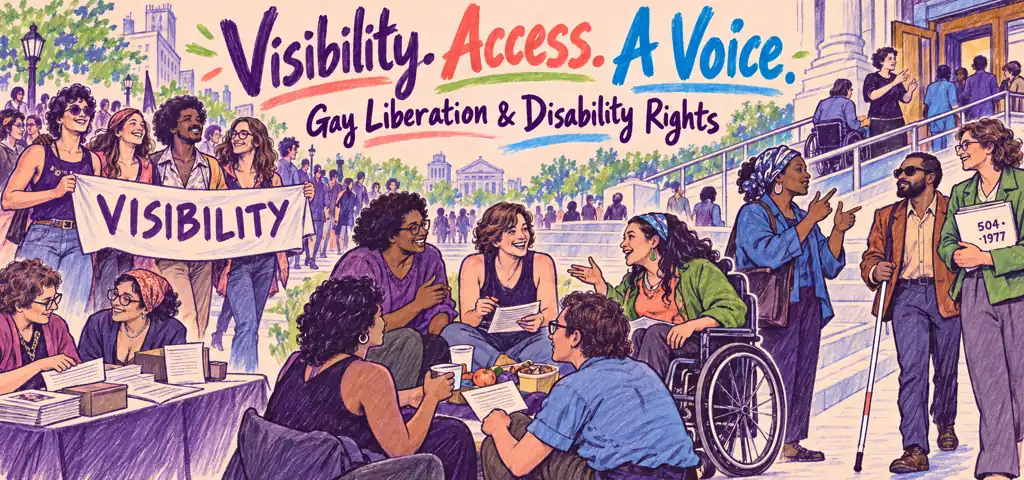
Chapter 14 of the CLEP History of the United States II study guide on Effortless Math covers Gay Liberation and Disability Rights: the key terms, the core ideas, and worked examples showing how this topic is tested on the exam.
CLEP History of the United States II, Chapter 14
Early homophile groups worked before Stonewall
The Mattachine Society formed in 1950, and the Daughters of Bilitis in 1955. These homophile organizations pursued education, cautious public protest, legal change, and respectability in a period of police raids, employment purges, and psychiatric classification. Their strategy often emphasized similarity to heterosexual citizens. Stonewall did not create the first gay-rights organization; it helped transform visibility, tactics, and the language of liberation.
The Lavender Scare joined sexuality to national-security policy
During the early Cold War, the federal government dismissed or excluded thousands of employees suspected of homosexuality. Officials claimed they were vulnerable to blackmail and morally unfit, though evidence did not establish disloyalty. Executive Order 10450 in 1953 formalized security standards used against gay and lesbian workers. The purge operated alongside McCarthyism but was institutionally distinct and lasted beyond McCarthy's fall.
Frank Kameny converted dismissal into employment-rights organizing
The Army Map Service fired astronomer Frank Kameny in 1957 after investigators questioned him about his sexuality. He challenged the dismissal through administrative appeals and a Supreme Court petition, then helped organize the Mattachine Society of Washington and public demonstrations against federal discrimination. Kameny did not found the first homophile organization: Chicago's Society for Human Rights dated to 1924, and the original Mattachine Society formed in 1950. His importance lies in turning one purge victim's case into sustained employment-rights activism.
Stonewall became a symbol through repeated resistance
Police raided the Stonewall Inn in New York on June 28, 1969. Patrons and a growing crowd resisted, and confrontations continued over several nights. Bars serving gay customers had been raided before, and resistance had occurred in other cities. Stonewall's lasting importance came from the organizing, annual commemorations, and liberation groups that followed, not from being the first moment when any LGBTQ person resisted police.
Liberation groups rejected cautious respectability
The Gay Liberation Front connected sexual freedom to antiwar, feminist, antiracist, and anti-imperialist politics. The Gay Activists Alliance focused more narrowly on gay civil rights and used confrontational "zaps" to pressure officials and media. Pride marches commemorated Stonewall while making public visibility itself a political act. These groups differed over coalition, identity, gender, and institutional strategy.
Law and medicine defined the field of conflict
States criminalized same-sex intimacy, police enforced public-morals rules, and employers discriminated openly. In 1973, the American Psychiatric Association removed homosexuality from its diagnostic manual after activism and professional debate. That decision did not repeal criminal laws or create a federal civil-rights statute. It removed one medical classification that had supported coercion and stigma.
Disability activists challenged the charity model
A medical or charity model treated disability mainly as an individual condition to cure or pity. Activists argued that stairs, segregated schools, inaccessible transit, institutionalization, and employment rules created disability through exclusion. Independent-living centers, including the Berkeley Center for Independent Living, joined peer support and personal assistance to demands for control over daily life. The slogan "nothing about us without us" captured participation rather than passive care.
Section 504 supplied a civil-rights rule
Section 504 of the Rehabilitation Act of 1973 prohibited disability discrimination in federally funded programs. The statute was brief, and the Ford administration delayed regulations explaining compliance. Without regulations, schools, hospitals, transit systems, and agencies lacked enforceable standards. Activists therefore targeted the administrative bottleneck rather than asking Congress to pass the same prohibition again.
The 504 sit-in converted law into implementation
In April 1977, demonstrators occupied the San Francisco office of the Department of Health, Education, and Welfare for twenty-six days; protests occurred elsewhere as well. The San Francisco action was sustained by cross-movement support, including food assistance from the Black Panther Party. Secretary Joseph Califano signed the regulations without weakening them. The episode shows how an enacted right can remain unusable until an agency issues rules and institutions change practice.
Deinstitutionalization created freedom and risk
Court rulings, new medications, exposés of abuse, and changing policy reduced large state institutions. Community living could increase autonomy, but governments often failed to fund housing, personal assistance, and mental-health services. Closing an institution was not the same as building support. Disability policy therefore raises a recurring question: does reform transfer control and resources to disabled people, or merely remove one form of custody?
The ADA grew from earlier statutes and organizing
The Americans with Disabilities Act of 1990 extended antidiscrimination rules to employment, public services, public accommodations, transportation, and telecommunications. It was not the origin of disability rights; it built on Section 504, independent living, accessible transit campaigns, litigation, and cross-partisan organizing. Requirements such as reasonable accommodation focus on removing barriers unless doing so imposes undue hardship or fundamentally alters a program.
Coalitions crossed but did not erase identities
The Young Lords, a Puerto Rican organization, and the Black Panther Party both ran free-breakfast and community-health programs while confronting police power and neighborhood neglect. The Young Lords also connected local demands to Puerto Rico's political status, a goal that was not part of the Panthers' program. Feminists, gay activists, people with disabilities, and ethnic-power groups likewise exchanged tactics and support while confronting distinct laws and institutions. Coalition is evidence of connected power, not proof that every movement had the same constituency or goal.
locate the implementation bottleneck
A federal statute prohibits discrimination in funded programs, but agencies have not issued compliance rules.
separate a landmark from an origin
A later protest becomes much better known than the organizations that preceded it.
Stonewall became a symbol because organizing already had roots
Police raids on gay bars were familiar, and patrons at the Stonewall Inn resisted one in June 1969. The ensuing clashes did not create gay activism from nothing; homophile groups had organized, litigated, published, and protested earlier. Stonewall helped energize a more public liberation movement, annual commemorations, and organizations willing to challenge policing and respectability politics. Treating the event as the absolute beginning erases earlier work, while treating it as ordinary misses the symbolic and organizational momentum it generated.
A broad coalition defeated California's Proposition 6
State senator John Briggs placed Proposition 6 on California's 1978 ballot to require dismissal of public-school employees who advocated homosexuality. Gay and lesbian organizers joined teachers' unions, civil libertarians, religious allies, and public figures, including former governor Ronald Reagan, in opposition. They reframed the initiative as government intrusion into employment, speech, and school administration. Voters rejected it by roughly 58 to 42 percent. The campaign shows how a threatened minority can prevail when allies connect a rights claim to institutional concerns shared by a wider electorate.
Independent-living activists reframed disability as an access problem
Rather than defining disability only as an individual medical defect, activists identified stairs, transportation, institutional confinement, hiring rules, and communication barriers as socially constructed exclusions. Centers for independent living combined peer support with advocacy and control by disabled people themselves. The 1977 Section 504 protests demanded enforcement of an existing civil-rights regulation, not a new medical cure. This perspective explains why curb cuts or interpreters are not charitable favors: they alter an environment that otherwise denies equal participation.
Watch the history in motion
This short lesson adds voices, images, and chronology to the ideas you just studied.
Video: The Civil Rights Movement EXPANDS [APUSH Review], Heimler's History.
Try four CLEP-style questions
- Why is it inaccurate to call Stonewall the beginning of all gay-rights organizing?
- Congress had already enacted a federal gay-rights statute in 1950.
- Homophile groups such as Mattachine and the Daughters of Bilitis had organized earlier.
- Stonewall concerned disability access rather than policing of a gay gathering place.
- The confrontation occurred after every state had repealed laws against same-sex intimacy.
- No new organizations or commemorations developed after the Stonewall resistance.
- What did the 1973 psychiatric decision accomplish?
- It created Section 504 protections for all federally funded medical programs.
- It required every employer to provide domestic-partner benefits under federal law.
- It invalidated state criminal statutes through a unanimous Supreme Court ruling.
- It removed homosexuality from the APA's diagnostic classification without repealing discriminatory laws.
- It prohibited police raids at bars and public gathering places nationwide.
- Why did disability activists press for Section 504 regulations in 1977?
- The protest sought a medical classification of disability rather than a civil-rights rule.
- Congress had repealed Section 504 before any federally funded program received notice.
- The regulations would replace independent living with permanent institutional placement.
- The statutory right existed, but delayed rules blocked practical compliance and enforcement.
- The statute applied only to voting and therefore required a constitutional amendment.
- Which comparison of Section 504 and the ADA is accurate?
- The ADA repealed Section 504 and replaced its administrative regulations with voluntary state guidelines.
- Section 504 addressed only disabled veterans, while the ADA applied only to public-school students.
- Section 504 required placement in state institutions, while the ADA prohibited community-based disability services.
- Both laws applied solely to federal employees and excluded public and private transportation systems.
- Section 504 covered federally funded programs; the ADA extended protections across major public and private settings.
Check your answers and reasoning
Independent preparation. CLEP is a registered trademark of the College Board, which does not endorse this lesson.

Related to This Article
More math articles
- The Best Grade 8 ELA Practice Tests for Maryland Students
- The Best Calculator for FE Exam
- 10 Most Common 6th Grade SBAC Math Questions
- Top 10 5th Grade NYSE Math Practice Questions
- Idaho ISAT Grade 7 Math Worksheets: 95 Free PDFs with Tutor-Style Answer Keys
- Connecting Limits at Infinity and Horizontal Asymptotes
- Bureaucracy, Pluralism, Elite Theory, and the Power Elite
- Grade 3 Math: Telling Time
- The Best Grade 8 Math Book for Montana Students
- Maine Algebra 1 Free Worksheets: Printable Algebra 1 Practice for Every Skill





















What people say about "Gay Liberation and Disability Rights"?
No one replied yet.