Chicano, Red Power, and Asian American Movements
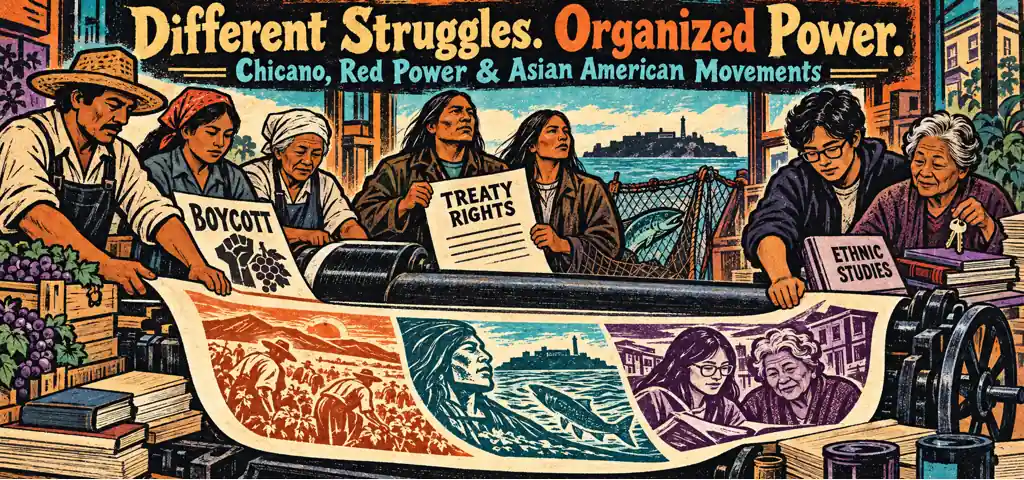
Chapter 14 of the CLEP History of the United States II study guide on Effortless Math covers Chicano, Red Power, and Asian American Movements: the key terms, the core ideas, and worked examples showing how this topic is tested on the exam.
CLEP History of the United States II, Chapter 14
The farmworker movement joined labor rights to civil rights
Filipino workers affiliated with the Agricultural Workers Organizing Committee began the Delano grape strike in September 1965. The mainly Mexican American National Farm Workers Association, led by Cesar Chavez and Dolores Huerta, joined them; the organizations later formed the United Farm Workers. The chronology matters because the strike was not begun by Chavez alone. Workers combined picketing, a national boycott, a long march, religious symbolism, and negotiation to pressure growers.
The boycott moved pressure beyond the fields
California farmworkers often lacked the bargaining protections industrial workers received under the National Labor Relations Act. Organizers therefore asked consumers and unions across the country to stop buying table grapes. The boycott connected distant purchasing decisions to local working conditions and increased the cost of refusing contracts. Chavez emphasized nonviolence and undertook fasts, while tensions persisted over strategy, pesticides, immigration, internal control, and rival unions.
The pesticide campaign connected worker exposure to consumer food
The United Farm Workers later made pesticide exposure part of its organizing. The campaign argued that chemicals threatened fieldworkers first and could also leave residues on produce bought by consumers. That framing expanded earlier wage-and-recognition campaigns by linking occupational health to the national market. It did not abandon contracts or rely only on a labor board; it used consumers' concern to strengthen workers who had less control over chemical conditions in the fields.
The Chicano movement contested schools, elections, and identity
East Los Angeles students walked out in 1968 over unequal facilities, high dropout rates, punitive discipline, and curricula that marginalized Mexican American history. The Brown Berets organized against police abuse and for community services. The Raza Unida Party pursued independent electoral power, especially in Texas. "Chicano" could express political pride and rejection of assimilation, but Mexican American organizations differed over party strategy, nationalism, class, gender, and relations with older groups.
LULAC and the American GI Forum used distinct constituencies
The League of United Latin American Citizens, founded in 1929, emphasized citizenship, education, litigation, and equal treatment for Mexican Americans. The American GI Forum began in 1948 under Hector P. Garcia after a funeral home denied services for Felix Longoria, a Mexican American soldier killed in the Philippines. Both used civic claims, but the GI Forum drew particular authority from veterans and military service.
Termination and relocation produced the conditions for Red Power
In the 1950s, federal termination policy sought to end the special trust relationship with selected tribes, while relocation programs encouraged Native people to move to cities. The results included loss of land, jurisdiction, services, and community ties, not simple integration into prosperity. Urban Indian networks later helped sustain intertribal activism. Red Power rejected termination and demanded treaty rights, sovereignty, land, and self-determination.
Four dates trace the policy reversal behind termination
Congress declared Native people born in the United States citizens in 1924, though several states continued blocking their votes. The Indian Reorganization Act ended allotment in 1934 and allowed tribes to adopt constitutions. Delegates founded the National Congress of American Indians in 1944 to defend treaty rights and tribal government. House Concurrent Resolution 108 announced termination as federal policy in 1953. The sequence moves from citizenship through partial institutional rebuilding to a renewed attempt to dissolve the federal-tribal relationship.
Alcatraz made federal land policy a public drama
Indians of All Tribes occupied Alcatraz Island from November 1969 to June 1971, citing treaty language about unused federal land and proposing a cultural and educational center. The occupation attracted broad attention and participants from many tribal backgrounds. It did not win ownership of the island, but it helped shift public debate from termination toward self-determination and inspired further occupations.
AIM combined urban organizing with treaty claims
The American Indian Movement formed in Minneapolis in 1968 to address police treatment, poverty, housing, and legal services. It later participated in the Trail of Broken Treaties and the 1973 occupation at Wounded Knee. The Bureau of Indian Affairs building occupation and Wounded Knee drew attention to treaty violations and tribal political conflict. AIM did not represent every Native nation or replace elected tribal governments.
Self-determination changed administration without ending federal responsibility
The Indian Self-Determination and Education Assistance Act of 1975 allowed tribes to contract to administer programs previously run by federal agencies. It did not revive allotment or terminate the trust relationship. The Indian Child Welfare Act of 1978 responded to the disproportionate removal of Native children by public and private agencies, giving tribes and Native families a stronger role in custody and placement decisions.
Asian American became a coalition identity
Activists coined "Asian American" in the late 1960s to build solidarity among groups law and society had separated. Student strikes demanded ethnic studies and greater access. After two Detroit autoworkers killed Vincent Chin in 1982 and received probation and a fine, organizers formed American Citizens for Justice and pursued federal civil-rights charges. Coalition did not erase Chinese, Japanese, Filipino, Korean, or other histories; it made a shared response to racial violence politically possible.
The movement linked community institutions to international politics
Asian American activists opposed the Vietnam War, supported tenant and labor struggles, defended immigrant neighborhoods, and challenged stereotypes of passivity. The International Hotel struggle in San Francisco resisted eviction of elderly Filipino and Chinese tenants. Some activists connected American racism to colonialism abroad. Others focused on local services or representation. The movement therefore operated through campuses, neighborhoods, unions, art, and foreign-policy protest.
identify the missing link in a power strategy
A farmworker organization has few members protected by federal labor law but can reach consumers nationally.
Fish-ins treated treaties as living law
Beginning in the 1960s, Native activists staged fish-ins in Washington State to assert treaty rights at "usual and accustomed" fishing places despite state arrests and seizures. Billy Frank Jr. was repeatedly arrested; Hank Adams helped organize the campaign. In 1974, Judge George Boldt held that treaty tribes were entitled to half the harvest. The claim rested on government-to-government promises, not merely on equal access under a general civil-rights statute.
ANCSA used corporations rather than reservations
The Alaska Native Claims Settlement Act of 1971 resolved aboriginal land claims by transferring about 44 million acres and roughly $960 million to Native-owned regional and village corporations. Shareholders received corporate interests rather than individual Dawes-style allotments or lower-forty-eight reservation trust land. The Prudhoe Bay discovery and pipeline route made settlement urgent. ANCSA did not simply terminate Alaska Native identity, but its corporate structure created distinct questions about land, dividends, development, and community control.
Native-controlled education and religion asserted cultural authority
The Navajo Nation chartered Navajo Community College in 1968 to provide higher education on the reservation under Navajo control, including Navajo language and history. The Native American Church, incorporated in Oklahoma in 1918, joined Christian teaching with older Native practice and used peyote sacramentally in all-night prayer meetings. Neither institution was a federal relocation program. Each asserted that Native communities could direct education or worship without surrendering cultural identity.
Chicano activism linked labor, schools, land, and political identity
The United Farm Workers used strikes, marches, consumer boycotts, and contracts to organize agricultural laborers, while student walkouts challenged unequal schools and curricular exclusion. Land-grant activists in New Mexico invoked a different history, and La Raza Unida pursued electoral power. These efforts shared cultural affirmation and opposition to discrimination but addressed distinct institutions. A grape boycott targeted growers and markets; a walkout targeted school authorities; a land claim addressed property and treaty history. Grouping them together should not erase the mechanism of each campaign.
The Chicano Moratorium made unequal military sacrifice a movement issue
The National Chicano Moratorium brought tens of thousands through East Los Angeles in August 1970 to protest the disproportionate Vietnam casualty burden borne by Mexican American servicemen and their neighborhoods. Its central claim differed from the East Los Angeles school walkouts, the UFW pesticide campaign, and protests against deportation. Each addressed inequality, but through a different institution and source of evidence.
Watch the history in motion
This short lesson adds voices, images, and chronology to the ideas you just studied.
Video: The Civil Rights Movement EXPANDS [APUSH Review], Heimler's History.
Try four CLEP-style questions
- Why was the national grape boycott important to the farmworker campaign?
- It replaced contract negotiations with automatic wage rates set by the Supreme Court.
- It transferred ownership of California vineyards directly to the federal government.
- It extended economic pressure from fields to retailers and consumers across the country.
- It ended competition between unions by barring Filipino workers from the strike.
- It brought farmworkers under the National Labor Relations Act without legislation.
- What best distinguishes the American GI Forum from LULAC?
- The GI Forum drew particular organizing authority from Mexican American veterans and military service.
- The GI Forum opposed citizenship claims, while LULAC rejected litigation and education.
- LULAC represented only recent immigrants, while the GI Forum excluded American citizens.
- LULAC organized farm strikes, while the GI Forum administered tribal trust lands.
- The GI Forum was a federal agency, while LULAC was a political party.
- How did the 1975 self-determination law differ from termination?
- It placed every reservation school under a single national curriculum board.
- It dissolved recognized tribes and distributed all remaining land to individual owners.
- It required Native families to relocate from reservations to industrial cities.
- It abolished federal treaty obligations in exchange for state welfare programs.
- It enabled tribal administration of federal programs while preserving a government-to-government relationship.
- What did the term Asian American accomplish politically?
- It confined organizing to college admissions and excluded neighborhood or labor campaigns.
- It replaced every national-origin identity with a single legally mandatory census category.
- It denied that Japanese incarceration and Chinese exclusion had differed historically.
- It offered a coalition identity across groups with distinct migration and exclusion histories.
- It required activists to support one uniform position on immigration and foreign policy.
Check your answers and reasoning
Independent preparation. CLEP is a registered trademark of the College Board, which does not endorse this lesson.

Related to This Article
More math articles
- Convert Units of Measurement
- The Best Grade 5 Math Book for Louisiana Students
- 10 Most Common 5th Grade Common Core Math Questions
- 8th Grade MCAS Math FREE Sample Practice Questions
- FREE DAT Quantitative Reasoning Math Practice Test
- Building with Blocks: How to Multiply Decimals by 1-digit Whole Numbers
- Full-Length HiSET Math Practice Test
- The Slope of The Slope: Second Derivatives
- How to Analyze and Understand Rational Functions: A Comprehensive Guide
- 7th Grade NJSLA Math Worksheets: Free Printable Review





















What people say about "Chicano, Red Power, and Asian Movements"?
No one replied yet.