California Algebra 1 Free Worksheets: Skill-by-Skill Algebra 1 Worksheets You Can Print Today

Algebra 1 is where math turns into a language. Up to this point, students have mostly been doing arithmetic in a foreign accent, solving a few word problems, hunting for the missing number in an equation, dealing with the occasional letter standing in for an unknown. Algebra 1 is the year that letter stops being decoration and starts being the whole point. Variables, functions, lines, and quadratics aren’t separate topics that happen to live in the same textbook. They’re sentences in a single grammar. Once a student picks up the grammar, the topics start to talk to each other.
The shift takes time. It usually doesn’t happen in a single lesson, and almost never in a single chapter. It happens slowly, across a year, as a student writes the same kinds of structures over and over until they read as naturally as English. Whether your ninth grader is in a Los Angeles high school, working through homework in San Diego, splitting weeks between activities in Fresno, or finishing assignments at a kitchen table in Sacramento, that gradual fluency is what the course is really teaching. The math itself is the side effect.
This page gives you 64 free PDFs to support that process. Each is one skill. Each is short enough to finish in a sitting. Each comes with a worked example and a student-facing answer key.
What’s on this page
Sixty-four single-skill worksheets aligned to the California Algebra 1 standards. The course is wide: writing and simplifying expressions, the properties of operations, solving linear equations at every level, one-step, two-step, multi-step, variables on both sides, literal, plus inequalities and absolute value, functions, relations, domain and range, arithmetic and geometric sequences, slope and lines, parallel and perpendicular lines, direct and inverse variation, systems of equations and inequalities, linear-quadratic systems, exponent rules, polynomial operations and special products, factoring trinomials, solving quadratics three different ways, statistics, probability, and exponential models. The set covers all of it.
Each PDF opens with a Quick Review page: the skill in plain language, one fully worked example, and a short note on the typical mistake to watch for. Then 12 practice problems that build from gentle to genuinely challenging, then a friendly answer key that reads like a tutor explaining, not just stating the answer, but walking through why. No accounts, no signup forms, no email collection. Print and use.
Algebra Foundations
- Variables, Expressions, and Properties, use letters for unknown values and the laws that govern them
- Order of Operations and Evaluating Expressions, PEMDAS in action, what to do first, second, and last
- Simplifying Algebraic Expressions, combine like terms and distribute to tidy any expression
- Introduction to Equations and Solutions, what it means for a value to ‘solve’ an equation
- Personal Financial Literacy, real-money algebra: interest, discount, markup, tax
Solving Linear Equations
- Solving One-Step Equations, undo one operation to isolate the variable
- Solving Two-Step Equations, two careful moves, in the right order
- Solving Multi-Step Equations, distribute, combine, then isolate, a full solve
- Equations with Variables on Both Sides, collect like terms on one side first
- Literal Equations and Formulas, solve a formula for a different letter
Inequalities and Absolute Value
- Solving One-Step Inequalities, one move, with one new rule for negatives
- Solving Multi-Step Inequalities, solve like an equation; flip the sign when dividing by a negative
- Compound Inequalities, AND vs. OR, and how to graph each
- Absolute Value Equations and Inequalities, split into two cases and read ‘and’ vs ‘or’ correctly
Functions and Sequences
- Relations and Functions, every input gets exactly one output, and how to check
- Function Notation and Evaluating Functions, read \(f(x)\) and plug in to evaluate
- Domain and Range, the inputs you may use and the outputs you get back
- Graphing Functions and Transformations, shift, stretch, and flip a parent graph
- Arithmetic Sequences as Linear Functions, add the same step each time, a line in disguise
- Geometric Sequences, multiply by the same ratio each time
- Graphing Square Root, Cube Root, and Piecewise Functions, graph nonlinear parent functions and split rules
- Comparing Functions, compare functions given as equations, tables, and graphs
- Combining Functions, add, subtract, multiply, and divide functions
- Inverse Functions, swap input and output, then solve for \(y\)
Linear Functions and Graphs
- Slope and Rate of Change, rise over run, a real-world rate of change
- Slope-Intercept Form, \(y = mx + b\), read slope and intercept right off it
- Point-Slope Form, build a line from one point and a slope
- Standard Form of a Linear Equation, \(Ax + By = C\), and when it’s most useful
- Writing Linear Equations from Graphs and Tables, turn a graph or a table into an equation
- Parallel and Perpendicular Lines, equal slopes for parallel, negative reciprocals for perpendicular
- Direct and Inverse Variation, \(y = kx\) versus \(y = k/x\)
- Understanding Graphs as Solution Sets, every point on the line satisfies the equation
Systems of Equations and Inequalities
- Solving Systems by Graphing, two lines, one shared point
- Solving Systems by Substitution, solve one equation for a variable, then substitute
- Solving Systems by Elimination, add or subtract the equations to cancel a variable
- Applications of Systems of Equations, two unknowns, two equations, one word problem
- Systems of Linear Inequalities, shade two regions and find where they overlap
- Solving Linear-Quadratic Systems, find where a line crosses a parabola
Exponents and Polynomials
- Properties of Exponents, product, quotient, power, zero, and negative-exponent rules
- Adding and Subtracting Polynomials, combine like terms in higher-degree expressions
- Multiplying Polynomials, FOIL and the box method, when each one helps
- Special Products of Polynomials, perfect squares and difference-of-squares patterns
- Rational and Irrational Numbers, tell a fraction-able number from one whose decimal never repeats
Factoring Polynomials
- Greatest Common Factor and GCF Factoring, pull out the biggest common piece first
- Factoring Trinomials: \(x^2 + bx + c\), two numbers that multiply to \(c\) and add to \(b\)
- Factoring Trinomials: \(ax^2 + bx + c\), the AC method and trial-and-error, side by side
- Factoring Special Products, spot difference of squares and perfect-square trinomials
Quadratic Functions
- Graphing Quadratic Functions, the parabola, its vertex, and the axis of symmetry
- Characteristics of Quadratic Functions, zeros, vertex, max/min, and end behavior
- Solving Quadratics by Factoring, set the product to zero, then each factor
- Solving Quadratics by Completing the Square, rewrite as \((x-h)^2 = k\) and take square roots
- The Quadratic Formula and the Discriminant, the formula every Algebra 1 student remembers, plus what the discriminant tells you
- Solving Quadratics by Square Roots, isolate the square, then take both roots
- Quadratic Applications and Modeling, real-world parabolas: projectiles, area, profit
Statistics and Probability
- Measures of Center and Spread, mean, median, range, and the feel of standard deviation
- Displaying Data: Histograms and Box Plots, two ways to picture a distribution
- Scatter Plots and Correlation, read clustering, outliers, and the direction of a trend
- Lines of Best Fit and Predictions, draw a trend line and predict the next value
- Probability and Counting Principles, count outcomes by multiplying and combine events
- Two-Way Frequency Tables, organize categorical data and read relative frequencies
Exponential Functions and Models
- Graphing Exponential Functions, the shape of \(y = ab^x\), growth or decay
- Exponential Growth and Decay, real-world doubling, half-life, and interest
- Comparing Linear, Quadratic, and Exponential Models, which model fits the pattern, and how to tell
- Interpreting Functions and Parameters, what every letter in the model actually means
How to use these worksheets at home
A common mistake is to treat a 64-page worksheet set like a textbook, start at page one, work to page sixty-four. That’s not how the course flows. The way to use these is to match the worksheet to whatever your student is doing in class right now, and to pair related skills so the pages reinforce each other. Do “Solving Two-Step Equations” before “Solving Multi-Step Equations” in the same week. Do “Slope and Rate of Change” before “Slope-Intercept Form.” Save “Solving Quadratics by Factoring” for the week after “Factoring Trinomials.” These pairs aren’t accidents, they’re the way the curriculum is built, and using them in pairs is how a student goes from understanding a skill in one form to recognizing it in another.
A fourteen- or fifteen-year-old wants independence with their schoolwork, and Algebra 1 is a course they can mostly drive themselves once the materials are in front of them. Print the PDF the night before so it’s waiting in the morning. Keep the answer key nearby but not on the table, students who can see the answers tend to peek. After the work is done, sit together for ten minutes and read the explanations for any wrong problems. That short review is where most of the actual learning happens. It also turns a graded mistake into a quick win, which keeps morale up across a long year.
California schools run on different calendars, semester systems, year-round schedules, summer programs, and there is rarely a single best time for math practice. Twenty minutes, two or three afternoons a week, is enough. Less is fine. The point is consistency, not volume.
A note about Algebra 1 in California
California’s high school accountability system covers Mathematics through the Smarter Balanced assessment, but there is no separate stand-alone statewide Algebra 1 end-of-course exam. The most important measures for an Algebra 1 student are the course itself, semester exams, district benchmarks, classroom assessments, and the cumulative high school math sequence. The California Algebra 1 standards are Common Core-aligned, which means the topics your student studies and the topics these worksheets cover come from the same framework.
That alignment is exactly what makes single-skill practice useful in California. Because the course is mostly evaluated through ongoing classroom work, rather than one all-or-nothing test date, what matters is steady mastery: every standard understood well enough to use in geometry, then Algebra 2, then beyond. The 64 PDFs let you treat the year as a checklist of skills your student can verify one at a time. Each one finished with confidence is one less worry when the next math class starts.
A short closing
The path through Algebra 1 is built one printed page at a time. Bookmark this page, pick a skill that feels almost-but-not-quite solid, and print that PDF tonight. From the coast to the Central Valley, California ninth graders do careful, capable work when the next step is clear. A worksheet on the desk tomorrow morning is exactly that next step.
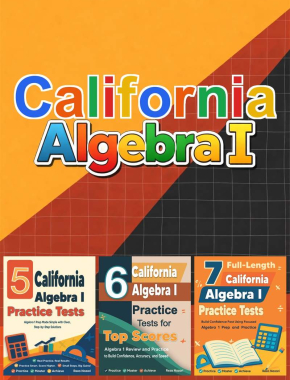
Best Bundle to Ace the California Algebra 1 Test
Want the fastest path through California Algebra 1 math? This bundle pulls it together, four full practice-test books with complete, step-by-step answer keys, instant PDF download.

Related to This Article
More math articles
- Estimating Products
- The Role of Math in Game Design
- Gravity, Circular Motion, and Orbits
- How to Compare Money Amounts
- Due Process Clause
- HiSET Math Formulas
- The Best Grade 3 Math Book for New Mexico Students
- How to Discover the Key to Math Mastery: “TABE Math for Beginners” Solution Manual Unveiled
- Crash Cash-Out Targets: 1.5x vs 2x vs 5x Compared
- DAT Quantitative Reasoning Formulas










What people say about "California Algebra 1: Free Worksheets"?
No one replied yet.