The Election of 1932 and the New Deal Coalition
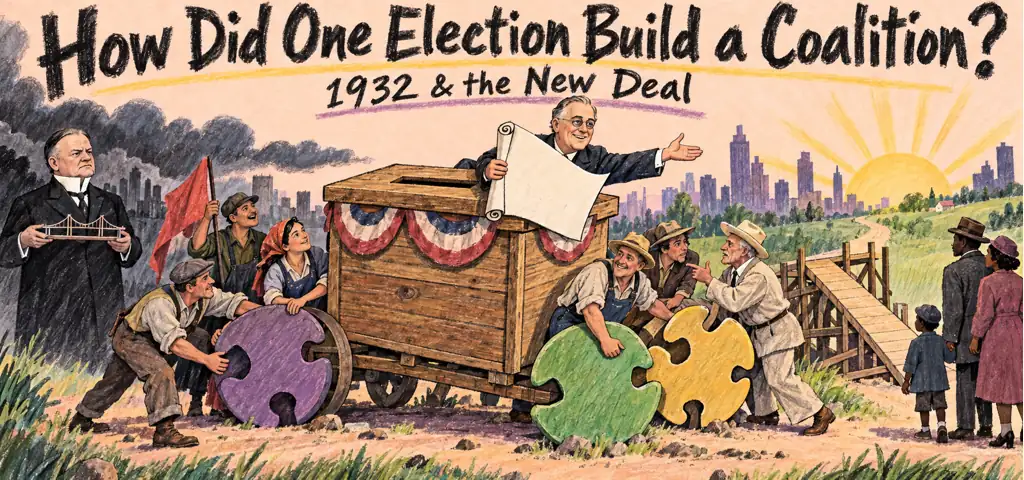
Chapter 9 of the CLEP History of the United States II study guide on Effortless Math covers The Election of 1932 and the New Deal Coalition: the key terms, the core ideas, and worked examples showing how this topic is tested on the exam.
CLEP History of the United States II, Chapter 9
The election became a referendum on governing capacity
By 1932 unemployment, bank failures, farm foreclosures, and relief collapse dominated politics. Hoover defended institutional credit, public works, and balanced constitutional government while warning that Democratic experimentation could undermine individual liberty. Franklin D. Roosevelt promised a "new deal for the American people" and called for bold, persistent experimentation. The phrase did not yet identify a finished program. It offered direction, flexibility, and responsibility where voters saw drift.
Roosevelt balanced reform and fiscal caution
During the campaign, Roosevelt criticized concentrated economic power and Hoover's record. He also attacked federal deficits and promised administrative economy. These positions later sat uneasily with emergency spending. The campaign's ambiguity allowed diverse Democrats to imagine different New Deals. Historical reasoning should not read the full 1935 welfare and labor state backward into speeches made before Roosevelt took office.
The electoral verdict was decisive but not unanimous
Roosevelt won about 57 percent of the popular vote and 472 electoral votes. Democrats also gained large congressional majorities. Hoover retained several northeastern states. Socialist Norman Thomas and other candidates attracted protest votes without threatening the two-party result. The landslide gave Roosevelt political capacity, not a detailed public mandate for every later statute.
The Twentieth Amendment shortened the lame-duck interval
Roosevelt was elected in November 1932 but did not take office until March 4, 1933, while banking conditions deteriorated. Ratified in January 1933, the Twentieth Amendment moved future presidential inaugurations to January 20 and new congressional terms to January 3. It did not shorten Roosevelt's own wait because its operative dates came later. The amendment reduced the dangerous delay between electoral decision and governing authority.
Coalition means constituencies, not identical beliefs
The New Deal coalition eventually joined white southerners, northern urban ethnic voters, many Catholics and Jews, organized labor, farmers, westerners, intellectuals, and increasing numbers of Black voters. These groups disagreed over race, unions, spending, religion, and local power. Federal programs and Democratic organization linked them electorally. A durable coalition can distribute different benefits and meanings to groups whose interests conflict.
Cities moved toward the Democratic Party
Immigrant and working-class urban voters had already supported some Democrats, but relief, jobs, labor policy, and mayoral organizations deepened the shift. Large cities supplied increasing Democratic margins. Political machines could help residents navigate programs while using patronage. Federal administration did not simply eliminate local organizations; it created resources around which mayors, unions, ethnic associations, and neighborhood leaders organized.
Black voters began a consequential realignment
Most Black voters had supported the party of Lincoln. In 1932 Hoover still received a large share, and segregationist southern Democrats made the new party an uncertain home. By 1936 many northern Black voters backed Roosevelt, influenced by relief access, Black federal appointees, Eleanor Roosevelt's advocacy, and New Deal labor possibilities. This shift did not mean the administration ended racial discrimination. It changed national electoral incentives while leaving the white South powerful inside the coalition.
Antilynching failure revealed the southern veto
Bills sponsored by Senators Robert Wagner and Edward Costigan sought federal action against lynching. Roosevelt did not spend decisive political capital for them, fearing southern senators would block the wider New Deal. Filibuster and committee power defeated federal legislation. The administration's calculation preserved other bills at the cost of Black lives and rights. Coalition maintenance and moral failure were part of the same decision.
The 1936 election consolidated the coalition
Republican Alf Landon criticized executive expansion and parts of the New Deal but accepted some reform. Roosevelt won every state except Maine and Vermont. Democrats also abolished their convention rule requiring two-thirds to nominate, a rule that had given southern delegations extra blocking power. The landslide confirmed broad support amid incomplete recovery, yet the coalition's internal conservative wing remained.
The 1938 purge exposed presidential limits
After the court fight, recession, and growing conservative opposition, Roosevelt campaigned in Democratic primaries against several conservative incumbents. Most targets won renomination. In the general election Republicans gained seats, and a conservative coalition of Republicans and southern Democrats constrained new domestic reform. Electoral popularity in 1936 had not given Roosevelt control over local party electorates or congressional ideology.
The Hatch Act separated federal administration from campaigns
Reports that relief jobs and federal authority could be used to reward supporters or pressure voters encouraged passage of the Hatch Act of 1939. The law restricted partisan political activity by most federal executive-branch employees and barred intimidation or bribery connected to federal programs. It did not strip employees of the right to vote or of every private political opinion. The act addressed a governing problem created by expansion itself: a larger administrative state required rules distinguishing public service from party election machinery.
The presidency gained institutional staff
The Brownlow Committee argued that "the president needs help." The Reorganization Act of 1939 authorized administrative changes, and an executive order created the Executive Office of the President, including the Bureau of the Budget. This increased professional capacity for planning and coordination. The development belongs to the New Deal's political legacy: an expanded federal role required an institutionally stronger presidency, a persuasive individual.
A third term broke custom before law set a limit
In 1940 Roosevelt sought and won a third term, breaking the two-term precedent associated with George Washington. No constitutional bar then prevented it. The Twenty-second Amendment, ratified in 1951, later imposed a two-election limit with specific succession provisions. Roosevelt's decision reflected international crisis and political strength, while also provoking fear of personal rule.
test coalition durability
A prompt lists southern committee chairs, urban machines, Black northern voters, and industrial unions.
New Deal liberalism reshaped party competition
Government responsibility for economic security, labor rights, and public investment became central to modern Democratic identity. Republicans contested the scope and administration of that responsibility rather than simply returning politics to 1928. The coalition made reform electorally viable and placed limits on reform through its southern and conservative members. Elections created the governing alliance; policy continually renegotiated it.
Watch the history in motion
This short lesson adds voices, images, and chronology to the ideas you just studied.
Video: The NEW DEAL, Explained [APUSH Review], Heimler's History.
Try four CLEP-style questions
- Why should Roosevelt's 1932 promise of a New Deal not be treated as a detailed mandate for the entire later program?
- The promise preceded construction of the later program.
- Congress enacted Social Security before the election.
- Hoover used the phrase first to describe the RFC.
- The Democratic platform opposed every form of federal action.
- Roosevelt refused to discuss economic policy during the campaign.
- Why was the Executive Office of the President created in 1939?
- To transfer federal budgeting permanently from the executive to state governors
- To dissolve cabinet departments in favor of independent congressional committees
- To give political parties direct authority over civil-service examinations
- To permit presidents to enact appropriations without congressional approval
- To provide professional coordination for expanded presidential responsibilities
- Which evidence best shows that Black movement toward the Democratic Party did not mean the New Deal coalition had overcome racial conflict?
- Black voters lived only in states without federal programs.
- Roosevelt abolished every segregated relief office by executive order.
- Republicans prohibited Black participation in the 1936 election.
- Southern Democrats helped defeat federal antilynching bills.
- Labor unions unanimously excluded Black workers.
- Which pairing from Roosevelt's 1932 campaign best explains why supporters could imagine different versions of a New Deal?
- A pledge to abolish tariffs paired with a plan to nationalize all commercial banks
- A defense of Hooverian voluntarism paired with opposition to any federal relief
- A completed Social Security bill paired with a detailed national labor-relations statute
- A presidential term-limit amendment paired with retention of the convention two-thirds rule
- A call for bold experimentation paired with criticism of deficits and administrative costs
Check your answers and reasoning
Independent preparation. CLEP is a registered trademark of the College Board, which does not endorse this lesson.

Related to This Article
More math articles
- 10 Most Common Pre-Algebra Math Questions
- Transitions Between Sections
- 10 Most Common 7th Grade Common Core Math Questions
- The Best Grade 8 ELA Practice Tests for Vermont Students
- How to Unravel the Mysteries of Nonexistent Limits in Calculus
- The Crucial Role of Mathematics in Engineering Education
- Arkansas ATLAS Grade 7 Math Worksheets: 95 Free Single-Skill PDFs with Step-by-Step Keys
- Ratio, Proportion and Percentages Puzzle -Critical Thinking 9
- SAT Math Vs. High School Math
- The National Labor Union and the Knights of Labor
















What people say about "The Election of 1932 and the New Deal Coalition"?
No one replied yet.