Banking Reform, Relief, and the First New Deal
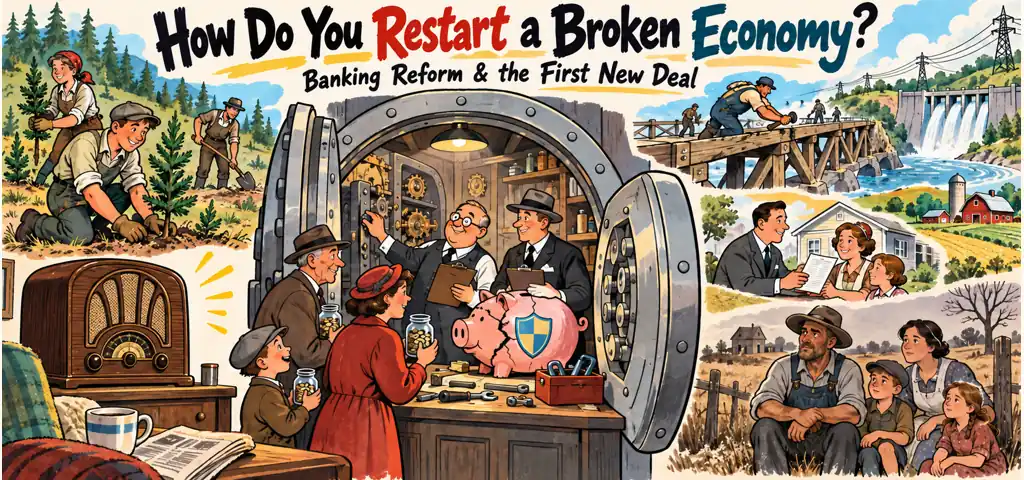
Chapter 9 of the CLEP History of the United States II study guide on Effortless Math covers Banking Reform, Relief, and the First New Deal: the key terms, the core ideas, and worked examples showing how this topic is tested on the exam.
CLEP History of the United States II, Chapter 9
The First New Deal attacked emergency on several fronts
Roosevelt took office on March 4, 1933, amid spreading bank closures. The special congressional session known as the Hundred Days produced measures for finance, relief, agriculture, industry, conservation, housing, and regional development. "Relief, recovery, reform" is a useful guide, but many programs served more than one purpose. The First New Deal did not follow a complete blueprint; it combined experiments shaped by Progressive precedents, wartime administration, state programs, and immediate crisis.
The bank holiday converted panic into inspection
Roosevelt proclaimed a national banking holiday. The Emergency Banking Act, enacted March 9, authorized federal review and assistance before banks reopened. Sound institutions resumed operations in stages, and Roosevelt's first fireside chat explained why redepositing money was safer than hoarding it. The act did not insure deposits or nationalize every bank. It used closure, examination, capital support, and public communication to interrupt runs.
Glass-Steagall separated functions and insured deposits
The Banking Act of 1933 separated commercial deposit banking from much securities underwriting and created the Federal Deposit Insurance Corporation. Deposit insurance changed incentives: small depositors no longer needed to run at the first rumor because qualifying deposits carried a federal guarantee. The law did not eliminate bank supervision or every investment activity. It reduced the contagion through which fear at one bank threatened otherwise sound institutions.
Securities reform targeted disclosure and market practice
The Securities Act of 1933 required truthful registration and disclosure for many new securities offerings. The Securities Exchange Act of 1934 regulated secondary trading and created the Securities and Exchange Commission to enforce disclosure, oversee exchanges and brokers, and police manipulation and insider abuses. The SEC did not guarantee that an investment would rise. It sought informed markets and fairer dealing after the speculative failures associated with the crash.
Monetary policy broke from gold
Roosevelt suspended domestic gold payments, prohibited most private monetary gold holdings, and supported legislation giving the president authority to change the dollar's gold value. The Gold Reserve Act of 1934 fixed a higher dollar price for gold, devaluing the dollar relative to the old parity. The goal was to resist deflation and raise commodity prices. Devaluation altered the monetary framework; it did not directly employ the jobless.
FERA made federal relief a grant responsibility
The Federal Emergency Relief Administration, led by Harry Hopkins, distributed federal grants to states for direct and work relief. This differed from Hoover's relief loans: states did not have to repay ordinary grants. Administration remained partly state and local, so standards and discrimination varied. FERA established that mass unemployment could require continuing federal funds even when recipients had no capacity to repay.
The CWA briefly put workers on a federal payroll
During the winter of 1933-1934, the Civil Works Administration hired roughly four million people for short-term public projects. FERA largely financed relief through grants administered by states and localities; the CWA instead treated workers as employees on temporary public-project payrolls supported by federal funds. It was deliberately short-lived, not a permanent pension or a loan to private firms. The comparison matters because both programs used federal money while assigning administration and employment differently.
The CCC joined employment, conservation, and family support
The Civilian Conservation Corps enrolled mainly young unmarried men in camps managed with Army logistical assistance. Enrollees planted trees, fought erosion and fires, improved parks, and performed other conservation work. Much of their pay went to dependents. The CCC was not the later WPA: it targeted a narrower population, used residential camps, and emphasized outdoor conservation rather than the wider range of public employment.
The NIRA pursued planning through industry codes
The National Industrial Recovery Act created the National Recovery Administration and the Public Works Administration. NRA codes set minimum prices, wages, hours, and trade practices with industry participation; Section 7(a) promised workers a right to organize. Supporters hoped to stop destructive competition and raise purchasing power. Large firms often shaped codes, consumer prices could rise, and labor enforcement was weak. The PWA separately financed large construction projects.
New Dealers disputed planning and competition
Rexford Tugwell and other planners accepted large-scale industry and sought national coordination of production. Reformers influenced by Louis Brandeis feared concentrated corporate power and preferred breaking up large firms to restore competition. NRA codes temporarily exempted approved industry agreements from antitrust law and allowed competitors to set prices and output together. The dispute was not public works versus budget balance; it concerned whether government should manage concentration or dismantle it.
The AAA paid for reduced farm production
The Agricultural Adjustment Act sought "parity," restoring farm purchasing power relative to a prewar base. Processing taxes financed payments to producers who reduced acreage or output. Lower supply could raise prices, but landlords often removed tenants and sharecroppers from contracted land while keeping payments. Farm recovery and rural displacement were linked effects. The destruction of crops and livestock also appeared morally jarring amid hunger.
The TVA was a federal corporation with multiple tasks
The Tennessee Valley Authority built or acquired dams, generated and sold electricity, controlled floods, improved navigation, conducted fertilizer and soil research, and promoted regional development. Congress gave it corporate form so it could operate projects and sell power while serving public goals. Private utilities attacked it as government competition. Local benefits were substantial but unequally distributed, especially where Black residents and workers faced segregation or displacement.
Lilienthal defended planning through local institutions
TVA chairman David Lilienthal later described the authority as "democracy on the march." He argued that planning a whole river valley need not mean remote regimentation because federal resources could work through local governments, cooperatives, farms, and community institutions. Critics questioned how much power local residents actually possessed. The defense distinguished decentralized implementation inside regional planning from leaving electricity and flood control solely to private utilities.
Housing policy used refinancing and insurance
The Home Owners' Loan Corporation refinanced troubled mortgages into longer-term, amortized loans, reducing foreclosure for many owners. The Federal Housing Administration, created in 1934, insured qualifying private mortgages and encouraged longer terms and lower down payments. These measures differed from direct public housing. Underwriting standards and neighborhood risk maps helped institutionalize racial segregation and disinvestment even as the programs stabilized many white homeowners.
Federal Reserve tools changed in a reorganized system
A central bank can buy government securities, lower discount rates, or reduce reserve requirements to expand money and credit. The Banking Act of 1935 strengthened the Federal Reserve Board in Washington and reorganized the Federal Open Market Committee. Tools matter only if officials use them effectively and banks and borrowers respond. Banking reform created capacity; it did not guarantee a particular monetary result.
distinguish instruments
A prompt lists reopening banks, insuring deposits, refinancing mortgages, and giving states relief grants.
The First New Deal stabilized without ending depression
Banks reopened, confidence improved, farm prices rose, relief expanded, and new institutions endured. Output recovered from its 1933 low, yet unemployment remained severe. NRA coordination and the first AAA later fell in court. The First New Deal's significance lies in rapid institutional innovation and a new federal commitment, not full recovery. Its limits and legal defeats helped produce the Second New Deal.
CCC nonrecourse loans made a loan rate act like a floor
The Commodity Credit Corporation lent against stored crops used as collateral. If the market price stayed below the loan rate, a farmer could surrender the crop and satisfy the debt without risking other assets. If prices rose above the rate, repaying the loan and selling the crop became more attractive. The government did not promise an unlimited purchase above the loan rate; the surrender option supported the floor.
Watch the history in motion
This short lesson adds voices, images, and chronology to the ideas you just studied.
Video: The NEW DEAL, Explained [APUSH Review], Heimler's History.
Try four CLEP-style questions
- What limitation followed from FERA's use of federal grants administered partly through states and localities?
- States financed federal relief grants with repayment obligations that began when recovery returned.
- Local administration confined federal auditing to infrastructure rather than household relief.
- The statute routed funds to public works but excluded direct household assistance.
- Federal grants established a uniform legal household benefit regardless of local standards.
- National funding could coexist with unequal local standards and discrimination.
- Why could an AAA acreage-reduction contract raise a landlord's income while worsening a tenant family's position?
- The statute required tenants to repay every processing-tax dollar received by landowners.
- Parity prices applied only to crops grown outside contracted acreage.
- A landlord could collect a reduction payment and remove tenants from land no longer planted.
- The program transferred legal title from tenants to agricultural processors.
- Acreage contracts prohibited landlords from using machinery on retained fields.
- Which pair of First New Deal institutions emerged from the same statute but used different approaches?
- TVA and the Supreme Court
- CCC and Federal Reserve Board
- FDIC and Social Security Board
- NRA industry codes and PWA construction finance
- HOLC and the Wagner Act
- How did HOLC and FHA use different housing-policy instruments?
- HOLC refinanced troubled loans, while FHA insured qualifying private mortgages.
- HOLC insured new construction, while FHA purchased farms from tenants.
- Both agencies nationalized mortgage lenders and abolished private underwriting.
- HOLC built public apartments, while FHA distributed direct cash relief.
- Both confined assistance to renters displaced by public-works construction.
Check your answers and reasoning
Independent preparation. CLEP is a registered trademark of the College Board, which does not endorse this lesson.

Related to This Article
More math articles
- How is the PSAT/NMSQT Test Scored?
- Three-Fifths Compromise
- Betting Odds Made Simple: Probability and Payouts
- The Best Grade 3 Math Book for Idaho Students
- The Best Grade 5 ELA Practice Tests for Maine Students
- How to Find Midpoint? (+FREE Worksheet!)
- What Is a Monomial?
- Complementary and Supplementary Angles: Definitions and Examples for 2026
- Unlocking the Mystery: How to Add Fractions with Different Denominators Using Visual Models
- ISEE Upper Level Math Flashcards (Free Online: Formulas, Terms & Concepts)


















What people say about "Banking Reform, Relief, and the First New Deal"?
No one replied yet.