The Second New Deal, Social Security, and the Federal Safety Net
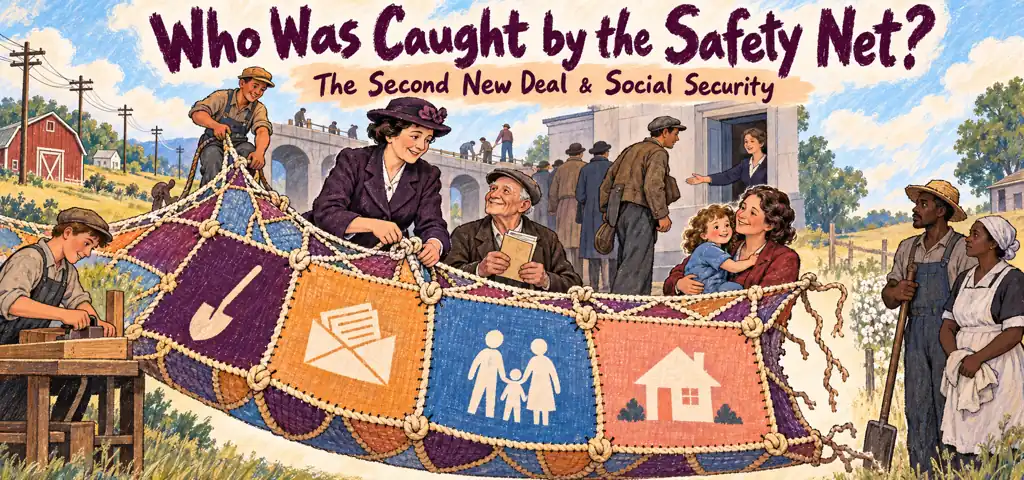
Chapter 9 of the CLEP History of the United States II study guide on Effortless Math covers The Second New Deal, Social Security, and the Federal Safety Net: the key terms, the core ideas, and worked examples showing how this topic is tested on the exam.
CLEP History of the United States II, Chapter 9
The Second New Deal shifted toward durable social rights
By 1935 emergency stabilization had not ended mass unemployment, courts had threatened major programs, and critics demanded more security or redistribution. The Second New Deal strengthened labor organization, created long-term income protections, expanded federal work relief, regulated utilities, and increased taxes on high incomes and large firms. The distinction from the First New Deal is analytical, not an exact wall: programs overlapped in time and drew on earlier experiments.
The WPA made work relief a federal system
The Works Progress Administration, later renamed Work Projects Administration, employed millions on roads, schools, parks, sewing rooms, airports, records, and cultural projects. Harry Hopkins favored useful paid work over a cash dole. WPA wages were generally below prevailing private wages to avoid competing with private employers. Projects created public assets and income, but employment never covered everyone in need and local administration could discriminate.
The NYA served youth outside the CCC model
The National Youth Administration offered part-time jobs to students and work training to unemployed young people, including women. Unlike the CCC, it did not center on residential conservation camps for young men. Projects ranged from clerical and workshop work to school assistance. The NYA recognized that depression interrupted education and labor-market entry, creating a distinct youth problem.
The Wagner Act created enforceable organizing rights
Section 7(a) of the NIRA had announced labor rights without strong enforcement. The National Labor Relations Act of 1935 prohibited specified employer unfair labor practices, established an independent National Labor Relations Board, provided elections, and required bargaining with majority representatives. The law did not compel workers to join a union or guarantee victory in every strike. It gave organization a federal legal and administrative framework.
Social Security combined insurance and assistance
Labor Secretary Frances Perkins, the first woman to serve in a presidential cabinet, chaired the Committee on Economic Security that developed the administration proposal. The Social Security Act of 1935 created federal old-age insurance financed through payroll contributions, a federal-state unemployment compensation system, and grants to states for means-tested assistance to the needy elderly, blind people, and dependent children. These parts used different eligibility and financing principles. "Social Security" can refer narrowly to contributory old-age insurance or broadly to the act's package.
Old-age insurance built an earned-benefit claim
Covered workers and employers paid payroll taxes, and benefits were tied to wage records. The original law scheduled monthly benefits later and initially covered employees in commerce and industry. In Helvering v. Davis (1937), the Supreme Court upheld the federal old-age program under Congress's taxing and spending power for the general welfare. The program's contributory design helped distinguish it politically from poor relief.
Unemployment compensation used a federal-state incentive
A federal payroll tax allowed employers credits for contributions to approved state unemployment systems. This encouraged every state to enact a program while leaving benefit rules and administration substantially state based. In Steward Machine Co. v. Davis (1937), the Court upheld the arrangement. In later downturns, unemployment benefits automatically replaced part of lost wage income as joblessness rose; joined with federal deposit insurance, such built-in support helped keep recessions from transmitting distress as destructively as earlier bank panics and mass income loss. It was neither one uniform national benefit nor a purely voluntary state system.
Aid to Dependent Children expanded and policed family assistance
ADC offered federal matching grants for approved state programs assisting needy children deprived of parental support. It grew from mothers' pension traditions and assumed that a mother should remain home to provide care. States and localities exercised discretion, often using moral judgments and racial discrimination. The program paid assistance based on need, unlike contributory old-age insurance.
Exclusions built inequality into the insurance base
The original old-age and unemployment systems excluded agricultural labor and domestic service, occupations containing large shares of Black workers and many women. Other excluded categories included much government and nonprofit work. The motive for the Title II old-age exclusions is disputed. Some scholarship emphasizes southern racial and low-wage labor politics; Social Security Administration historian Larry DeWitt instead attributes the farm and domestic exclusions to Treasury concerns about collecting payroll taxes from scattered small employers with weak records. The disproportionate racial and gender effect is secure even though historians disagree about whether racial intent caused this particular coverage rule. A formally national statute can produce unequal coverage when occupation determines entry.
The 1939 amendments strengthened the family-wage model
Amendments added benefits for wives, widows, and dependent children of covered male workers and moved monthly payments earlier. They changed old-age insurance toward family protection. Because benefits derived from the primary earner's record, the structure reinforced a single-earner family model and treated many women as dependents rather than workers with independent claims. Expansion and gender hierarchy arrived together.
Rural electrification used cooperatives and federal loans
The Rural Electrification Administration began in 1935 and gained statutory authority in 1936. It lent money to local cooperatives and other providers to build lines where private utilities saw insufficient profit. Farm electrification rose dramatically over subsequent decades. The federal government did not wire every farm directly; finance and cooperative ownership changed the economics of serving dispersed customers.
Utility regulation attacked pyramided control
The Public Utility Holding Company Act of 1935 required geographically and operationally coherent systems and directed the SEC to simplify sprawling holding-company structures. Its "death sentence" language referred to dissolution of unnecessary corporate layers, not execution of individuals or abolition of every private utility. The law answered the financial pyramids exposed by the crash.
Public housing differed from insured private mortgages
The Wagner-Steagall Housing Act of 1937 created the United States Housing Authority, which lent and granted funds to local public housing agencies that cleared designated areas and built rental projects for low-income residents. This was direct support for publicly sponsored housing, unlike the FHA's insurance of mortgages issued by private lenders to qualified borrowers. Slum clearance could displace residents, and local authorities often enforced racial segregation. Both programs shaped housing, but they used different institutions and served different markets.
Flood control became a general federal responsibility
The Flood Control Act of 1936 declared flood control a proper federal activity when expected benefits exceeded estimated costs and authorized projects through national agencies. This benefit-cost standard broadened federal responsibility beyond emergency relief or one regional experiment. The act did not give the TVA exclusive authority over every American river: the Army Corps of Engineers and other institutions remained central. Depression-era public works thus joined immediate employment to a lasting federal role in managing risk, waterways, and infrastructure.
Tax and labor standards broadened the program
The Revenue Act of 1935 raised rates on very high incomes and large corporations, earning the label "wealth tax" despite modest immediate revenue. The Fair Labor Standards Act of 1938 established a federal minimum wage, maximum hours with overtime, and restrictions on child labor for covered interstate employment. Agricultural and domestic workers were again excluded, extending the safety net unevenly.
classify safety-net claims
A prompt compares an unemployed factory worker, an elderly farm laborer, and a child in a needy single-parent household in 1936.
Recovery remained incomplete and vulnerable
By 1937 output had approached its earlier level, but employment lagged and many workers still depended on relief. Federal spending cuts, new payroll taxes, monetary tightening, and inventory adjustment contributed to the 1937-1938 recession. The downturn demonstrated that institutional reform and partial recovery did not guarantee sufficient demand. Wartime mobilization later ended the remaining mass unemployment and led Congress to close the relief agencies.
Watch the history in motion
This short lesson adds voices, images, and chronology to the ideas you just studied.
Video: What few people know about the program that "saved" America – Meg Jacobs, TED-Ed.
Try four CLEP-style questions
- Why were WPA wages generally set below prevailing private wages?
- To convert relief jobs into unpaid probation before private employment
- To reserve federal work projects for workers already receiving pensions
- To provide paid work relief without drawing labor away from private employers
- To prevent workers from spending relief earnings outside their home states
- To make each project's wages identical to military enlistment pay
- Which feature made original federal old-age insurance different from Aid to Dependent Children?
- Old-age insurance was administered only by private charities.
- Insurance used wage contributions; ADC used need and state plans.
- ADC required lifetime payroll contributions from children.
- ADC provided the same cash amount in every state.
- Old-age insurance included farm and domestic labor from the outset.
- Which conclusion best respects the historical dispute over farm and domestic exclusions from original old-age insurance?
- Congress inserted an explicit racial classification at the Treasury's request to simplify contribution collection.
- Tax administration alone explains the exclusions, making their racial distribution incidental to coverage history.
- The original statute covered both occupations nationally, but southern states declined to collect their contributions.
- Disproportionate racial effects are clear even though scholars dispute whether racial intent or tax administration best explains the rule.
- Unsettled motives prevent distributional evidence from informing interpretation of the exclusions.
- Which distinction best separates WPA work relief from federal old-age insurance?
- Both paid one uniform national sum without work or contribution requirements.
- WPA required payroll contributions; insurance tested immediate household need.
- WPA served only retirees; insurance assigned workers to public construction.
- Both covered farm and domestic workers fully from their first year.
- WPA paid assigned work; insurance tied benefits to covered wage records.
Check your answers and reasoning
Independent preparation. CLEP is a registered trademark of the College Board, which does not endorse this lesson.

Related to This Article
More math articles
- New Jersey Plan
- Grade 2 Math Worksheets for Tennessee Second Graders — Free PDFs
- Age
- Why Privacy Needs Math: A Student’s Guide to Staying Safe Online
- Ideological conflict
- The Fundamental Theorem of Algebra
- How to Graph Quadratic Functions? (+FREE Worksheet!)
- CLEP U.S. History I 032: Yorktown, Peace, and International Consequences
- Congressional elections
- 10 Most Common GED Math Questions [Updated for 2026]













What people say about "The Second New Deal and Social Security"?
No one replied yet.