Critics of the New Deal from Left and Right
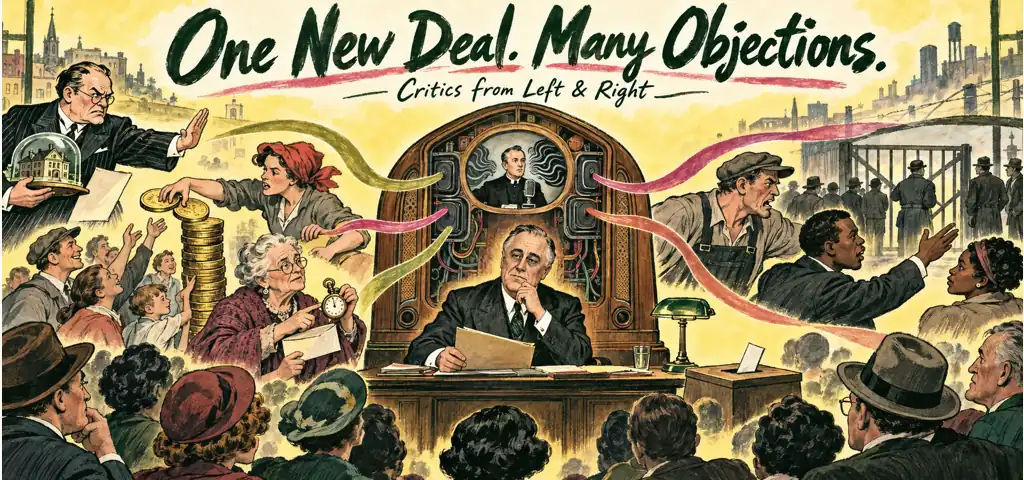
Chapter 9 of the CLEP History of the United States II study guide on Effortless Math covers Critics of the New Deal from Left and Right: the key terms, the core ideas, and worked examples showing how this topic is tested on the exam.
CLEP History of the United States II, Chapter 9
Critics disagreed about the direction of danger
New Deal opponents did not form one camp. Some argued Roosevelt had centralized power, threatened property, encouraged unions, and undermined constitutional government. Others argued that relief and reform left wealth concentrated and insecurity intact. A proposal can oppose the New Deal because it goes too far, not far enough, or uses the wrong institution. Identifying the critic's remedy is more reliable than treating anger at Roosevelt as one ideology.
The Liberty League defended property and limited government
Business leaders and conservative Democrats organized the American Liberty League in 1934. It attacked the Wagner Act, Social Security, taxes, and executive power as threats to constitutional liberty and private enterprise. Its prominent corporate backing made it vulnerable to claims that it defended privilege during mass suffering. The League did not demand nationalization or a guaranteed family income.
Conservative constitutionalism joined economic opposition
Critics challenged delegation to agencies, federal regulation of local activity, taxation, and spending conditions. Supreme Court decisions against the NRA and AAA validated some objections before the Court shifted. Opposition could be legal, partisan, sectional, or economic. A court holding that one statute exceeded federal power did not prove that every New Deal program was unconstitutional.
Huey Long offered redistribution and personal power
Louisiana senator Huey Long proposed Share Our Wealth clubs, steep limits on large fortunes and incomes, and grants or guarantees for households. His slogans promised to make "every man a king." Long had built roads, schools, and hospitals as Louisiana governor while centralizing patronage and suppressing opponents. His appeal mixed material redistribution with authoritarian political methods. He was assassinated in 1935 before a national campaign could test his support.
Townsend turned old-age security into purchasing power
California physician Francis Townsend proposed monthly federal pensions for older Americans, conditioned on retirement and rapid spending of the benefit. The plan was far more generous than the initial Social Security program and aimed to open jobs while stimulating demand. Townsend clubs created political pressure for old-age security. The proposal was not contributory insurance tied to a worker's wage record.
Coughlin moved from reform support to poisonous reaction
Catholic priest Charles Coughlin reached millions through radio. He first supported Roosevelt, then attacked bankers and the New Deal, promoted monetary reform and nationalization of some financial institutions, formed the National Union for Social Justice, and eventually broadcast antisemitic and authoritarian ideas. His career shows how a mass medium could join economic grievance to religious authority and scapegoating.
The Communist Party organized within a Popular Front
Communists criticized capitalism and relief inadequacy, organized unemployed councils and unions, and after 1935 joined a Popular Front against fascism. Party members and allies participated in CIO organizing and cultural projects. Soviet loyalty and internal discipline created deep controversy. The Popular Front could support New Deal measures while seeking more radical structural change; tactical cooperation did not make communism and New Deal liberalism identical.
Socialists pressed democratic alternatives
Norman Thomas and the Socialist Party advocated public ownership, social insurance, labor rights, and planning through democratic politics. Some Socialist proposals influenced public debate even as the party lost voters to Roosevelt. The New Deal absorbed parts of the reform constituency without adopting full socialist ownership. Electoral decline can coexist with ideological influence.
Labor and civil-rights critics exposed exclusions
A. Philip Randolph, Black newspapers, the NAACP, tenant organizers, and women's groups criticized discriminatory relief, occupational exclusions, failure on antilynching, and unequal access to jobs and housing. These critiques came from constituencies sometimes inside the Democratic coalition. Supporting the New Deal against its enemies did not require silence about its racial and gender limits.
Roosevelt answered pressure by moving and absorbing
Social Security undercut Townsend's monopoly on old-age politics, the wealth tax answered redistribution demands symbolically, and the Wagner Act strengthened labor. Roosevelt also attacked "economic royalists" in 1936. The administration adopted some objectives while rejecting rivals' scale or method. Policy response can weaken an opposition movement without proving the opponent caused a statute single-handedly.
The recession and court fight strengthened conservatives
The 1937-1938 downturn damaged claims of recovery, while the court plan alienated legislators who feared executive aggrandizement. Republicans gained in 1938. Southern Democrats and Republicans formed a conservative coalition that blocked much further domestic reform and investigated labor and relief agencies. Opposition became more effective through Congress than through one national organization.
New Deal liberalism changed the argument
Before the 1930s, liberalism often emphasized individual rights, free exchange, and restraints on government. New Deal liberalism increasingly treated federal action as necessary to secure economic freedom, bargaining rights, and minimum security. Conservatives claimed that this expansion threatened liberty; critics on the left argued that security remained too dependent on private ownership and employment. The word "liberal" changed because the object of feared power changed.
infer ideology from remedy
A prompt offers a wealth ceiling, contributory insurance, corporate constitutional litigation, and nationalized banking.
Criticism set both boundaries and agendas
The New Deal survived challenges because Roosevelt retained a broad coalition and adapted parts of rival demands. Critics influenced Social Security, taxation, labor politics, constitutional debate, and public rhetoric. They also helped build the conservative alliance that halted expansion after 1938. The period did not resolve whether security required regulated capitalism, redistribution, public ownership, or local liberty. It made those alternatives central to national politics.
Watch the history in motion
This short lesson adds voices, images, and chronology to the ideas you just studied.
Video: Opposition to the New Deal (APUSH), RTHS History Dept. (RTHS History).
Try four CLEP-style questions
- Which proposal most clearly distinguishes Townsend from the original Social Security program?
- Public works financed by the PWA
- Federal insurance tied to covered wage contributions
- State administration of unemployment compensation
- Collective bargaining through majority representation
- Large pensions conditioned on retirement and rapid spending
- Which description captures the central tension in Huey Long's political appeal?
- He defended concentrated wealth while refusing to use Louisiana patronage.
- He joined redistribution promises to highly centralized personal political power.
- He opposed public construction and left state administration decentralized.
- He promoted constitutional restraint without offering material redistribution.
- He based Share Our Wealth on contributory payroll insurance for retirees.
- What best explains Coughlin's importance to Depression politics?
- Radio combined economic grievance, religious authority, and antisemitic reaction.
- He served as Roosevelt's treasury secretary.
- He created the contributory old-age insurance system.
- He led the Supreme Court majority against the NRA.
- He organized the Flint sit-down strike.
- What did Communist participation in the Popular Front demonstrate?
- The party abandoned labor organizing and accepted private enterprise without qualification.
- Soviet policy became irrelevant to American Communist organization and controversy.
- Communists replaced the Democratic Party as the governing congressional majority.
- Tactical support for reforms against fascism did not erase ideological differences.
- The alliance required Socialists and liberals to accept one-party government.
Check your answers and reasoning
Independent preparation. CLEP is a registered trademark of the College Board, which does not endorse this lesson.

Related to This Article
More math articles
- Grade 6 Math: Area of Rectangles and Squares
- The Math Behind Slot Machines: Randomness, RTP, and Volatility
- Grade 8 Informational Reading: Central Idea, Claims, and Text Structure Strategies
- Photosynthesis, Respiration, and Cell Division
- CLEP U.S. History I 070: Abolitionists and Antislavery Politics
- Grade 7 Literary Analysis: Theme, Character Change, and Text Evidence Made Practical
- The Best Grade 8 ELA Practice Tests for Rhode Island Students
- Chapter 8: Congressional Organization
- 8th Grade GMAS Math Worksheets: FREE & Printable
- How to Prepare for the ISEE Lower Level Math Test?


















What people say about "Critics of the New Deal, Left and Right"?
No one replied yet.