The Court Fight and the Constitutional Revolution of 1937
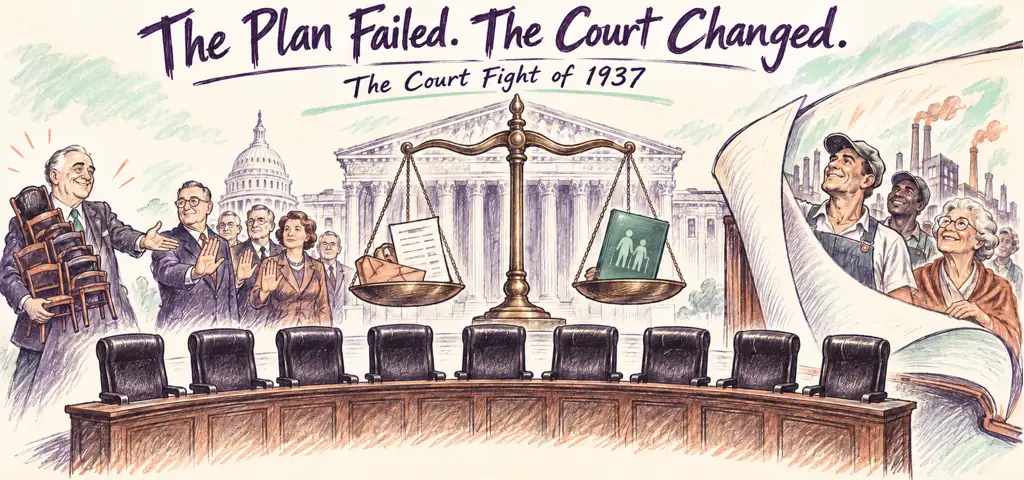
Chapter 9 of the CLEP History of the United States II study guide on Effortless Math covers The Court Fight and the Constitutional Revolution of 1937: the key terms, the core ideas, and worked examples showing how this topic is tested on the exam.
CLEP History of the United States II, Chapter 9
Early decisions narrowed several New Deal experiments
The Supreme Court did not reject every New Deal law, but major defeats made constitutional authority uncertain. Cases questioned delegation to administrators, regulation of local commerce, federal taxes and spending, state minimum wages, and removal of agency officials. The conflict concerned both particular drafting defects and older doctrines limiting economic regulation. Understanding the later shift requires separating each holding.
Schechter invalidated the NRA on two grounds
In A. L. A. Schechter Poultry Corp. v. United States (1935), the Court unanimously invalidated the National Industrial Recovery Act's code system. Congress had delegated legislative authority without adequate standards, and the Brooklyn slaughterhouse transactions at issue were intrastate activity whose interstate journey had ended. The case did not hold that Congress could never regulate labor conditions affecting interstate commerce.
Butler struck the AAA tax-and-payment design
In United States v. Butler (1936), the Court accepted a broad understanding of the general-welfare spending power but invalidated the Agricultural Adjustment Act. The processing tax funded contracts that pressured farmers to reduce production, invading a regulatory domain reserved to the states. Congress later used soil-conservation payments. The 1938 farm act added acreage allotments, loans, and marketing quotas tied more directly to interstate commerce rather than restoring the invalidated processing-tax contracts. A policy objective survived through new constitutional design.
Adkins and Morehead preserved liberty of contract
In Adkins v. Children's Hospital (1923), the Court struck down a District of Columbia minimum wage for women, reasoning that it interfered with liberty of contract and that the Nineteenth Amendment weakened claims of women's special legal dependency. In Morehead v. New York ex rel. Tipaldo (1936), a narrow majority invalidated another women's wage law. The latter ruling intensified demands for constitutional change.
Nebbia had already weakened a rigid price-regulation category
In Nebbia v. New York (1934), the Court upheld a state milk-price law against a due-process challenge. The majority rejected the idea that legislatures could regulate prices only for a closed set of businesses previously classified as "affected with a public interest." Economic regulation still required a public purpose and a reasonable relation to it, but the Constitution did not freeze one historical list of regulable enterprises. The decision foreshadowed wider deference without deciding the later New Deal cases.
Roosevelt proposed adding justices, not removing them
After his 1936 landslide, Roosevelt proposed that the president appoint an additional justice for each sitting justice over age seventy who did not retire, up to six additions. He framed the plan as help for an overworked Court. Critics called it court packing because it would let him create a favorable majority without constitutional amendment. Congress rejected the plan. No justice had to be declared incompetent, and the Court's size remained nine.
West Coast Hotel ended the minimum-wage barrier
In West Coast Hotel Co. v. Parrish (1937), Justice Owen Roberts joined a five-member majority upholding Washington State's minimum wage for women. Chief Justice Hughes wrote that the Constitution did not speak of liberty of contract and that regulation protecting workers could support community welfare. The decision moved away from Adkins. The vote occurred before Roosevelt publicly announced his plan, complicating the slogan "switch in time that saved nine."
Jones and Laughlin broadened practical commerce analysis
In NLRB v. Jones & Laughlin Steel Corp. (1937), the Court upheld the Wagner Act as applied to a large manufacturer. Although manufacturing itself was local, labor conflict could have a close and substantial relation to interstate commerce. Congress could protect union rights to prevent burdens on that commerce. The ruling did not make the commerce power unlimited; it rejected a rigid separation when industrial effects crossed state lines.
Social Security survived through taxing and spending power
Steward Machine Co. v. Davis upheld the federal tax-credit structure encouraging state unemployment programs. Helvering v. Davis upheld federal old-age insurance and treated national economic security as a general-welfare judgment for Congress. Together, the decisions supported cooperative federalism and national social insurance. The Court did not require every benefit to be administered by Washington.
The court plan failed politically while doctrine changed
The Senate Judiciary Committee condemned the bill, public concern grew, and even many Democrats resisted. Meanwhile, the Court upheld wage, labor, and Social Security laws; Justice Willis Van Devanter retired, allowing Roosevelt an appointment. The plan's defeat preserved institutional independence, but retirements soon gave Roosevelt a large appointing influence. Political failure and constitutional transformation occurred together.
Humphrey's Executor limited presidential removal
In Humphrey's Executor v. United States (1935), the Court held that Roosevelt could not remove a Federal Trade Commission member contrary to statutory limits simply because the commissioner opposed administration policy. The Court distinguished an independent commission performing quasi-legislative and quasi-judicial functions from a purely executive officer. The case constrained presidential control even during broader expansion of federal regulatory power.
TVA power sales survived on a narrower basis
In Ashwander v. TVA (1936), the Court upheld the challenged sale of electricity connected to Wilson Dam, federal property and constitutional powers over navigation and war assets. Justice Brandeis's concurrence articulated principles of judicial restraint, including avoiding constitutional questions when a case can be resolved otherwise. The decision did not give Congress a general power to operate any business for any purpose.
Later cases extended the new constitutional order
United States v. Darby (1941) upheld federal wage and hour regulation and overruled the earlier child-labor decision Hammer v. Dagenhart. Wickard v. Filburn (1942) allowed regulation of wheat grown for home use because many similar decisions could substantially affect interstate markets. In NBC v. United States (1943), the Court upheld Federal Communications Commission authority over chain-broadcasting practices under the public-interest licensing standard. These outcomes belong partly to wartime federal power but show the reach of the post-1937 framework.
Carolene Products separated ordinary economic review from other concerns
In United States v. Carolene Products Co. (1938), the Court presumed ordinary economic legislation constitutional when facts could reasonably support it. Footnote Four suggested that closer judicial review might be appropriate when legislation conflicted with a specific constitutional prohibition, distorted the political process, or burdened "discrete and insular minorities." The footnote did not instantly create every later level of scrutiny, but it pointed toward deference in economic regulation alongside more searching review in certain rights cases.
identify defect and repair
A prompt pairs the first AAA, soil-conservation payments, and the 1938 farm act.
The revolution altered review of economic regulation
After 1937, the Court generally deferred to elected government on ordinary economic and social legislation while enforcing other constitutional rights through different doctrines. Congress gained broad practical authority over national markets, and taxing and spending supported a federal safety net. The change came through appointments, decisions, politics, and revised statutes rather than a formal amendment. "Constitutional revolution" names a durable shift in doctrine, not a legal coup completed on one day.
Watch the history in motion
This short lesson adds voices, images, and chronology to the ideas you just studied.
Video: HIST 346 US 1920-45 Chapter 8 Part 7 The Court Packing Plan, History Class with Dr. W.
Try four CLEP-style questions
- Which principle from Nebbia v. New York foreshadowed greater judicial deference toward economic regulation?
- Only Congress could regulate prices because every retail sale constituted interstate commerce.
- Due process prohibited retail price rules whenever sellers objected to the regulated amount.
- A state could regulate prices for public welfare without relying on a closed list of public-interest businesses.
- Milk dealers became federal utilities whenever state officials licensed their stores.
- Price regulation was constitutional only for railroads, grain elevators, and natural monopolies.
- What fact complicates the claim that the court plan alone caused West Coast Hotel's doctrinal change?
- Congress had enacted the plan before the minimum-wage case was argued.
- Roosevelt announced the plan only after every justice had retired.
- The decisive vote occurred before Roosevelt publicly announced the proposal.
- The ruling invalidated Washington's wage law and reaffirmed Adkins.
- A constitutional amendment required the Court to uphold the statute.
- What distinction did Carolene Products' Footnote Four suggest?
- An emergency-economic label prevented courts from reviewing the legislation's constitutional burdens.
- Property rights warranted closer review, while political-process burdens ordinarily received legislative deference.
- Closer review applied only to state laws because federal political-process legislation was immune from it.
- Economic cases required judicial avoidance, while rights cases remained solely within legislative judgment.
- Ordinary economic laws might receive deference while some rights and politically vulnerable minorities warranted closer review.
- Which principle is most associated with Brandeis's Ashwander concurrence?
- Federal property power authorizes any national commercial enterprise without limit.
- Courts should decide constitutional questions even when narrower grounds resolve a case.
- TVA electricity sales converted every regional project into a private utility.
- Courts should avoid unnecessary constitutional rulings when narrower grounds suffice.
- Navigation and war powers cannot support federal management of dam property.
Check your answers and reasoning
Independent preparation. CLEP is a registered trademark of the College Board, which does not endorse this lesson.

Related to This Article
More math articles
- TExES Core Subjects Math Worksheets: FREE & Printable
- Advanced Vocabulary Words: Assimilate to Charisma
- Free Grade 5 English Worksheets for Connecticut Students
- Top 10 3rd Grade ACT Aspire Math Practice Questions
- Chapter 16: Supreme Court Processes and Power
- How to Support Grade 8 Reading at Home: 12 Smart Strategies That Build Independence
- Marginal is not average or total
- Absolute Poverty, Relative Poverty, and Measurement
- Electricity, Magnetism, and Nuclear Science
- How to Solve Compound Interest Problems?


















What people say about "The Court Fight and the 1937 Revolution"?
No one replied yet.