The CIO, Labor’s Breakthrough, and the New Deal’s Exclusions
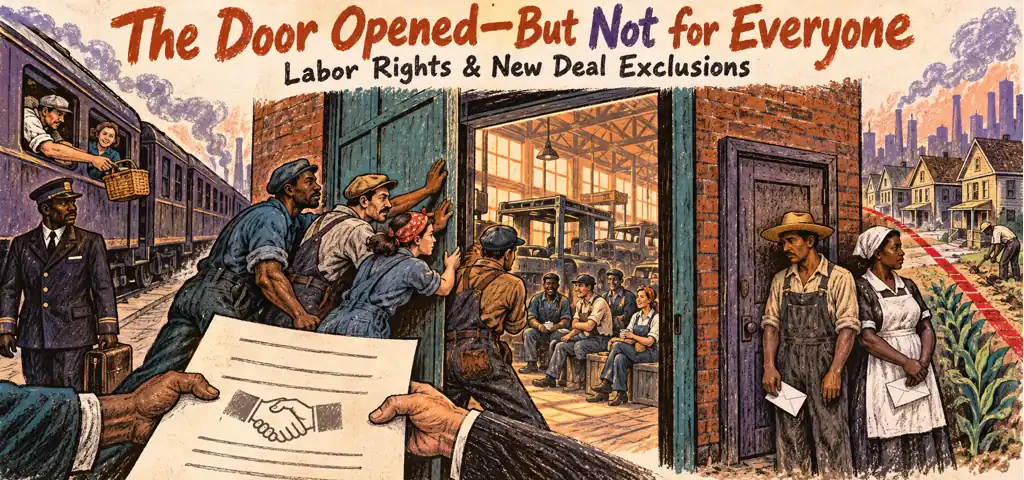
Chapter 9 of the CLEP History of the United States II study guide on Effortless Math covers The CIO, Labor’s Breakthrough, and the New Deal’s Exclusions: the key terms, the core ideas, and worked examples showing how this topic is tested on the exam.
CLEP History of the United States II, Chapter 9
Mass production challenged craft-union structure
The American Federation of Labor organized largely through separate craft unions. Automobile, rubber, steel, and electrical plants combined many occupations under one corporate employer. John L. Lewis of the United Mine Workers and allies argued for industrial unions representing all eligible production workers in a plant or industry. The Committee for Industrial Organization formed within the AFL in 1935; after suspension and separation, it became the Congress of Industrial Organizations.
The Wagner Act changed organizing risk
Federal law protected organizing, majority representation, and collective bargaining while defining employer unfair labor practices. Before the Supreme Court upheld the act in 1937, injunctions and employer resistance weakened enforcement. After Jones & Laughlin, NLRB elections and orders gained authority. Law did not organize workers by itself. It changed the risks and resources within which organizers, employers, and strikers acted.
Sit-down occupation disrupted production and eviction
In late 1936 and early 1937, United Auto Workers members occupied General Motors plants in Flint, Michigan. Staying inside prevented replacement workers from operating equipment and made removal likely to damage valuable machinery. Families and supporters supplied food, information, and public pressure. Michigan governor Frank Murphy declined to use the National Guard for a violent eviction. GM recognized the union as bargaining representative for its members.
The tactic had unusual strengths and legal limits
A sit-down gave workers physical control of the workplace and reduced exposure to strikebreakers outside. It also occupied an employer's property and later lost legal protection. In NLRB v. Fansteel Metallurgical Corp. (1939), the Supreme Court held that the NLRB could not order reinstatement of workers discharged for an unlawful seizure. Flint's success does not mean every sit-down was lawful or effective.
Steel showed both breakthrough and violence
U.S. Steel recognized the Steel Workers Organizing Committee in 1937 without a major strike. Smaller "Little Steel" firms resisted. During the Memorial Day incident at Republic Steel in Chicago, police fired on marchers, killing ten and injuring many. The conflict shows why aggregate union growth should not be mistaken for a smooth administrative process. Legal rights depended on organizing strength, employer strategy, local police, and public opinion.
Industrial unions broadened membership unevenly
Union membership rose sharply in the late 1930s. CIO unions often recruited semiskilled workers, immigrants, Black workers, and some women whom craft structures had neglected. Racial discrimination persisted in locals, seniority, job ladders, and employers' assignments. Inclusion could reflect both principle and the practical need to organize an entire plant. Neither motive guarantees equality after recognition.
Contracts constrained everyday shop-floor discretion
Recognition mattered only if workers could enforce rules after a strike ended. Industrial unions therefore sought written seniority provisions governing layoffs, transfers, and promotion, together with grievance steps for contesting discipline and contract violations. Such clauses did not guarantee a job when a plant closed or transfer hiring to the government. They made a foreman's decisions reviewable under negotiated standards, often ending in arbitration, and converted collective power into an institution used between major confrontations.
The Brotherhood of Sleeping Car Porters linked labor and rights
A. Philip Randolph led the Brotherhood of Sleeping Car Porters, which became the first predominantly Black union to receive an American Federation of Labor charter in 1935. It won recognition from the Pullman Company that year and a contract in 1937. The union built Black leadership and demonstrated that labor organization could challenge racial as well as economic domination. It predated the core CIO victories and was affiliated with the AFL, so it should not be mislabeled a CIO creation or the first industrial union.
The National Negro Congress built a wider coalition
Randolph also served as the first president of the National Negro Congress, founded in 1936 as a coalition of hundreds of civil-rights, labor, religious, fraternal, and community organizations. The Congress connected opposition to lynching and discrimination with industrial unionism and mass protest. It was broader than the porters' union, unlike a legal-defense fund limited to court cases, and independent of the federal relief agencies. Communist participation later produced serious conflict, but the organization's original form shows how Depression-era activists tried to unite racial justice and labor power.
Consumer protest targeted job exclusion
"Don't Buy Where You Can't Work" campaigns urged Black consumers to boycott businesses in Black neighborhoods that refused to hire Black employees. The tactic used purchasing power to demand jobs, especially in urban retail. It differed from NLRB bargaining inside a workplace and from courtroom desegregation. Economic citizenship could be asserted as consumer pressure, union organization, litigation, or electoral action.
Tenant farmers organized against New Deal displacement
Black and white sharecroppers formed the Southern Tenant Farmers' Union after AAA acreage reduction encouraged landlords to evict tenants or keep benefit payments. Organizing across race challenged the plantation order, though violence, poverty, and internal political conflict limited the union. The 1934 nationwide textile strike likewise collapsed under employer and state resistance, especially in the South. New law had not erased regional coercion.
The Black Cabinet supplied access without cabinet authority
Mary McLeod Bethune headed the National Youth Administration's Division of Negro Affairs and helped convene Black federal appointees informally called the Black Cabinet. They advised, monitored discrimination, and pressed agencies from inside. They were not a formal cabinet with department heads or binding authority. Their influence depended on appointments, relationships, evidence, and presidential willingness.
Social insurance exclusions had unequal effects and disputed origins
Agricultural and domestic workers were excluded from original federal old-age and unemployment insurance. Because Black workers were heavily concentrated in those occupations, formally occupational rules produced racial inequality; the exclusions also affected many women. Historians debate the motive for the specific Title II old-age coverage rule. Scholarship emphasizing southern racial and labor politics differs from Social Security Administration historian Larry DeWitt's conclusion that tax-collection feasibility for scattered employers, rather than a southern racial amendment, produced the farm and domestic exclusions. The disparate impact is well established even though the intent explanation remains contested.
Housing policy created another exclusionary structure
HOLC refinancing and FHA insurance stabilized mortgages and promoted long-term home finance. Appraisal systems treated racially mixed or Black neighborhoods as risky, while restrictive covenants and local segregation narrowed access. Federal policy increased ownership and construction for many households while channeling investment away from others. Redlining was not merely a private prejudice operating outside the New Deal state.
TVA development distributed benefits unequally
Dams, electricity, fertilizer research, and flood control transformed the Tennessee Valley. Black employees often received menial jobs, segregated facilities, and fewer training opportunities; Black farm families could lose land through displacement or unequal local administration. Public development does not have one distributional effect. Regional gains can coexist with racialized access to jobs, land, and power.
Industrial disease revealed the limits of workplace protection
Workers drilling the Hawks Nest Tunnel in West Virginia inhaled extreme silica dust and died from acute silicosis in large numbers. Many were Black migrant workers assigned the most dangerous exposure. Public hearings and reporting revealed employer neglect, but federal safety protection remained fragmented. A labor-rights decade still left occupational health outside secure national enforcement.
distinguish access from equality
A prompt notes that a CIO local admits Black workers, Social Security excludes domestic labor, and FHA underwriting penalizes Black neighborhoods.
The breakthrough stopped short of a universal labor order
The conservative coalition slowed reform after 1938. Wartime production later expanded unions but brought a no-strike pledge and major coal disputes; after the war, Operation Dixie failed to organize much of the South and Taft-Hartley restricted labor. Those later developments belong to subsequent chapters. The New Deal created durable bargaining rights and mass industrial unions while leaving regional, racial, occupational, gender, and health exclusions embedded in American work.
Watch the history in motion
This short lesson adds voices, images, and chronology to the ideas you just studied.
Video: The New Deal: Crash Course US History #34, CrashCourse.
Try four CLEP-style questions
- Why should the Flint sit-down victory not be treated as proof that factory occupation guaranteed union recognition?
- Federal law required every occupied plant to recognize a craft union within thirty days.
- The Flint settlement occurred only after the Supreme Court had declared every sit-down lawful.
- Its outcome depended on organization, public authority, bargaining pressure, and the employer's particular vulnerabilities.
- General Motors had already recognized every CIO affiliate before workers entered the plants.
- The settlement eliminated later employer resistance to industrial unionism in steel and textiles.
- How did major steel producers respond differently to organizing in 1937?
- Every producer signed one national agreement after the Flint occupation.
- U.S. Steel recognized SWOC, while Little Steel firms resisted through conflict.
- Little Steel recognized SWOC voluntarily while U.S. Steel relied on police force.
- Both groups waited until wartime before recognizing any industrial union.
- Federal ownership forced identical bargaining terms across the steel industry.
- What did the failed nationwide textile strike of 1934 demonstrate?
- Craft autonomy made a plantwide textile organization unnecessary for bargaining.
- The Wagner Act already guaranteed victory in every multistate industrial dispute.
- Textile employers recognized one national union before workers left their jobs.
- Mass participation did not erase employer and state coercion, especially in the South.
- Federal troops protected southern picket lines from local police and militias.
- Why is the Hawks Nest Tunnel disaster important to New Deal labor history?
- It exposed lethal silica hazards amid fragmented workplace-safety protection.
- It demonstrated that Social Security fully compensated occupational illness by 1935.
- It led the CIO to prohibit Black workers from underground employment.
- It established a universal federal inspection service for every worksite.
- It concerned mine ownership rather than workers' health and racial assignment.
Check your answers and reasoning
Independent preparation. CLEP is a registered trademark of the College Board, which does not endorse this lesson.

Related to This Article
More math articles
- Third parties and minor parties
- Point-Slope Form Worksheet with Answers
- The Best Calculators for School 2026
- Top 10 Tips to Overcome ISEE Math Anxiety
- Set Calculator — Union, Intersection & Difference (Free)
- How long is the TEAS Test?
- Acceleration and Free Fall
- Grade 3 Math: Word Problems: Division
- How Viruses Replicate: Life Cycles and Practice Questions
- The Best Grade 7 ELA Practice Tests for South Carolina Students















What people say about "The CIO, Labor, and New Deal Exclusions"?
No one replied yet.