From Neutrality Acts to Pearl Harbor
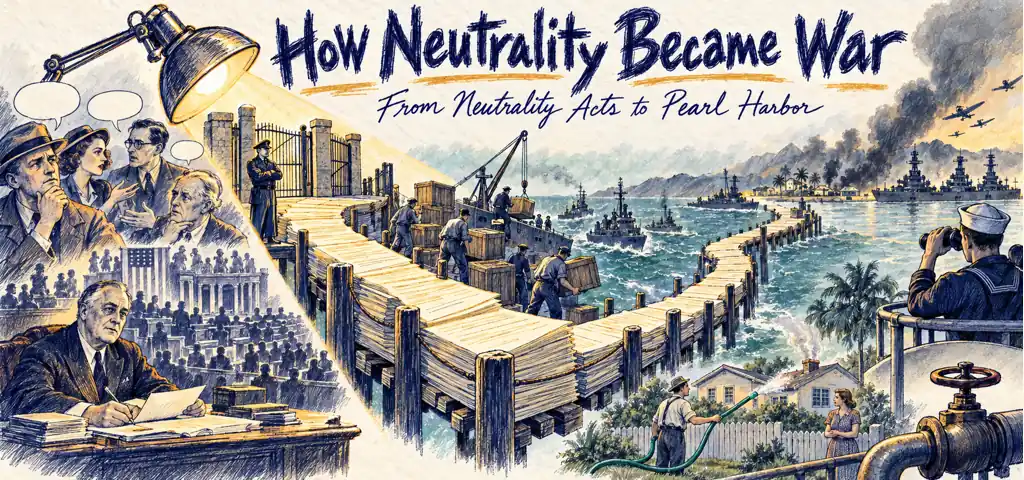
Chapter 10 of the CLEP History of the United States II study guide on Effortless Math covers From Neutrality Acts to Pearl Harbor: the key terms, the core ideas, and worked examples showing how this topic is tested on the exam.
CLEP History of the United States II, Chapter 10
Disillusionment made neutrality popular
The Senate investigation chaired by Gerald Nye publicized the belief that bankers and arms manufacturers had pulled the United States into the First World War for profit. Revisionist histories and the memory of unpaid Allied debts strengthened that interpretation, although economic interests alone do not explain the 1917 decision. Congress responded to a public determined to avoid another slide from commerce into war. The neutrality laws were therefore preventive rules aimed at American conduct, not declarations that aggression abroad did not matter.
Neutrality laws tried to remove familiar paths to war
The Neutrality Acts imposed an arms embargo on belligerents and later required cash-and-carry purchases of nonmilitary goods: buyers paid immediately and transported goods in their own ships. Congress also restricted loans and warned Americans away from belligerent vessels. The scheme treated aggressor and victim formally alike and reduced presidential discretion. After war began in Europe in 1939, Congress allowed cash-and-carry arms sales, which favored Britain and France because their fleets could reach American ports.
Executive power remained an unsettled boundary
In United States v. Curtiss-Wright (1936), the Court upheld a joint resolution authorizing the president to prohibit arms sales into the Chaco conflict. Justice Sutherland described broad presidential authority in external affairs. The ruling did not give presidents a general power to ignore Congress; Congress had delegated the embargo choice. It nevertheless supplied influential language for executive initiative abroad, contrasting with neutrality statutes designed to bind presidential choice through categorical rules.
Good Neighbor policy changed the instrument
Franklin Roosevelt renounced armed intervention in Latin America, withdrew Marines from Haiti, accepted Cuba's release from the Platt intervention provision, and pursued reciprocal diplomacy. The Good Neighbor policy did not end American economic or political influence. It replaced repeated unilateral military occupation with nonintervention, consultation, and trade at a moment when Washington wanted hemispheric cooperation. The practical test is whether troops and intervention rights receded, not whether unequal power vanished.
Nonrecognition expressed principle without reversing conquest
After Japan seized Manchuria, Secretary of State Henry Stimson announced that the United States would not recognize territorial changes achieved in violation of treaty obligations. Nonrecognition denied legal approval but imposed neither an effective embargo nor military reversal. Japan consolidated Manchukuo. The episode reveals the gap between declaring a rule and supplying enforcement. It also formed part of the background to later economic pressure as Japanese expansion continued into China and Southeast Asia.
Conflict changed Americans' risk calculations
The Neutrality Act of 1937 reflected the high point of statutory restraint. Japan's full-scale war in China, Germany's expansion, and the European war of 1939 then shifted debate. Roosevelt proclaimed a quarantine analogy in 1937 but public reaction remained cautious. When Japanese aircraft sank the American gunboat Panay in China that December, Japan apologized and paid indemnity; unlike the Maine crisis of 1898, the incident did not generate war. Context and diplomatic response shaped escalation.
Steps short of war accumulated
Congress revised cash-and-carry in 1939. In September 1940 Roosevelt transferred fifty old destroyers to Britain in exchange for long base leases without submitting a treaty. That month Congress enacted the first peacetime draft in American history; unlike the 1917 law adopted after a declaration of war, Selective Service began before belligerency. The 1940 election returned Roosevelt for a third term. Each step increased capacity or aid without itself declaring war.
Lend-Lease shifted from sales to presidential transfer
The Lend-Lease Act of March 1941 authorized the president to sell, transfer, exchange, lease, or lend defense articles to any country whose defense he deemed vital to the United States. Britain no longer had to provide immediate cash. Roosevelt compared the arrangement to lending a neighbor a garden hose during a fire. The act did not enter the United States formally into war, but it abandoned impartial economic neutrality and made American production central to Allied survival.
The Atlantic became an undeclared contest
American forces occupied Greenland and Iceland, extended naval patrols, and escorted shipping in the western Atlantic. After the destroyer Greer encountered a German submarine, Roosevelt ordered a shoot-on-sight policy. Congress weakened Neutrality Act restrictions in late 1941. Meanwhile the Atlantic Charter issued by Roosevelt and Churchill endorsed self-government, freer trade, economic cooperation, freedom from fear and want, and a postwar peace without territorial aggrandizement. It was a statement of principles, not a ratified alliance treaty.
Internationalists and opponents offered rival futures
The America First Committee argued that oceans, continental defense, and avoidance of European power politics offered greater security than intervention; Charles Lindbergh became its most visible speaker. Internationalists warned that Axis control of Europe would endanger the Western Hemisphere. Henry Luce called for an "American Century" of active leadership, while Henry Wallace later imagined a "century of the common man" extending social and anticolonial democracy. Both rejected mere withdrawal, but they disagreed about whose power and welfare should define leadership.
Economic pressure and Japanese strategy converged
Japan occupied southern French Indochina in July 1941. Roosevelt froze Japanese assets, and the United States effectively cut off oil exports. Washington demanded withdrawal from China and Indochina; Japanese leaders faced the prospect that reserves would shrink while negotiations continued. They planned attacks to secure Southeast Asian resources and disable the American Pacific Fleet. Sanctions did not mechanically compel Pearl Harbor, but they sharply narrowed the time and options Japanese leaders believed they possessed.
Pearl Harbor converted partial belligerency into declared war
Japan attacked Pearl Harbor on December 7, 1941, damaging battleships and killing more than 2,400 Americans. Congress declared war on Japan the next day with one dissenting vote; Germany and Italy then declared war on the United States. The attack unified a country divided over entry, but it did not create the preceding Atlantic aid, conscription, sanctions, or naval encounters. The path is best read as staged movement from statutory neutrality to material support and confrontation, followed by sudden formal belligerency.
separate legal status from material alignment
A timeline lists cash-and-carry arms, destroyers for bases, peacetime conscription, Lend-Lease, Atlantic escorts, and Pearl Harbor.
The central issue was how risk moved
Neutrality statutes tried to prevent private trade, loans, travel, and executive discretion from producing another unwanted intervention. Axis victories then made noninvolvement itself appear risky. Roosevelt and Congress moved unevenly: aid increased, the military expanded, executive authority widened, and pressure on Japan intensified. Each policy redistributed danger among Americans, Allies, and targeted powers. Pearl Harbor ended the entry debate, but the decisions before it explain why the nation was already an arsenal, patrol partner, and economic belligerent.
Good Neighbor policy followed an uneven occupation chronology
United States forces occupied Haiti in 1915 and the Dominican Republic in 1916. Marines left the Dominican Republic in 1924. The Clark Memorandum, written in 1928 and published in 1930, rejected the broad intervention claim associated with the Roosevelt Corollary. In 1934 a new treaty with Cuba ended the Platt Amendment's unilateral intervention right, and Roosevelt withdrew the Marines from Haiti. The sequence shows a gradual retreat from occupation and claimed intervention rights, not a single withdrawal announced at the start of the Good Neighbor policy.
SEATO followed the Manila Pact but lacked a NATO-style integrated force
The Southeast Asia Collective Defense Treaty was signed at Manila in September 1954 after the Geneva settlement divided Vietnam provisionally. It created SEATO, whose members promised consultation and action against covered aggression. The organization had no standing integrated military command comparable to NATO's. Its protocol area extended protection to South Vietnam, Laos, and Cambodia without making them treaty members.
Watch the history in motion
This short lesson adds voices, images, and chronology to the ideas you just studied.
Video: Why the U.S. Couldn't Stay NEUTRAL in World War II [APUSH Review], Heimler's History.
Try four CLEP-style questions
- Why could the same cash-and-carry rule be formally neutral yet materially more useful to Britain than to Germany in 1939?
- Germany accepted the rule but prohibited Britain from entering the Atlantic.
- The rule granted Britain credit while requiring Germany to pay cash.
- Congress reserved military goods for Germany and civilian goods for Britain.
- The policy transferred American merchant ships permanently to the Royal Navy.
- British naval access made cash-and-carry purchases more usable.
- What does the contrast between nonrecognition of Manchukuo and the later oil cutoff to Japan demonstrate?
- Nonrecognition barred Japanese state firms from buying American oil through neutral intermediaries.
- Both measures authorized American ground forces to restore Chinese territory.
- The oil cutoff treated Japanese territorial claims as lawful while limiting only future expansion.
- Legal protest and economic coercion were different instruments with different practical pressure.
- Economic sanctions lacked practical effect until Congress formally declared war.
- Which evidence most strongly challenges the claim that Roosevelt alone dismantled statutory neutrality before Pearl Harbor?
- Congress revised cash-and-carry, enacted conscription, and authorized Lend-Lease.
- British elections directly repealed American neutrality restrictions.
- The Supreme Court invalidated the central neutrality restrictions before Congress revised them.
- Executive agreements supplied the same statutory authority as congressional neutrality amendments.
- Congress first reconsidered arms sales and defense preparation after the attack on Pearl Harbor.
- What did American Atlantic escorts and a shoot-on-sight order before a declaration of war demonstrate?
- Material and naval alignment could deepen before legal belligerency changed.
- Germany had transferred command of its submarines to the United States Navy.
- Naval escorts restored impartial commerce with every European belligerent.
- Congress had secretly declared war through the Neutrality Act of 1937.
- The Atlantic Charter required automatic American entry into every British conflict.
Check your answers and reasoning
Independent preparation. CLEP is a registered trademark of the College Board, which does not endorse this lesson.

Related to This Article
More math articles
- 5th Grade ILEARN Math Worksheets: FREE & Printable
- FREE TASC Math Practice Test
- Top 10 Tips to Create a PERT Math Study Plan
- CLEP U.S. History I 055: Election of 1824 and the Changing Party System
- Top 10 ASTB Math Practice Questions
- Top 10 Tips You MUST Know to Retake the CLEP College Algebra
- Top 10 Accuplacer Math Prep Books (Our 2023 Favorite Picks)
- 8th Grade MEAP Math FREE Sample Practice Questions
- Timing, Stamina, and Test Day
- Top 10 Tips You MUST Know to Retake the ACT Math





















What people say about "From Neutrality Acts to Pearl Harbor"?
No one replied yet.