The European Theater and Allied Grand Strategy
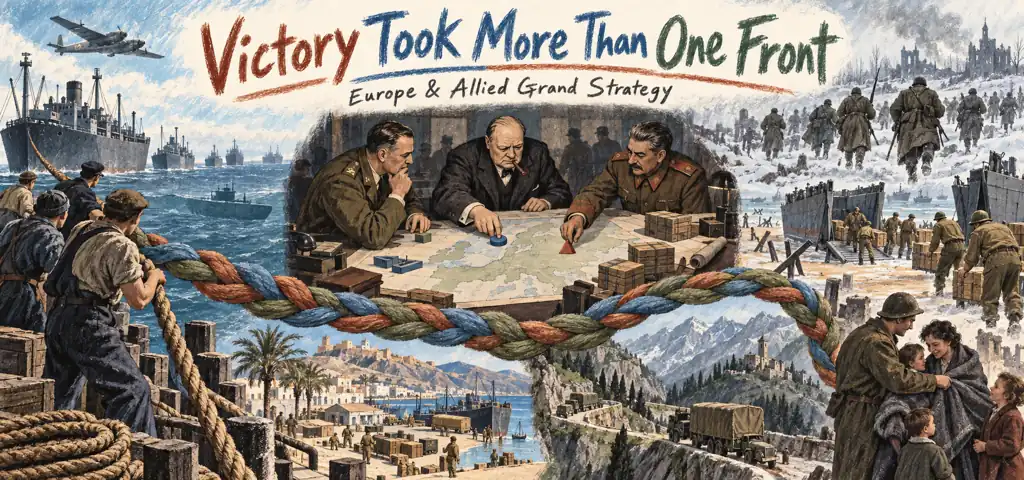
Chapter 10 of the CLEP History of the United States II study guide on Effortless Math covers The European Theater and Allied Grand Strategy: the key terms, the core ideas, and worked examples showing how this topic is tested on the exam.
CLEP History of the United States II, Chapter 10
Germany first was a coalition strategy
After Pearl Harbor, American leaders confirmed that defeating Germany would receive priority even though Japan had attacked the United States. Germany possessed the stronger industrial base, threatened Britain and the Soviet Union, and might dominate Europe if either ally collapsed. The Pacific could not be ignored, but resources were allocated within a larger sequence. "Germany first" therefore described priority, not a refusal to fight Japan before victory in Europe.
A global coalition had unequal needs
Britain needed survival and protection of imperial routes; the Soviet Union demanded rapid relief from the eastern front; the United States had to train forces and move them across submarine-infested oceans. The Combined Chiefs of Staff coordinated Anglo-American planning, while Lend-Lease supplied Britain and the Soviet Union. Coalition strategy required compromise because a ship, bomber, landing craft, or division assigned to one theater was unavailable elsewhere. Common enemies did not erase different political interests or military timetables.
The Atlantic lifeline came first
German U-boats attacked shipping faster than early Allied defenses could offset losses. Convoys, escort carriers, long-range patrol aircraft, radar, sonar, intelligence, and mass shipbuilding gradually changed the Battle of the Atlantic. Liberty ships simplified construction, but production alone could not protect a vessel at sea. Victory required a system joining factories, codebreaking, routing, escorts, air coverage, and trained crews. Without that lifeline, neither a British buildup nor an American cross-Channel invasion was sustainable.
North Africa postponed the direct return to France
Stalin pressed for a second front in France in 1942. American planners generally favored an early cross-Channel attack, while Churchill emphasized the Mediterranean. Operation Torch landed Anglo-American forces in French North Africa in November 1942. The campaign gave inexperienced American units combat experience and opened the Mediterranean but delayed a direct assault on northwest Europe. At Casablanca in January 1943, Roosevelt and Churchill announced that the Axis must accept unconditional surrender, signaling coalition resolve while potentially discouraging enemy factions seeking negotiated terms.
The Darlan bargain exposed expediency
Admiral Jean Darlan, a senior Vichy official, happened to be in Algiers during Torch. American officials accepted his order ending French resistance in exchange for recognizing his authority temporarily. The bargain reduced immediate fighting but angered anti-Vichy French and people who believed a war for democracy should not equip a collaborator. It illustrates a recurring grand-strategy problem: a locally useful partner can contradict declared political aims. Tactical convenience and legitimacy must be evaluated separately.
The ceasefire and political settlement came in stages
Darlan ordered general resistance in French North Africa to cease on November 10, 1942. Clark and Darlan reached a provisional arrangement on November 13, and their final agreement followed on November 22. That accord confirmed Allied military access and cooperation while leaving Darlan temporarily in charge of the existing French administration. It did not create the initial ceasefire on November 22, install de Gaulle, or bring the French fleet at Toulon to the Allies. Keeping the three dates separate explains both the military convenience and the political scandal.
The Mediterranean route reached Italy
After victory in North Africa, the Allies invaded Sicily in July 1943. Mussolini fell, and Italy surrendered in September, but German forces occupied much of the peninsula and fought a difficult defensive campaign. Salerno, Anzio, and Monte Cassino showed how terrain and fortified positions could slow advance. The campaign tied down German divisions and knocked Italy from the Axis, yet it did not provide the decisive western front the Soviet Union had demanded.
Strategic bombing pursued several objectives
British bombers increasingly attacked cities by night, while American doctrine emphasized daylight precision attacks on industrial and transportation targets. Weather, navigation, enemy defenses, and the difficulty of hitting targets made practice less precise than doctrine. Bombing destroyed production and homes, killed civilians, and forced Germany to divert fighters and antiaircraft guns. Its effect was cumulative and intertwined with ground offensives; air attack alone did not occupy territory or compel German surrender on the timetable its strongest advocates predicted.
Overlord joined deception, logistics, and force
At Tehran in 1943 the major Allies fixed a 1944 cross-Channel invasion alongside a Soviet offensive. Operation Overlord landed in Normandy on June 6, 1944. Deception suggested an attack at Pas-de-Calais, while landing craft, artificial harbors, air superiority, airborne troops, and months of stockpiling supported the beaches. German defenses and the Normandy hedgerows imposed heavy costs. The breakout and liberation of Paris followed, but the logistical buildup mattered as much as the dramatic landing.
Liberation exposed Nazi mass murder
Advancing Allied armies encountered concentration camps and evidence of the Holocaust. Nazi Germany and its collaborators had murdered six million Jews and millions of other victims. The United States fought to defeat Germany, not because rescue of European Jews had been made the central operational objective. Immigration restrictions, disbelief, antisemitism, competing military priorities, and delayed action limited rescue. The War Refugee Board, created in 1944, supported efforts to save people and transmit aid, but it came after most victims had already been killed.
The western campaign did not end in summer
Allied supply lines stretched after the rapid advance across France. Operation Market Garden failed to secure a quick route across the Rhine. In December 1944 Germany launched its last major western offensive through the Ardennes, creating the Battle of the Bulge. American forces held key positions, and Allied air power returned when weather cleared. Germany spent fuel, armor, and trained personnel it could not replenish, ending its ability to mount another comparable western offensive.
The eastern front remained decisive in scale
The Soviet Union absorbed and inflicted the largest military losses in the European war. Stalingrad and Kursk broke German offensive momentum before Overlord, and Soviet forces drove west through Eastern Europe. Western aid supported Soviet capacity, but Soviet armies made the central land advance against Germany. Coalition victory cannot be explained as one nation's campaign. It resulted from Soviet sacrifice, British endurance, American production and deployment, resistance movements, and multiple fronts that Germany could not sustain.
identify the coalition tradeoff
A Soviet memorandum demands France in 1942; a British memorandum recommends North Africa; an American plan stresses landing-craft shortages.
Victory required military and political choices
The Allies defeated Germany through shipping protection, industrial scale, intelligence, air power, Soviet ground offensives, amphibious invasion, and coalition coordination. Yet means shaped the peace: bargains with Vichy officials, bombing of cities, delayed rescue, and Soviet occupation created moral and political consequences. Grand strategy is not a list of battles. It is the allocation of finite power toward a sequence of objectives while partners argue about time, legitimacy, casualties, and the postwar order.
Watch the history in motion
This short lesson adds voices, images, and chronology to the ideas you just studied.
Video: World War II: Military Strategy [APUSH Review Unit 7 Topic 13] Period 7: 1898-1945, Heimler's History.
Try four CLEP-style questions
- Why did the Battle of the Atlantic determine whether a later cross-Channel invasion was feasible?
- U-boats operated only after Allied armies landed in Normandy.
- Convoys transferred command of the invasion to merchant captains.
- Landing craft could be built only in British shipyards supplied by German submarines.
- Atlantic victory eliminated the need for air superiority over France.
- Invasion required Atlantic supply lines protected from submarines.
- What is the strongest criticism of treating the Darlan arrangement as proof that Allied war aims were irrelevant?
- The bargain had no operational effect because French resistance continued everywhere.
- The arrangement was a postwar treaty ratified by the United States Senate.
- Darlan had led the Free French movement and opposed Vichy rule.
- An expedient could conflict with democratic aims without erasing them.
- The bargain transferred North Africa to permanent German control.
- Why did the campaign in Italy fail to satisfy the Soviet demand for a second front in the fullest sense?
- Italy remained neutral and therefore contained no German troops.
- It did not create a large northwest-European front threatening Germany directly.
- The campaign used no American or British ground forces.
- Soviet leaders had requested a Pacific invasion rather than operations in Europe.
- The Italian campaign began only after Germany surrendered.
- A bombing campaign forces Germany to divert fighters and antiaircraft guns but does not by itself produce surrender. What conclusion follows?
- Bombing imposed indirect strategic costs but could not compel surrender alone.
- Diversion proves that bombing caused no damage to production or transport.
- Failure to compel immediate surrender makes the air campaign militarily irrelevant.
- Ground forces became unnecessary once Germany dispersed its defenses.
- Civilian casualties demonstrate that every raid pursued the same target and method.
Check your answers and reasoning
Independent preparation. CLEP is a registered trademark of the College Board, which does not endorse this lesson.

Related to This Article
More math articles
- How to Read and Interpret Graphs: Bar, Line, Pie & Scatter
- Buffers and Titrations: Conjugate Pairs, Endpoints, and Equivalence
- 10 Most Common 6th Grade MEAP Math Questions
- Slavery and constitutional conflict
- Top 10 Tips to Create an ACT Math Study Plan
- How to Simplify Variable Expressions? (+FREE Worksheet!)
- The Missouri MAP Grade 3 Math Worksheet Set — 49 Free Printable PDFs
- The Ultimate DAT Math Formula Cheat Sheet
- Nouns and Pronouns
- Best Mobile Laptop Stands for Presentation in Schools





















What people say about "The European Theater and Allied Strategy"?
No one replied yet.