The Pacific War and the Atomic Bomb
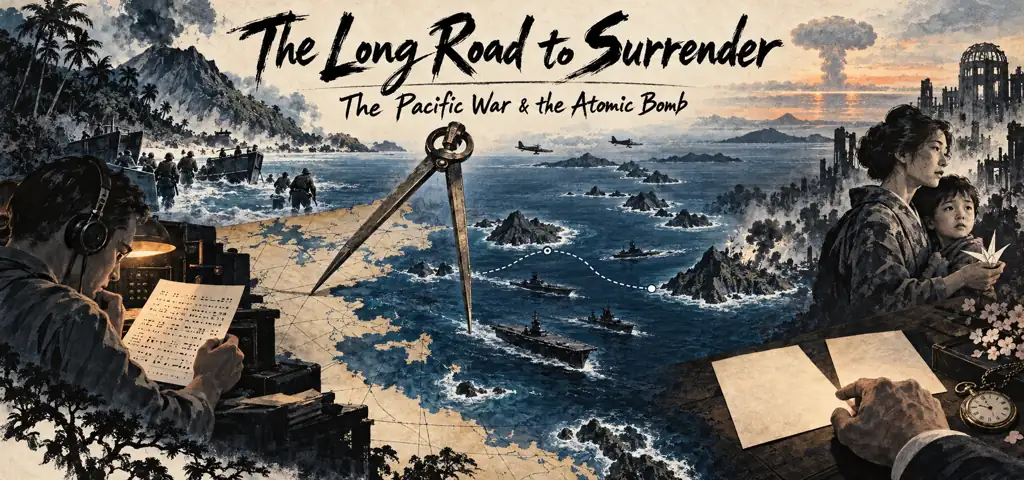
Chapter 10 of the CLEP History of the United States II study guide on Effortless Math covers The Pacific War and the Atomic Bomb: the key terms, the core ideas, and worked examples showing how this topic is tested on the exam.
CLEP History of the United States II, Chapter 10
Germany first still allowed an active Pacific war
The Arcadia conference confirmed that Germany would receive strategic priority, but the United States could not leave Australia, Hawaii, or the Pacific supply routes undefended. Resources therefore moved to both theaters within an unequal allocation. Early Pacific operations aimed to halt further Japanese expansion, protect lines to Australia, and build bases for a counteroffensive. Germany first described the coalition's decisive sequence; it did not mean that American forces waited for victory in Europe before fighting Japan.
Midway reversed the carrier balance
At the Coral Sea in May 1942, carrier aircraft stopped a Japanese seaborne move toward Port Moresby even though the opposing fleets never came within gun range. The following month, American cryptanalysts identified Midway as Japan's target. Admiral Chester Nimitz concentrated three carriers northeast of the island. American aircraft sank four Japanese carriers while losing Yorktown. Midway ended Japan's offensive carrier advantage, but it did not destroy Japanese resistance or make later island campaigns unnecessary. Intelligence created an opportunity that ships, pilots, timing, and risk converted into victory.
Guadalcanal began a sustained counteroffensive
American Marines landed on Guadalcanal in August 1942 to deny Japan an airfield threatening the route to Australia. Six months of land, sea, and air combat exhausted both sides; Japan eventually withdrew. The campaign showed that a captured airfield had to be supplied and defended through contested waters. It also marked a transition from stopping expansion to advancing through overlapping Pacific routes.
Bypassing conserved force without ending combat
American commanders did not assault every Japanese-held island. They selected positions needed for airfields, naval bases, or control of sea lanes, while submarines, aircraft, and surrounding bases isolated bypassed garrisons. This strategy is often called island hopping or leapfrogging. Bypassing was not surrender: it sought to make a strongpoint strategically useless without paying the full cost of storming it. Fortified islands still had to be taken when geography made them essential.
China had to be supplied around a closed road
Japan's seizure of Burma cut the Burma Road in 1942. Allied aircraft then carried supplies from India over the Himalayan route known as the Hump, a hazardous operation limited by weather, altitude, aircraft, and airfields. Later, engineers built the Ledo Road to reconnect with the old route, and Allied campaigns reopened a land corridor. Supplying Chiang Kai-shek's Nationalist government served the goal of keeping Japanese forces tied down in China, but transport constraints limited what aid could accomplish.
The Philippines joined strategy to political obligation
At Leyte Gulf in October 1944, Japan committed much of its remaining fleet against the American return to the Philippines. The complex battle destroyed Japanese naval striking power even though individual American formations faced danger. General Douglas MacArthur's return fulfilled a political promise and severed Japan from resources to the south. The campaign also produced severe destruction and civilian suffering. Strategic position and national commitment reinforced one another, but neither made liberation costless.
Iwo Jima and Okinawa intensified invasion estimates
Iwo Jima offered airfields between the Marianas and Japan; Okinawa could support an invasion of the home islands. Japanese defenders used caves, tunnels, and dispersed positions to survive bombardment. American forces took both islands at high cost, while kamikaze attacks damaged ships around Okinawa and enormous numbers of Okinawan civilians died. These battles shaped American estimates of invasion casualties, yet estimates varied and were only one part of the later atomic decision.
Strategic bombing destroyed cities before the atomic attacks
B-29 bombers operating from the Marianas first attempted high-altitude precision attacks, then shifted toward low-altitude incendiary raids against urban-industrial areas. The March 1945 Tokyo fire raid killed tens of thousands and burned vast neighborhoods. Submarine blockade and mining also constricted food, fuel, and transport. Japan was strategically isolated, but its government had not accepted unconditional surrender. The choice in summer 1945 was therefore made after extensive conventional destruction, not between atomic bombing and an otherwise untouched Japan.
The Manhattan Project joined science to industrial scale
The atomic project coordinated university laboratories, private contractors, the Army Corps of Engineers, and secret production sites. Oak Ridge separated uranium isotopes, Hanford produced plutonium, and Los Alamos designed weapons. The Trinity test in New Mexico on July 16, 1945, demonstrated a plutonium implosion device. Scientific theory was indispensable, but so were electricity, construction, materials, security, and federal finance. The bomb was a research achievement embedded in a giant industrial system.
The atomic decision had several stated purposes and disputed alternatives
Truman and advisers sought rapid surrender, avoidance of an invasion, and an end to the war before further casualties. Some officials hoped Soviet entry would add pressure; the Soviet Union declared war on Japan on August 8. Historians debate whether modifying surrender terms, demonstrating the bomb, waiting for Soviet entry, or continuing blockade could have ended the war without attacking cities. Evidence must distinguish what decision makers knew in July from later claims and must treat casualty forecasts as ranges, not a single certain number.
Hiroshima, Nagasaki, and surrender formed a compressed sequence
The United States dropped a uranium bomb on Hiroshima on August 6 and a plutonium bomb on Nagasaki on August 9. Immediate and later deaths from blast, burns, and radiation reached into the tens of thousands in each city. Emperor Hirohito intervened for surrender after the atomic attacks and Soviet entry. Japan accepted the Potsdam terms with an understanding that imperial authority would be subject to the Supreme Commander. No responsible causal account should erase either atomic shock, Soviet intervention, internal deadlock, or the emperor's decision.
test a single-cause claim
A prompt argues that Midway alone won the Pacific war because Japan lost four carriers.
Victory left an ethical and geopolitical argument
The Pacific war destroyed Japanese empire and ended immense suffering under occupation, while American bombing killed civilians on an unprecedented scale. The atomic attacks demonstrated a weapon that would shape diplomacy, military planning, and public fear after 1945. To judge the decision historically, students must reconstruct alternatives, uncertainty, and contemporary aims without treating civilian destruction as an abstraction. Military effectiveness, moral responsibility, and the emerging Soviet-American rivalry are related questions, not interchangeable verdicts.
Watch the history in motion
This short lesson adds voices, images, and chronology to the ideas you just studied.
Video: World War II: Military Strategy [APUSH Review Unit 7 Topic 13] Period 7: 1898-1945, Heimler's History.
Try four CLEP-style questions
- American codebreakers identify a likely Japanese carrier operation, but commanders must still decide where to concentrate scarce ships. What does the episode most clearly show?
- Intelligence replaces the need for operational judgment once a code is partly read.
- A decoded message guarantees that every tactical prediction will be correct.
- Carrier aviation matters only when surface fleets first exchange gunfire.
- Japan's numerical losses were determined before American pilots launched.
- Intelligence creates an advantage only when commanders integrate it with deployment, timing, and combat capability.
- Why could bypassing a heavily fortified island advance the American campaign?
- The strategy substituted long-range bombing for seizure of forward bases closer to Japan.
- The isolated garrison continued receiving supplies but could no longer threaten nearby operations.
- Neutralization depended on a treaty recognizing American control of the unoccupied island.
- Blockade alone made the island's airfields available for American operations.
- Isolation could neutralize a garrison without costly direct assault.
- Which evidence would best distinguish a claim that Japan was militarily weakened from a claim that its government was ready to surrender in July 1945?
- Japanese cabinet terms compared with evidence of military damage
- The distance between the Marianas and Tokyo
- The total tonnage of American ships launched since 1941
- The number of Allied conferences held in Europe
- A list of islands bypassed during the advance
- A historian compares invasion, demonstration, blockade, Soviet entry, and city attack as alternatives available in summer 1945. What is the soundest method?
- Assume that the alternative preferred later would certainly have worked on schedule.
- Treat every casualty estimate as a verified count of deaths that had already occurred.
- Exclude Japanese political records because only American intentions affected surrender.
- Compare contemporary evidence, uncertain costs and timelines, and likely responses.
- Judge each option only by whether it used a newly developed technology.
Check your answers and reasoning
Independent preparation. CLEP is a registered trademark of the College Board, which does not endorse this lesson.

Related to This Article
More math articles
- How long Is the CBEST Test Valid?
- Free Grade 8 English Worksheets for Florida Students
- Free Grade 3 English Worksheets for New Hampshire Students
- Confrontation of witnesses
- Free Printable Grade 2 English Worksheets for Maryland
- Crime Data, the Dark Figure, and Justice Patterns
- How to Find the Volume and Surface Area of Rectangular Prisms? (+FREE Worksheet!)
- NES Essential Academic Skills Math Flashcards
- FREE 5th Grade ACT Aspire Math Practice Test
- Missouri MAP Grade 8 Math Free Worksheets: Printable Practice for Every Eighth-Grade Math Topic




















What people say about "The Pacific War and the Atomic Bomb"?
No one replied yet.