The War Economy, Federal Power, and the End of the Depression
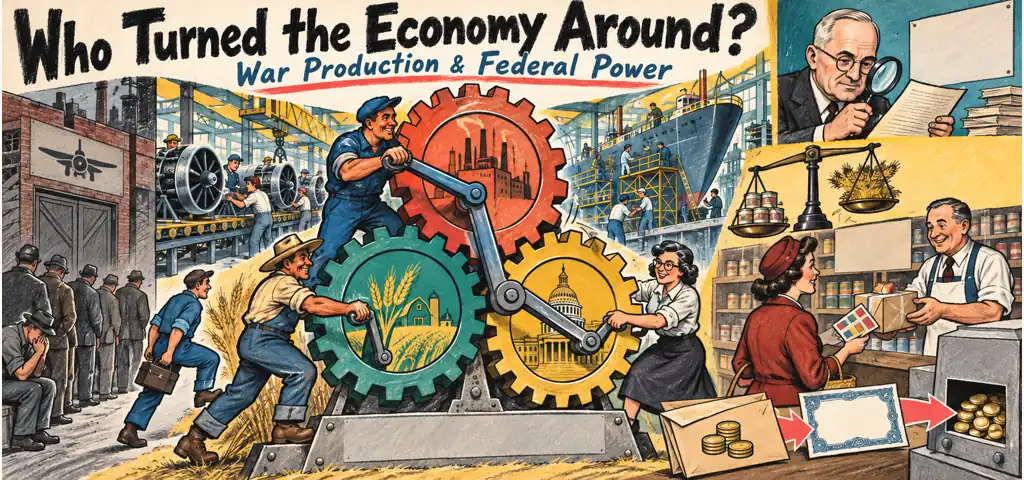
Chapter 10 of the CLEP History of the United States II study guide on Effortless Math covers The War Economy, Federal Power, and the End of the Depression: the key terms, the core ideas, and worked examples showing how this topic is tested on the exam.
CLEP History of the United States II, Chapter 10
Mobilization ended unemployment through extraordinary demand
Federal purchases of ships, aircraft, vehicles, weapons, food, and construction drove spending to roughly two-fifths of national output at the wartime peak. Factories hired workers who had lacked jobs, the armed forces absorbed millions, and farm demand rose. Full employment did not arrive because ordinary private recovery simply resumed; deficit-financed mobilization created demand on a scale the New Deal had not attempted. That fact explains the Depression's end without implying that war is a desirable economic program.
Agencies allocated scarce industrial capacity
The War Production Board set priorities, prohibited some civilian uses, and coordinated conversion. Automobile production for civilians stopped in 1942 as plants shifted to aircraft engines, tanks, trucks, and other matériel. The government supplied contracts, machine tools, plant finance, and access to materials. Conversion displayed private engineering and labor skill inside a federal allocation system. A before-and-after chart of auto output therefore records an institutional redirection, not merely consumer preference.
Contract design accelerated production and shifted risk
Cost-plus-fixed-fee contracts reimbursed allowable costs and added an agreed fee. They encouraged firms to accept unfamiliar projects because the government bore much of the uncertainty, but weak cost discipline could encourage waste. Fixed-price contracts placed more overrun risk on the contractor. Auditing and renegotiation were therefore part of mobilization. The question is not whether public or private actors produced the goods; public finance and private management were interdependent.
The Truman Committee investigated without halting production
The Senate Special Committee to Investigate the National Defense Program, chaired by Harry Truman, examined waste, delays, camp construction, contracting, and coordination. Its field investigations and hearings sought economy and accountability while protecting necessary secrecy. Oversight need not mean opposition to mobilization. It can improve capacity by identifying bottlenecks and deterring profiteering, provided investigation does not disclose operational information or paralyze decisions.
OPA joined price ceilings to rationing
The Emergency Price Control Act of 1942 empowered the Office of Price Administration to establish maximum prices and rents. Rationing coupons allocated scarce goods such as gasoline, tires, sugar, and meat. A ceiling limits the legal price; rationing limits how much an eligible buyer may acquire. Used together, they tried to prevent money-rich demand from bidding scarce civilian supplies upward or allowing wealthier households to take the available stock. Black markets exposed the enforcement problem.
Taxes and bonds restrained purchasing power as well as financed war
Congress broadened the income tax far beyond its prewar base. Payroll withholding beginning in 1943 collected tax incrementally as wages were paid, making mass taxation administratively workable and improving the timing of revenue. War bonds borrowed household savings for current government spending and deferred some private consumption. Unlike the First World War, stronger taxation, withholding, price control, rationing, and expanded output helped contain inflation, though prices still rose.
Labor peace was bargained and coerced
Major union leaders pledged not to strike after Pearl Harbor. The National War Labor Board settled disputes and limited wage increases. Wage ceilings encouraged employers to offer health insurance, pensions, and paid leave as fringe benefits outside direct wage limits, helping tie insurance to employment after the war. Labor peace was incomplete: miners led by John L. Lewis struck repeatedly in 1943. The government seized mines, and the Smith-Connally or War Labor Disputes Act authorized seizure of struck war plants and restricted union activity, passing over Roosevelt's veto.
Farm policy favored maximum output
Wartime demand, price supports, mechanization, fertilizer, and improved yields increased farm production even as rural workers entered the military or industry. Price supports reduced the risk of expanding output; they did not ask farmers to recreate the early AAA's emergency destruction of crops. Larger farms often gained most from mechanization and scale. Wartime abundance and labor shortage accelerated consolidation and migration away from farms.
Wickard constitutionalized aggregate economic power
In Wickard v. Filburn (1942), an Ohio farmer grew wheat beyond his federal allotment for use on his own farm. The Supreme Court reasoned that although his individual activity was local, many similar choices would alter national market demand and therefore could be regulated under the commerce power. The holding did not say one farmer's wheat physically crossed a state line. It treated aggregate market effect as the constitutional connection.
Information policy differed from First World War publicity
The Office of War Information produced news, posters, broadcasts, and films, including Frank Capra's Why We Fight series explaining the Axis threat and the Allied cause to troops and later civilians. The separate Office of Censorship reviewed international mail and cables while asking domestic editors and broadcasters to follow a voluntary code protecting military information. The CPI of 1917 centered publicity and persuasion; the 1941 office combined communications review with voluntary press restraint rather than licensing every newspaper.
Teenagers entered work as schooling adjusted
Labor scarcity drew adolescents into farms, factories, retail, and military-related work. Some schools shortened schedules, released students for harvests, or saw enrollment and graduation disrupted. Higher wages could increase family income and independence, but long hours could limit education. Wartime youth experience was therefore military enlistment or patriotic clubs; mobilization changed the allocation of time between school and paid work.
Relief agencies ended because the labor market changed
Congress terminated the CCC in 1942 and the WPA in 1943 as military service and war production absorbed unemployment. Ending those agencies did not repeal the Wagner Act, Social Security, deposit insurance, or other durable New Deal institutions. Emergency work relief became less necessary under full employment, while the administrative state expanded through war agencies. The sequence distinguishes the termination of a particular remedy from the disappearance of federal economic responsibility.
classify an anti-inflation instrument
A household has higher wages but cannot buy unlimited gasoline, while a landlord cannot charge above a posted rent.
Reconversion produced a boom rather than renewed depression
After 1945, contracts ended, servicemembers returned, and factories resumed civilian production. Many feared mass unemployment. Instead, accumulated household savings, pent-up demand for homes and durable goods, veterans' benefits, unemployment insurance, and continued American industrial strength supported spending. Shortages and strikes produced inflation and conflict, but not a return to the 1930s collapse. Wartime institutions did not mechanically guarantee prosperity; they changed household balance sheets, productive capacity, and federal readiness to manage demand.
War permanently enlarged federal capacity
Mobilization demonstrated national power to tax mass incomes, allocate materials, finance plant, control prices, mediate labor, sponsor information, and purchase on an immense scale. Private corporations grew, unions expanded, and family incomes rose, but access remained unequal and concentration increased. The end of the Depression and the growth of the state were the same wartime process viewed from different angles: public demand activated productive resources while administrative rules decided who received contracts, wages, scarce goods, and protection.
Watch the history in motion
This short lesson adds voices, images, and chronology to the ideas you just studied.
Video: World War II: MOBILIZATION [APUSH Review Unit 7 Topic 12] Period 7: 1898-1945, Heimler's History.
Try four CLEP-style questions
- A store has a legal maximum price for gasoline, yet total supply remains below what buyers want at that price. Why add ration coupons?
- Coupons permit sellers to exceed the ceiling for customers with urgent travel.
- A ceiling determines each household's share without any allocation rule.
- Rationing allocates scarce quantity; ceilings limit its price.
- Coupons remove the need to enforce prices against black-market sellers.
- Rationing increases refinery output by converting consumers into producers.
- Which distinction best separates payroll withholding from household purchases of war bonds?
- Both were voluntary loans that households could redeem after victory.
- Withholding rationed scarce goods, while bonds fixed maximum retail prices.
- Bond purchases collected mandatory tax before wages reached the worker.
- Withholding collected tax as wages were paid; bonds borrowed household savings.
- Both transferred wages permanently without creating a public debt claim.
- A civilian automobile plant receives federal machine tools, priority steel, and a contract to build aircraft engines. Which interpretation is strongest?
- Conversion proves that consumer automobile demand increased during the war.
- Private production capacity was redirected through federal purchasing, finance, and material allocation.
- The armed forces acquired the factory permanently through eminent domain.
- War output arose without public coordination because firms chose identical products independently.
- Priority access meant the company could continue unlimited civilian production.
- Why did terminating the WPA during wartime not by itself show that the federal safety net had been abandoned?
- The WPA became the permanent agency administering federal old-age insurance.
- Relief employment expanded as war production absorbed unemployed workers.
- Wartime employment ended work relief while durable institutions continued.
- Congress transferred WPA employment guarantees into private defense contracts.
- Closing the WPA also terminated the continuing Social Security and Wagner Act systems.
Check your answers and reasoning
Independent preparation. CLEP is a registered trademark of the College Board, which does not endorse this lesson.

Related to This Article
More math articles
- The Best Grade 4 ELA Practice Tests for Mississippi Students
- The Ultimate KAP Algebra 1 Course (+FREE Worksheets)
- Unlocking the Secrets of Curves: Higher Order Derivatives in Graph Analysis
- West Virginia WVGSA Grade 4 Math Free Worksheets: Printable Grade 4 Math Practice with Answer Keys
- First Party System
- Candidate recruitment
- Digital Platforms: Revolutionizing Math Education
- How to Compare Numbers Up to a Billion: A Step-by-Step Guide
- Enlightenment thinkers, especially John Locke
- What a Theory Does




















What people say about "The War Economy and the End of the Depression"?
No one replied yet.