Wartime Science, Medicine, and Technology
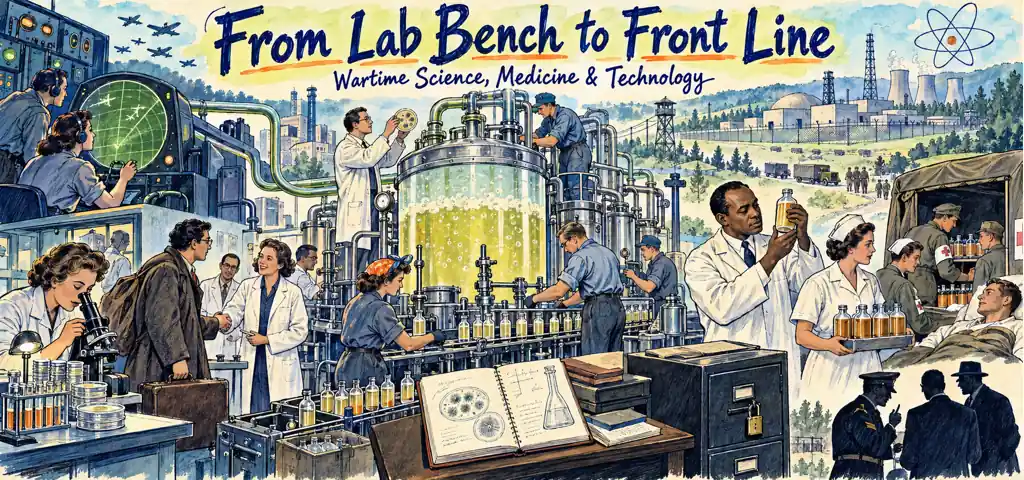
Chapter 10 of the CLEP History of the United States II study guide on Effortless Math covers Wartime Science, Medicine, and Technology: the key terms, the core ideas, and worked examples showing how this topic is tested on the exam.
CLEP History of the United States II, Chapter 10
War changed the scale and patronage of research
Before the war, universities, foundations, and firms supported much American basic research. Mobilization made the federal government a dominant sponsor through contracts, laboratories, and mission-driven projects. Vannevar Bush's Office of Scientific Research and Development connected civilian scientists to military needs while preserving university and industrial participation. Afterward, Bush's report Science, the Endless Frontier argued for continuing federal support, helping establish the postwar expectation that public funding could sustain basic knowledge as well as immediate weapons.
Refugee scientists strengthened American capacity
Nazism and fascism expelled or drove away Jewish and anti-fascist scholars from Europe. Physicists, chemists, physicians, and mathematicians brought expertise and international networks to American universities and laboratories. Their migration damaged Axis intellectual capacity and accelerated American research, including nuclear work. The outcome reveals that persecution can redistribute knowledge across borders; it does not mean every refugee worked on the atomic project or that American science had lacked a domestic foundation.
Radar converted invisible signals into operational knowledge
Radar sent radio waves and measured their return to locate aircraft and ships. The Radiation Laboratory at MIT coordinated improvements in microwave radar, while British cavity-magnetron technology aided the program. Radar supported air defense, navigation, bombing, and antisubmarine warfare. A device alone did not win battles: operators, maintenance, production, doctrine, and integration with command systems determined whether electronic detection improved decisions.
Synthetic rubber answered a resource cutoff
Japanese conquest in Southeast Asia cut access to most natural-rubber supplies. The federal government financed a large synthetic-rubber program, built plants, allocated feedstocks, and coordinated chemical firms. Production expanded rapidly enough to supply tires and military equipment. The case shows why market price alone could not solve a sudden strategic shortage on the required timetable; government absorbed construction risk and organized capacity across competing companies.
Penicillin required production science after discovery
Alexander Fleming observed penicillin's antibacterial effect in 1928, and British researchers later demonstrated its medical promise. Wartime American laboratories and drug companies developed deep-tank fermentation, improved strains, and purification techniques for mass production. By 1944 penicillin reached wounded servicemembers in large quantities. The central wartime achievement was not claiming the original discovery but turning a scarce laboratory substance into reliable industrial medicine.
Blood plasma improved transport but policy preserved segregation
Plasma could be dried, stored, and transported more easily than whole blood for emergency transfusion. Charles Drew developed important blood-banking and plasma-processing methods, directed Blood for Britain, and organized the first American Red Cross blood bank. He completed that assignment and returned to Howard University in April 1941. The Red Cross later implemented the armed forces' policy of first excluding and then segregating Black donors' blood, a scientifically baseless rule Drew publicly criticized. He did not leave a Red Cross post in 1942 because of that policy. Medical innovation and racial hierarchy nevertheless operated inside the same system.
Combat psychiatry moved treatment forward
Armies initially evacuated many soldiers with severe combat stress far from their units. Physicians learned that prompt treatment near the front, with rest, food, reassurance, and an expectation of return, could restore some soldiers more effectively. Terms and diagnoses changed, and many veterans still suffered long after service. Wartime psychiatry expanded attention to environmental trauma, but military goals influenced treatment and the desire to return personnel to duty.
Atomic towns fused secrecy, work, and federal planning
Oak Ridge, Tennessee; Hanford, Washington; and Los Alamos, New Mexico, grew rapidly as project sites. Federal authorities acquired land, built housing and utilities, controlled access, and divided knowledge so many workers understood only their immediate tasks. Population charts showing sudden wartime growth therefore record a secret public-industrial network. These were not ordinary private company towns, even though contractors operated many facilities.
The Manhattan Project coordinated unlike institutions
General Leslie Groves directed the Army project while J. Robert Oppenheimer led the Los Alamos laboratory. University physics, corporate engineering, military security, and immense electrical power converged. Uranium enrichment and plutonium production used different technical routes, and an implosion design was tested at Trinity. The project's organization is as historically important as its famous scientists: federal authority mobilized dispersed expertise toward one secret deadline.
Scientists disputed political control after the bomb
The Franck Report urged considering a demonstration and warned of an arms race. After the war, scientists' groups campaigned for civilian rather than permanent military control and for international safeguards. The May-Johnson proposal gave the military a stronger role; the McMahon Act, enacted as the Atomic Energy Act of 1946, created a civilian Atomic Energy Commission while imposing tight secrecy. Civilian control did not mean open publication or international ownership.
Civilian control still preserved monopoly and secrecy
The 1946 act placed the commission outside the armed services, yet kept fissionable material under federal ownership and treated weapons information as "born secret" unless formally declassified. A Military Liaison Committee gave the armed services an institutional channel without turning the commission into a military agency. Private firms did not gain a general right to own and operate commercial reactors until the 1954 revision created a licensing system. The arrangement therefore combined civilian administration with public monopoly, military consultation, and strict security rather than choosing between civilian control and secrecy.
separate invention from scaling
A timeline places Fleming's observation in 1928, clinical development around 1940, and mass military supply in 1944.
The wartime compact shaped postwar science
Federal research contracts, national laboratories, pharmaceutical production, and military medicine continued to influence universities and industry. The Office of Naval Research and later National Science Foundation supported research, while atomic secrecy and defense priorities limited openness. The compact produced knowledge and public goods but raised durable questions: who sets research agendas, owns results, bears risk, and decides when security overrides exchange?
Watch the history in motion
This short lesson adds voices, images, and chronology to the ideas you just studied.
Video: Medical Advances During WWII (Penicillin and Blood Banks), BOCHO.
Try four CLEP-style questions
- Radar prototypes work in a laboratory, but fleets still fail to detect submarines reliably. Which additional evidence would best identify the institutional bottleneck?
- Records on production volume, operator training, maintenance, and integration with patrol commands
- The peacetime retail price of household receivers
- A list of all naval battles before radar existed
- A biography of the first physicist to describe radio waves
- A statement that electronic signals are invisible
- What larger relationship is illustrated when authoritarian persecution drives scientists abroad and receiving countries expand research capacity?
- Migration matters only to universities and cannot affect industrial or military research.
- Political repression increases the persecuting state's access to dissenting expertise.
- Political regimes can redistribute human capital internationally, weakening one research system while strengthening another.
- Every refugee scientist necessarily supports the receiving government's policies.
- Scientific knowledge remains fixed within the country where a researcher was born.
- A town's population rises abruptly after federal land acquisition, access is restricted, and workers employed by several contractors know only compartmentalized tasks. What is the strongest inference?
- The settlement grew chiefly through unplanned tourism.
- A secret federal project combined contractors, infrastructure, and compartmentalization.
- Local government independently created a consumer-electronics district.
- The residents were all uniformed soldiers under battlefield command.
- Federal participation ended once the first houses were built.
- What governance problem could persist when universities and firms performed federally funded wartime research?
- Sponsors could shape agendas and secrecy without owning the research institutions.
- Contract research prevented public sponsors from defining any mission or deadline.
- University participation required immediate publication of every military result.
- Industrial laboratories answered only to local voters rather than contract terms.
- Federal funding eliminated disputes over patents, risk, and scientific exchange.
Check your answers and reasoning
Independent preparation. CLEP is a registered trademark of the College Board, which does not endorse this lesson.

Related to This Article
More math articles
- Middle School Math Worksheets: FREE & Printable
- Scarcity, Opportunity Cost, and the Production Possibilities Frontier
- 6th Grade PSSA Math Practice Test Questions
- NES Essential Academic Skills Math Flashcards
- How to Construct the Incircle of a Triangle
- Human Ecology and Urban Spatial Models
- How to Find Patterns of Equivalent Fractions?
- Utah RISE Grade 7 Math Worksheets: 95 Free Printable Single-Skill PDFs with Keys
- The Best Grade 8 ELA Practice Tests for Utah Students
- How to Solve Rational Inequalities?















What people say about "Wartime Science, Medicine, and Technology"?
No one replied yet.