Models of Congressional Representation
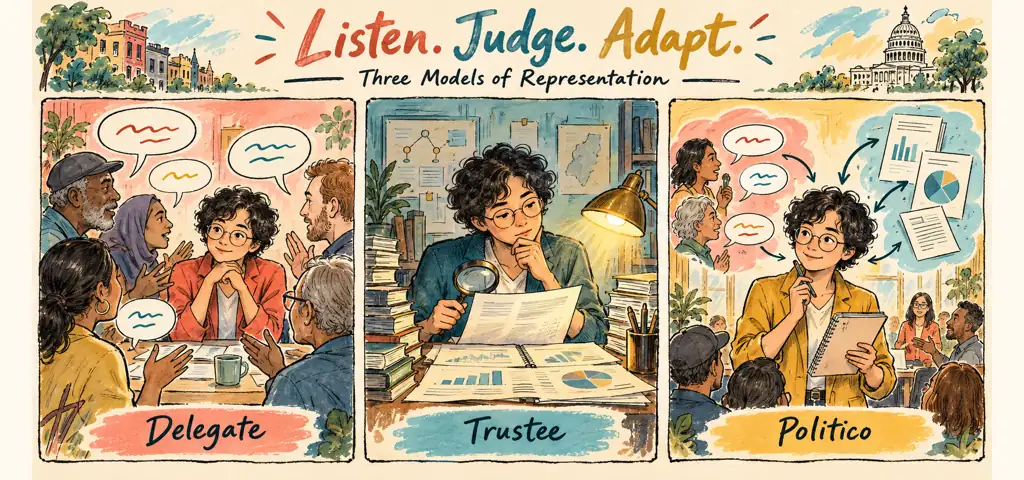
The delegate model expects a legislator to follow constituents’ expressed preferences. The trustee model permits the legislator to use independent judgment about the public interest, even when that choice is temporarily unpopular. The politico model describes members who shift between these approaches depending on the issue, its visibility, the strength of constituency opinion, and their own expertise.
These models describe decision-making roles, not the demographic identity of the officeholder. Descriptive representation asks whether representatives share characteristics or experiences with constituents. Substantive representation asks whether they advance constituents’ interests. A member can be descriptively representative while acting as a trustee, or lack a shared background while acting as a faithful delegate.
A closer look at models of congressional representation
Electoral incentives affect which role is attractive. Clear and intense district opinion, an approaching election, or a highly visible vote can push a member toward delegate behavior. Low-salience or technically complex questions may leave more room for trustee judgment. Party commitments, committee specialization, donors, organized groups, and national conditions also shape legislative choices.
Models of Congressional Representation: what the rule leaves unsettled
In an application item, look for the reason the member gives. Following district instructions signals a delegate. Relying on personal judgment despite contrary polls signals a trustee. Varying the approach by issue signals a politico. Do not assume that casework, pork-barrel advocacy, party-line voting, or incumbency by itself establishes one representational model.
Check your understanding of models of congressional representation
Write one sentence a delegate might use to justify a vote and another a trustee might use. What evidence separates them?
Check your reasoning
The delegate model expects a legislator to follow constituents’ expressed preferences. The trustee model permits the legislator to use independent judgment about the public interest, even when that choice is temporarily unpopular. Electoral incentives affect which role is attractive.
Video lesson: Models of Congressional Representation
Khan Academy gives a focused explanation of this topic in Representatives as delegates, trustees, and politicos | US government and civics.
If the player does not load, watch this lesson directly on YouTube.
Connect this lesson to the larger course
For a broader map connecting models of congressional representation to Congress, the presidency, the courts, and the bureaucracy, use the AP U.S. Government and Politics learning hub.

Related to This Article
More math articles
- How to Solve Pythagorean Theorem Problems? (+FREE Worksheet!)
- Unlocking the Power of Visualizations: How to Use Diagrams and Drawings to Master Math Concepts
- How to Find The Derivative of a Trigonometric Function
- Slavery, Caste, Estate, and Class Systems
- Population and samples
- The Best Grade 5 ELA Practice Tests for Pennsylvania Students
- SSAT Upper-Level Math Worksheets: FREE & Printable
- Reading tables, charts, and graphs
- Advanced Vocabulary Words: Precocious to Redoubt
- Geometry Puzzle – Challenge 64






















What people say about "Models of Congressional Representation"?
No one replied yet.