How Government Institutions Shape Public Policy
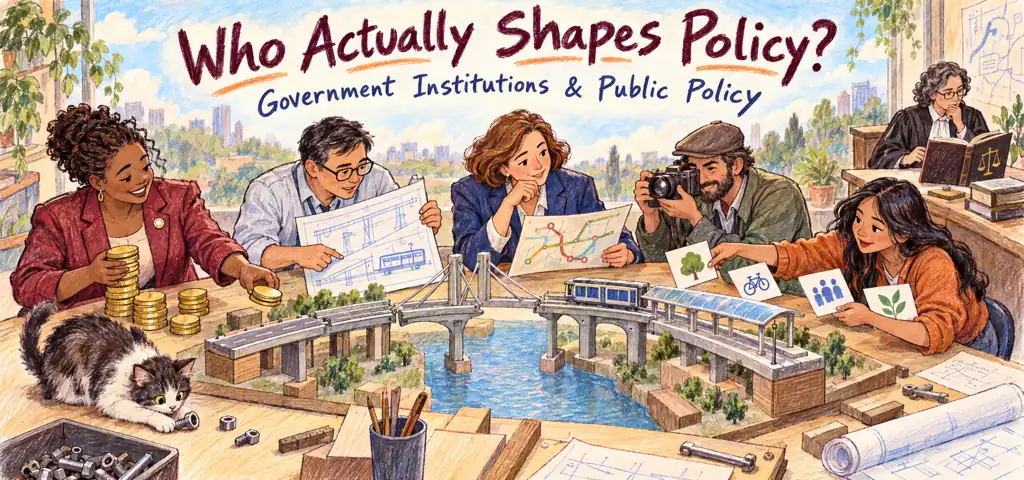
Formal authority and political influence are not the same resource. Congress and the president can enact national policy through constitutional procedures. Agencies implement delegated programs. And courts resolve legal challenges in proper cases. Parties organize legislative agendas, elections, and governing coalitions. Interest groups contribute expertise, testimony, campaign activity, litigation, and pressure. News organizations and digital platforms affect which conditions receive attention and how audiences interpret them. Public opinion changes elected officials’ incentives, especially when preferences are intense, visible, and connected to an approaching election.
No participant controls the full process. A group may place an issue on the agenda but fail to assemble votes. A president may focus public attention without persuading Congress. Congress may enact broad language while agencies shape practical meaning through implementation. Courts can invalidate unlawful action but ordinarily cannot supply the money, staffing, or political cooperation required for a replacement program. Influence also varies by stage: media attention and public mobilization may be especially important during agenda setting, while organized specialists often gain use during technical formulation and rule implementation.
How Government Institutions Shape Public Policy: the working rule
Resources work through mechanisms. Legislators have votes and oversight powers. Presidents have agenda visibility, a veto, appointments, and executive direction within law. Agencies have expertise and administrative capacity. Groups have information, organization, and access. Media have publicity and framing. Citizens have votes, participation, and opinion. Possessing a resource does not guarantee success. Information may be discounted as biased, a veto threat may lack credibility, intense public attention may fade, and an agency may lack statutory authority for its preferred solution.
How Government Institutions Shape Public Policy: limits and hard cases
Consider a proposal to change military procurement. Contractors and watchdog groups supply competing information. Committees write authorization and funding provisions. The president recommends priorities and directs administration. Defense agencies purchase equipment. Journalists investigate performance. And courts address any proper legal dispute. Public reaction may raise the electoral cost of continuing or ending the program. In a course question, identify the actor’s actual resource and trace it to a specific stage. Visibility is not authority, and influence over one choice is not control of the entire policy outcome.
A new case involving how government institutions shape public policy
Choose a concrete example connected to how government institutions shape public policy, then name the government actor, the governing rule, and the limit that could change the result.
Video lesson: How Government Institutions Shape Public Policy
Khan Academy gives a focused explanation of this topic in Introduction to the public policy process | US government and civics | Khan Academy.
If the player does not load, watch this lesson directly on YouTube.
Connect this lesson to the larger course
For a broader map connecting how government institutions shape public policy to Congress, the presidency, the courts, and the bureaucracy, use the AP U.S. Government and Politics learning hub.

Related to This Article
More math articles
- Top 10 Tips You MUST Know to Retake the PERT Math
- Two-Column Proofs: How to Write Statements and Reasons
- Getting Better at Math: Realistic Tips and Suggestions
- How to Calculate the Geometric Mean in Triangles
- How to Perform Scalar Multiplication
- How to Write the Equation of Parabola?
- Free Grade 8 English Worksheets for Alabama Students
- 10 Most Common ISEE Upper-Level Math Questions
- Grade 4 ELA Tests: A Clear Parent Guide to Reading, Writing, and Test-Day Readiness
- The Ultimate 6th Grade NDSA Math Course (+FREE Worksheets)











What people say about "How Government Institutions Shape Public Policy"?
No one replied yet.