CLEP U.S. History I 032: Yorktown, Peace, and International Consequences
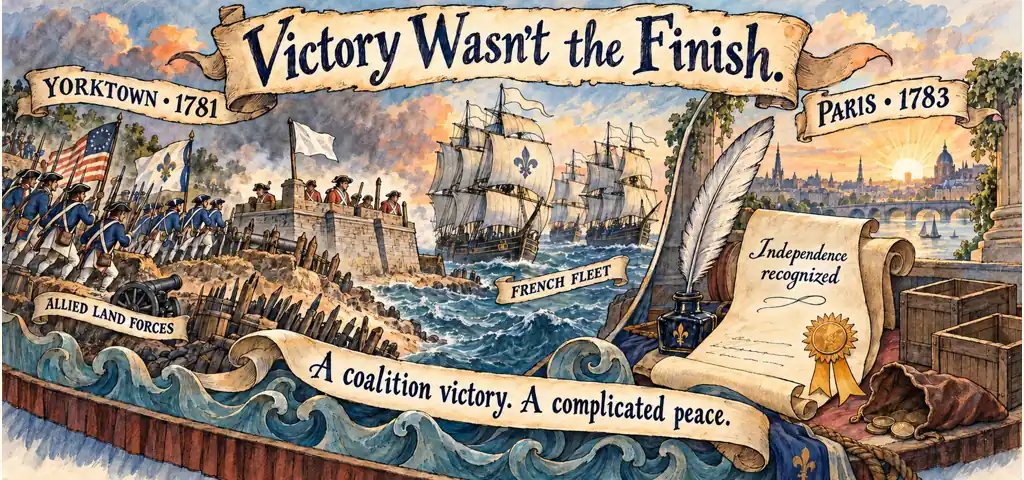
Lesson 6.6 of Chapter 6 of the U.S. History to 1877 study guide on Effortless Math covers CLEP U.S. History I 032: Yorktown, Peace, and International Consequences: the key terms, the core ideas, and worked examples showing how this topic is tested on the exam.
U.S. History to 1877 | Chapter 6 | Lesson 6.6
In 1781, British General Charles Cornwallis established a position at Yorktown, Virginia, expecting naval support. Washington and French General Rochambeau moved American and French troops south while a French fleet under de Grasse controlled Chesapeake access. Trapped by land and sea, Cornwallis surrendered in October. Yorktown did not formally end all fighting, but it destroyed British political willingness to continue a costly offensive war.
Peace negotiations produced the Treaty of Paris of 1783. Britain recognized U.S. independence and accepted generous boundaries to the Mississippi River. Article IV protected the recovery of lawful prewar debts. Article V required Congress to recommend, not guarantee, restitution of confiscated Loyalist property. Native nations were excluded even though the boundary transferred claims to their homelands. Spain regained Florida but did not receive all it wanted along the Mississippi.
The alliance demonstrates the Revolution’s international character. France helped defeat Britain but accumulated debt that contributed to its own fiscal crisis. Revolutionary language circulated in an Atlantic world that included later upheaval in France, Haiti, and Latin America, though each arose from distinct conditions. Britain’s empire survived and shifted attention toward other regions. Canada received many Loyalist refugees.
The new United States gained legal sovereignty but faced enormous tasks: paying debt, maintaining union, negotiating commerce, defending borders, and managing western settlement. Military victory did not answer how republican government would work. Indeed, wartime financial weakness and disputes among states would soon fuel arguments for constitutional reform.
Watch the topic in context
Mr. Burnett's Social Studies Classes offers a visual route through this topic. As you watch, compare its explanation with the source limits in the written lesson.
Video: American Revolution, pt. 4–Yorktown and Treaty of Paris, Mr. Burnett's Social Studies Classes.
Check your understanding
- French naval control was decisive at Yorktown because it
- transferred command of the Continental Army to France
- forced Britain to evacuate Canada
- completed peace negotiations before the siege
- cut every British supply line in North America
- prevented British relief or escape
- The Treaty of Paris recognized
- continued British sovereignty with colonial home rule
- Native ownership as the basis of the western boundary
- U.S. independence
- French sovereignty over the thirteen states
- cancellation of debts owed to British creditors
- Select all that apply. Postwar challenges included
- choosing a British governor
- interstate cooperation
- commerce
- western diplomacy
- public debt
- Explain one way the peace settlement benefited the United States while harming another group.
Write a brief response using a named fact from the lesson.
Open the answers and reasoning
Independent preparation. CLEP is a registered trademark of the College Board, which does not endorse this lesson.

Related to This Article
More math articles
- How to Modeling Real-World Situations Using Functions
- CPA FAR Bonds: Reconcile Carrying Value and Interest Expense (2027 Prep)
- 6th Grade CMAS Math Worksheets: FREE & Printable
- 8th Grade OAA Math Worksheets: FREE & Printable
- How to Understand the Concept of Scale Changes: Area and Perimeter
- Free Grade 4 English Worksheets for West Virginia Students
- A Parents’ Guide To Supporting Teens With Their Math Skills
- The Best Grade 8 ELA Practice Tests for South Dakota Students
- ILTS TAP Math Flashcards
- Evidence: The Support Behind a Claim



















What people say about "Yorktown, Peace and International Consequences"?
No one replied yet.