CLEP U.S. History I 031: Republicanism and the Revolution’s Social Limits
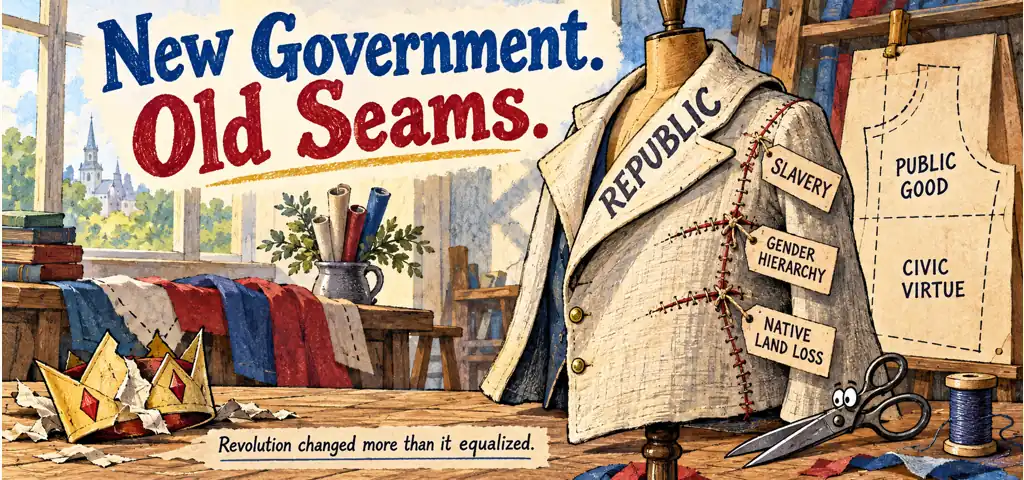
Lesson 6.5 of Chapter 6 of the U.S. History to 1877 study guide on Effortless Math covers CLEP U.S. History I 031: Republicanism and the Revolution’s Social Limits: the key terms, the core ideas, and worked examples showing how this topic is tested on the exam.
U.S. History to 1877 | Chapter 6 | Lesson 6.5
Republicanism held that legitimate government served the public good and depended on citizens’ virtue rather than hereditary rule. Americans rejected monarchy and aristocratic titles, wrote state constitutions, and expanded political discussion. Several states moved toward broader white male voting, though property rules persisted unevenly. Deference weakened without disappearing.
Revolution changed religious policy. Virginia’s struggle over established religion culminated in the Statute for Religious Freedom in 1786, while other states revised church support more gradually. The war also accelerated northern challenges to slavery. Pennsylvania adopted gradual abolition in 1780. Other northern states followed different paths through laws and courts. Gradual plans often left people enslaved for years and did not create racial equality.
For women, the language of consent exposed contradictions in household authority, but formal political rights barely changed. Abigail Adams’s appeal to “remember the ladies” did not bring legal equality. Republican motherhood linked women’s education to civic responsibility, simultaneously valuing public influence and restricting it to a gendered role. For Native nations, republican expansion frequently meant land loss.
The Revolution’s limits were not merely failures after the “real” political story. Slavery, settler colonialism, and gender hierarchy helped define who could count as an independent citizen. At the same time, revolutionary principles and political mobilization created new tools for contesting exclusion. A balanced interpretation avoids both celebration without conflict and dismissal without change.
Watch, then test the claim
Use this lesson from Bill of Rights Institute to review the period and its central historical problem. Pause when the video reaches the turning point named above.
Video: Jonathan Den Hartog: The American Revolution & Republicanism | BRI Scholar Talks, Bill of Rights Institute.
Check your understanding
- Republicanism emphasized
- political obedience without civic participation
- hereditary executive authority
- representation without concern for public virtue
- permanent social privilege for a titled nobility
- civic virtue and public good
- Northern gradual abolition laws generally
- applied only to slavery in southern states
- emancipated every enslaved person immediately
- ended slavery over time rather than immediately
- guaranteed full racial equality with freedom
- prohibited future state antislavery legislation
- Select all that apply. Revolutionary change included
- written state constitutions
- religious disestablishment in some states
- northern antislavery measures
- wider political debate
- universal equality
- Make a claim about the Revolution’s depth using one political change and one social limit.
Write a brief response using a named fact from the lesson.
Open the answers and reasoning
Independent preparation. CLEP is a registered trademark of the College Board, which does not endorse this lesson.

Related to This Article
More math articles
- Unlocking the Secrets of Similar Polygons: Shape, Size, and Proportions!
- Top 10 Tips You MUST Know to Retake the TExES Math Test
- How to Prepare for Maths Exams?
- Theories of Aging
- Math Refresher for Adults: Free Lessons & Worksheets
- Race, Ethnicity, and Migration
- Multiplying & Dividing Fractions Practice — Free Drills
- CLEP U.S. History I 046: Louisiana Purchase and Western Exploration
- The Ultimate OAE Elementary Education Math (018-019) Course (+FREE Worksheets & Tests)
- Free Grade 5 English Worksheets for ACT Aspire Students

















What people say about "Republicanism and the Revolution's Social Limits"?
No one replied yet.