CLEP U.S. History I 030: Loyalists, Native Nations, Enslaved People, and Women
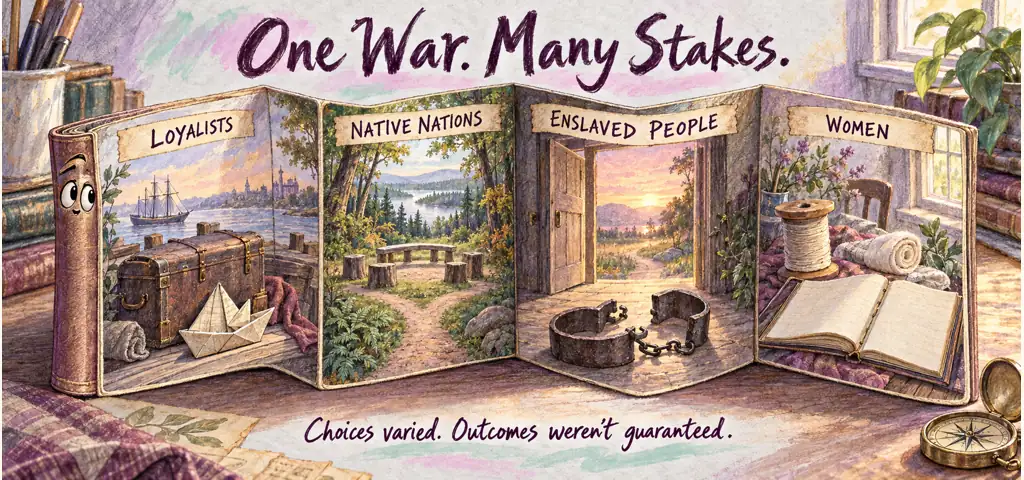
Lesson 6.4 of Chapter 6 of the U.S. History to 1877 study guide on Effortless Math covers CLEP U.S. History I 030: Loyalists, Native Nations, Enslaved People, and Women: the key terms, the core ideas, and worked examples showing how this topic is tested on the exam.
U.S. History to 1877 | Chapter 6 | Lesson 6.4
The Revolution was a civil war as well as an independence struggle. Loyalism was strongest in some port communities, the lower Hudson Valley, and the southern backcountry, but no region belonged wholly to one side. Crown officials and Anglican clergy might defend imperial order. Merchants could value Atlantic credit. Recent migrants or religious minorities might distrust patriot neighbors. Tenants could oppose patriot landlords. Other colonists tried to remain neutral or shifted allegiance as armies arrived. Patriot governments answered uncertainty with loyalty oaths, property confiscation, banishment, and at times crowd violence. Roughly tens of thousands of Loyalists eventually migrated to British Canada, Britain, the Caribbean, or other parts of the empire, while many stayed and negotiated reintegration.
Native diplomacy followed local calculations rather than a single “Native side.” Most Haudenosaunee nations supported Britain because British officials appeared more likely than land-hungry colonists to restrain western settlement. Many Oneidas and Tuscaroras, however, aided the United States, splitting the confederacy and sometimes communities and families. Cherokee towns disagreed over strategy as settlers invaded southern homelands. Some fought with Britain, while others sought separate accommodations. In the Ohio Valley and Southeast, Britain supplied Native allies but could not command their purposes. Patriot campaigns such as Sullivan’s 1779 expedition destroyed Haudenosaunee towns and food stores. The 1783 peace then transferred British territorial claims without Native consent, not Native sovereignty itself, and intensified warfare over U.S. settlement.
Enslaved people also acted strategically. Lord Dunmore’s November 1775 proclamation applied to enslaved people held by rebels who could reach British lines and serve the crown. It did not emancipate people owned by Loyalists or abolish slavery in Virginia. The broader 1779 Philipsburg Proclamation invited people escaping rebel owners in areas reached by British forces, even without military enlistment. Thousands pursued freedom behind British lines, yet evacuation, disease, reenslavement, and broken promises made outcomes uncertain. Black patriots served too, especially where northern manpower needs opened enlistment. Massachusetts service and Rhode Island’s 1778 regiment did not erase racial inequality, while southern patriot governments generally feared arming enslaved men. Northern gradual-emancipation laws emerged unevenly. Plantation slavery survived and expanded after the war.
Women’s work likewise varied by legal status, race, class, and location. Farm and shop managers sustained household production during men’s absence. Camp followers cooked, laundered, nursed, and carried supplies. Women organized boycotts, made homespun, gathered intelligence, and a small number entered ranks disguised as men. Loyalist women protected property or joined refugee migrations. Enslaved women used wartime movement to seek family freedom while also facing capture and sexual violence. These activities expanded responsibility without granting equal civil or political rights. The later ideal of “republican motherhood” justified more education for some white women by making childrearing a civic duty, but it still routed citizenship through motherhood rather than votes or office.
The strongest comparison therefore begins with a group’s objective: land, order, family security, freedom, or local autonomy: and then asks what choices the geography and military situation made possible. Labels such as Loyalist, patriot, Native ally, or camp follower describe coalitions, not uniform motives. Wartime opportunity and postwar outcome must also be separated: service could create influence without guaranteeing citizenship, freedom, land, or safety.
See the history take shape
History Chronicles traces the people and chronology behind this lesson. Listen for the evidence that sharpens the written account, then try the questions below.
Video: 21/28 The Role Of Native Americans, Enslaved People & Women In The American Revolution, History Chronicles.
Check your understanding
- Which applicant met the explicit conditions in Dunmore’s November 1775 proclamation?
- an enslaved dockworker held by a Loyalist who requested civilian evacuation
- a free Black sailor seeking wages but not military service
- an enslaved field hand who remained on a rebel’s plantation
- an enslaved man held by a rebel who escaped and joined British forces
- an enslaved woman held by a neutral owner who enlisted in a patriot militia
- The split between British-allied Mohawk and Seneca communities and many American-allied Oneidas and Tuscaroras best supports which explanation?
- Haudenosaunee nations made different strategic judgments about alliances, local security, and settler expansion.
- A formal Grand Council decision placed the entire confederacy under British military command.
- The confederacy enforced neutrality even as individual warriors entered the conflict without national support.
- American alliance offers included an enforceable guarantee of Haudenosaunee territory after victory.
- Proximity to a British or American post determined allegiance more strongly than Native political debate.
- Select all that apply. Documented forms of women’s wartime labor included
- managing farms and shops
- holding equal voting seats in the Continental Congress
- gathering intelligence
- nursing and camp work
- producing and transporting supplies
- Compare the strategic choices of one Loyalist, Native, or enslaved group with patriot goals.
Write a brief response using a named fact from the lesson.
Open the answers and reasoning
Independent preparation. CLEP is a registered trademark of the College Board, which does not endorse this lesson.

Related to This Article
More math articles
- How to Multiply Rational Expressions? (+FREE Worksheet!)
- Pattern Power: How to Unravel Division Trends Across Expanding Place Values
- Parabola Calculator — Vertex, Focus & Directrix
- Hyperbola in Standard Form and Vertices, Co– Vertices, Foci, and Asymptotes of a Hyperbola
- Texas STAAR Algebra 1 Free Worksheets: 59 Printable TEKS-Aligned Algebra 1 PDFs with Answer Keys
- Grade 3 Math: Subtracting 3-Digit Numbers
- 6 Strategies to Make Your Math Test Preparation More Effective
- Top 10 Free Websites for SHSAT Math Preparation
- The Wonderful World of the Triangle Inequality Theorem
- How to Distance Teach Math with a Drawing Pad?


















What people say about "Loyalists, Native Nations and Enslaved People"?
No one replied yet.