CLEP U.S. History I 029: Military Turning Points and the French Alliance
Lesson 6.3 of Chapter 6 of the U.S. History to 1877 study guide on Effortless Math covers CLEP U.S. History I 029: Military Turning Points and the French Alliance: the key terms, the core ideas, and worked examples showing how this topic is tested on the exam.
U.S. History to 1877 | Chapter 6 | Lesson 6.3
Britain possessed a professional army, a powerful navy, credit, and an empire. Americans fought over familiar ground and could win by avoiding decisive destruction, but they faced short enlistments, supply shortages, inflation, and political division. Washington’s greatest strategic contribution was often preservation of the army rather than battlefield brilliance.
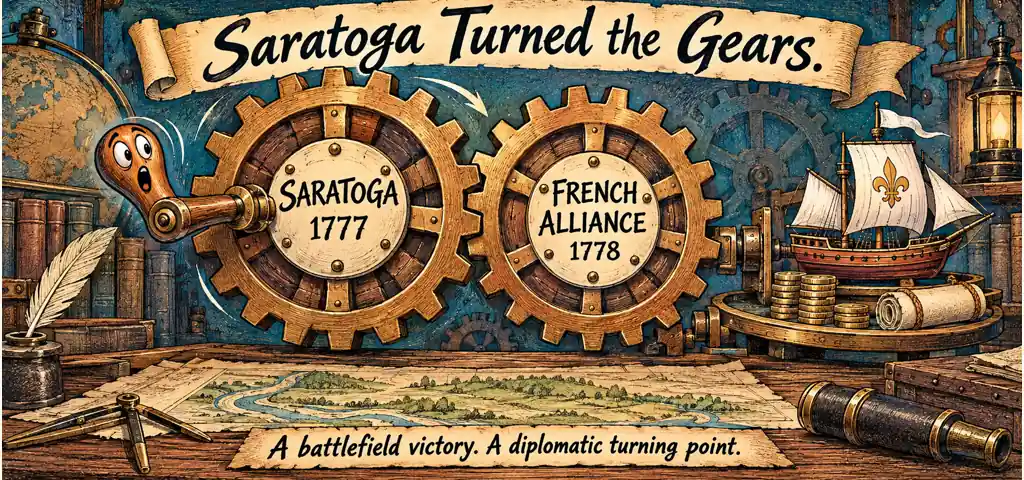
After defeat around New York in 1776, Washington crossed the Delaware and attacked Hessian troops at Trenton, then struck Princeton. These small victories restored morale. In 1777, British General John Burgoyne advanced from Canada expecting support that did not arrive. American forces surrounded him near Saratoga. His surrender was the important diplomatic turning point because it convinced France that the American rebellion could survive.
France recognized the United States and entered a formal alliance in 1778, supplying money, arms, troops, and naval power. Spain joined the war against Britain as France’s ally, not as a formal U.S. Ally, and fought along the Gulf Coast and Mississippi. The Netherlands also became involved. Britain now faced a global imperial war, which dispersed its military resources.
The winter at Valley Forge did not produce the army from nothing, but it exposed supply failures and tested endurance. Baron von Steuben’s training improved standardized drill, while Nathanael Greene and others helped administration. War in the South became brutal civil conflict among patriots, Loyalists, and militias. American victory came through endurance, foreign intervention, local support, British mistakes, and the difficulty of occupying a vast rebellious territory.
A focused video lesson
This American Battlefield Trust lesson supplies a second explanation of the same period. Note where chronology, cause, and perspective connect.
Video: America's Alliance with France: The Revolutionary War In4 Minutes, American Battlefield Trust.
Check your understanding
- Saratoga mattered most because it
- eliminated Loyalist military service
- forced Britain to recognize independence immediately
- destroyed the British army’s ability to fight elsewhere
- helped secure French alliance
- placed every British position in North America under patriot control
- Washington’s broad strategic requirement was to
- win every major engagement
- keep an army in the field
- match British naval strength without allies
- occupy Canada before seeking diplomacy
- avoid reliance on state and local mobilization
- Select all that apply. American victory depended on
- endurance
- foreign aid
- British strategic problems
- American naval superiority from 1775
- local mobilization
- Explain the difference between a military event and its diplomatic consequence at Saratoga.
Write a brief response using a named fact from the lesson.
Open the answers and reasoning
Independent preparation. CLEP is a registered trademark of the College Board, which does not endorse this lesson.

Related to This Article
More math articles
- Standard Deviation Calculator (Free)
- Free Grade 5 English Worksheets for Wisconsin Students
- 8th Grade PARCC Math Worksheets: FREE & Printable
- Top 10 8th Grade NYSE Math Practice Questions
- Greek Roots for Science, Time, and Thought
- How to Use a Venn Diagram to Classify Rational Numbers?
- Math Books for 8th Graders: Compare Four Options by Learning Need
- Estimate Sums for 4th Grade
- How to Simplify Ratios? (+FREE Worksheet!)
- How to Master Motion: A Comprehensive Guide to Understanding the Distance Formula in Real-World Problems





















What people say about "Turning Points and the French Alliance"?
No one replied yet.