CLEP U.S. History I 028: Common Sense and the Declaration
Lesson 6.2 of Chapter 6 of the U.S. History to 1877 study guide on Effortless Math covers CLEP U.S. History I 028: Common Sense and the Declaration: the key terms, the core ideas, and worked examples showing how this topic is tested on the exam.
U.S. History to 1877 | Chapter 6 | Lesson 6.2
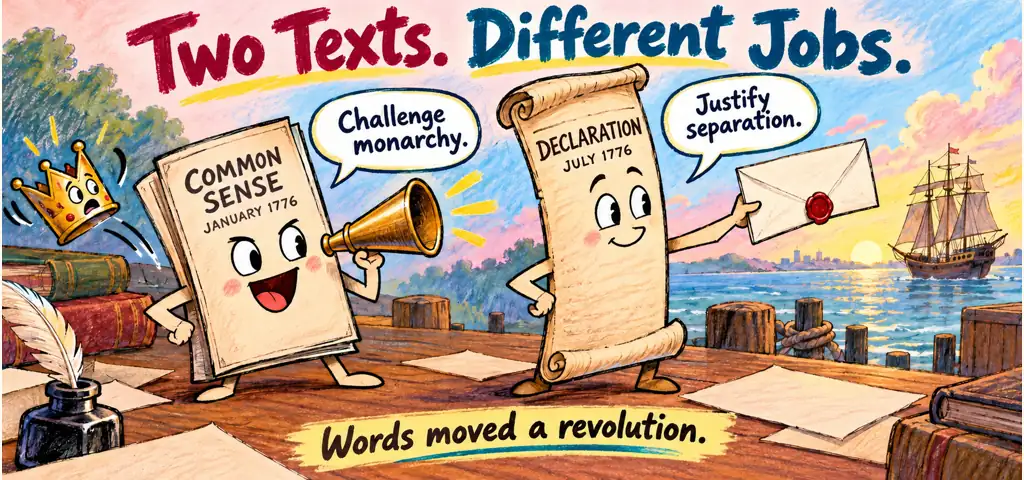
Thomas Paine’s Common Sense, published in January 1776, attacked monarchy in direct, accessible prose. Paine argued that an island should not rule a continent and that America could gain trade and security through independence. He shifted debate from Parliament’s particular abuses to the legitimacy of hereditary kingship itself. Wide circulation and public reading carried the argument beyond political elites.
The Declaration of Independence, adopted July 4 after Congress voted for independence, performed different work. Drafted principally by Thomas Jefferson and revised by Congress, it announced a collective political act to an international audience. Its opening reasoned from human equality and natural rights to government by consent and a people’s right to alter a destructive government. A list of grievances then portrayed George III as a tyrant who had broken the imperial bond.
The Declaration’s universal language exceeded its immediate application. The new states maintained slavery, women lacked equal political rights, and the document’s description of Native warfare repeated colonial prejudice. Yet claims about equality and rights became tools that excluded people could use. Enslaved petitioners, abolitionists, women’s-rights advocates, and later reformers measured American practice against declared principles.
Reading the Declaration requires distinguishing principle, grievance, and purpose. It did not create a detailed government or immediately free individuals. It justified separation, sought foreign recognition, and helped create a national political identity. The contradiction between universal principle and restricted citizenship is not a reason to dismiss the text. It is one of the Revolution’s central historical dynamics.
[.47 ] images/bank-selected/declaration-of-independence-1776.jpg Read the object before reading the transcript The engrossed Declaration of Independence, adopted July 4, 1776. National Archives. The faded parchment preserves the formal act and signatures, but the photograph cannot make the full argument legible. Use the transcript to separate principles, grievances, and the declaration of political separation.
Watch the topic in context
Watch this account from Hip Hughes (HipHughes) with one question in mind: which evidence makes the lesson's strongest claim hold up?
Video: "Common Sense" Explained: US History Review, Hip Hughes (HipHughes).
Check your understanding
- Paine’s most radical argument attacked
- alliances with European powers
- representative colonial assemblies
- religious liberty among Protestants
- republican government in the colonies
- hereditary monarchy
- The Declaration’s primary immediate purpose was to
- specify the structure of a permanent union
- justify political separation
- enact immediate emancipation throughout the states
- allocate Congress’s taxing powers
- create a national court system
- Select all that apply. The Declaration includes
- a complete frame of government
- consent
- grievances
- a claim to alter government
- natural rights
- Explain how excluded people could use the Declaration’s language beyond its 1776 application.
Write a brief response using a named fact from the lesson.
Open the answers and reasoning
Independent preparation. CLEP is a registered trademark of the College Board, which does not endorse this lesson.

Related to This Article
More math articles
- The Best Grade 4 ELA Practice Tests for Maine Students
- What Are The Optimization Problems: Beginners Complete Guide
- FREE 4th Grade STAAR Math Practice Test
- Free Grade 4 English Worksheets for Louisiana Students
- Free Grade 5 English Worksheets for Louisiana Students
- How to Use Integers to Complete Equations
- How to Determine Limits Using the Squeeze Theorem?
- FTCE General Knowledge Math- Test Day Tips
- How to Find the Increasing or Decreasing Functions?
- Facts, Opinions, Values, and Evidence


















What people say about "Common Sense and the Declaration"?
No one replied yet.