CLEP U.S. History I 027: Lexington, Concord, and the Move toward Independence
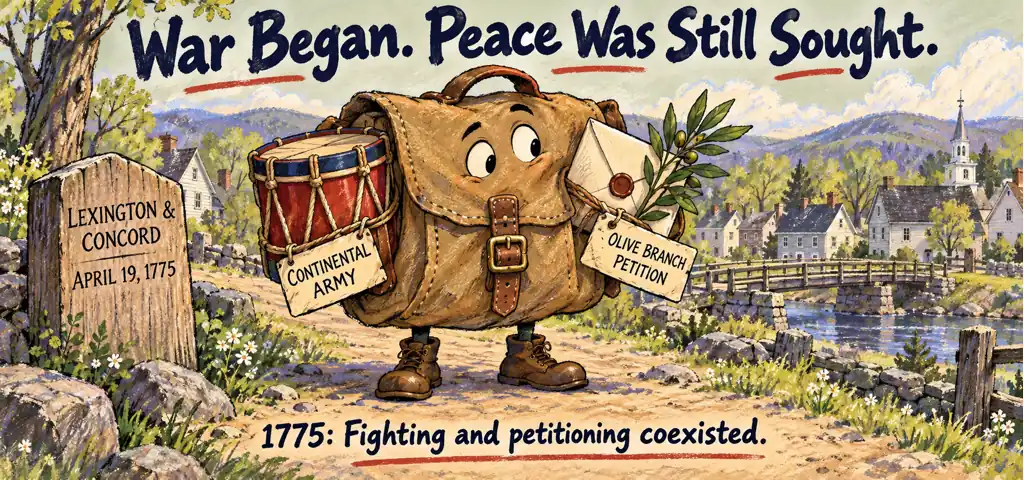
Lesson 6.1 of Chapter 6 of the U.S. History to 1877 study guide on Effortless Math covers CLEP U.S. History I 027: Lexington, Concord, and the Move toward Independence: the key terms, the core ideas, and worked examples showing how this topic is tested on the exam.
U.S. History to 1877 | Chapter 6 | Lesson 6.1
By early 1775, Massachusetts patriots had formed committees, stored military supplies, and trained militia. General Thomas Gage sent British troops toward Concord to seize arms and possibly arrest leaders. Fighting at Lexington on April 19 left militiamen dead. At Concord and along the return to Boston, militia inflicted serious losses. Who fired first at Lexington remains uncertain, but the political result was clear: bloodshed turned a constitutional dispute into open war.
Militia forces surrounded Boston, and the Second Continental Congress met in Philadelphia. It created a Continental Army and appointed George Washington commander, giving the New England fighting a continental symbol. At the same time, Congress sent the Olive Branch Petition professing loyalty and seeking peace. This apparent contradiction reflected divided expectations. Delegates could prepare defense while hoping the king would restrain Parliament.
The Battle of Bunker Hill in June 1775, fought mainly on Breed’s Hill, ended in British occupation of the position but heavy British casualties. It showed that inexperienced colonial forces could impose great cost. King George III declared the colonies in rebellion and refused the Olive Branch approach. British plans to use force, including hiring German troops, further weakened attachment to monarchy.
Independence emerged through escalation, not a single awakening. Local committees displaced royal authority. Warfare demanded money and alliances. And royal rejection narrowed compromise. Yet Loyalism remained substantial and many people tried to avoid either side. The historian should explain why possibilities closed without reading July 1776 backward into April 1775.
Watch, then test the claim
PBS offers a visual route through this topic. As you watch, compare its explanation with the source limits in the written lesson.
Video: The Shot Heard ’Round the World: Lexington, Concord and the Start of War | The American Revolution, PBS.
Check your understanding
- British troops marched toward Concord primarily to
- arrest Patriot leaders believed to be meeting in Lexington
- collect customs revenue withheld by Boston merchants
- locate and destroy military stores gathered by the Massachusetts militia
- reopen Boston’s port under a colonial customs board
- negotiate militia disarmament under local supervision
- The Olive Branch Petition demonstrates that
- reconciliation still had supporters
- Congress had already made independence its official aim
- military mobilization ended before the petition
- George III accepted Congress as a lawful legislature
- armed conflict had not yet begun
- Select all that apply. Escalation included
- militia mobilization
- Continental Army formation
- unanimous Loyalist support
- local committee rule
- royal rejection
- Explain why military preparation and a peace petition were not necessarily contradictory in 1775.
Write a brief response using a named fact from the lesson.
Open the answers and reasoning
Independent preparation. CLEP is a registered trademark of the College Board, which does not endorse this lesson.

Related to This Article
More math articles
- Groups, Networks, and Organizations
- Number Properties Puzzle -Critical Thinking 2
- The Best Grade 3 ELA Practice Tests for Kentucky Students
- A Comprehensive Collection of Free HiSET Practice Tests
- The Ultimate PSAT 10 Math Formula Cheat Sheet
- How to Balance the Scales: Inequalities in Decimal Addition and Subtraction
- FREE 7th Grade STAAR Math Practice Test
- Top 10 ASVAB Math Prep Books (Our 2023 Favorite Picks)
- How to Help Your 3rd Grade Student Prepare for the Texas STAAR Math Test
- 10 Most Common PERT Math Questions




















What people say about "Lexington, Concord and the Move to Independence"?
No one replied yet.