CLEP U.S. History I 026: Tea, Coercion, and Intercolonial Resistance
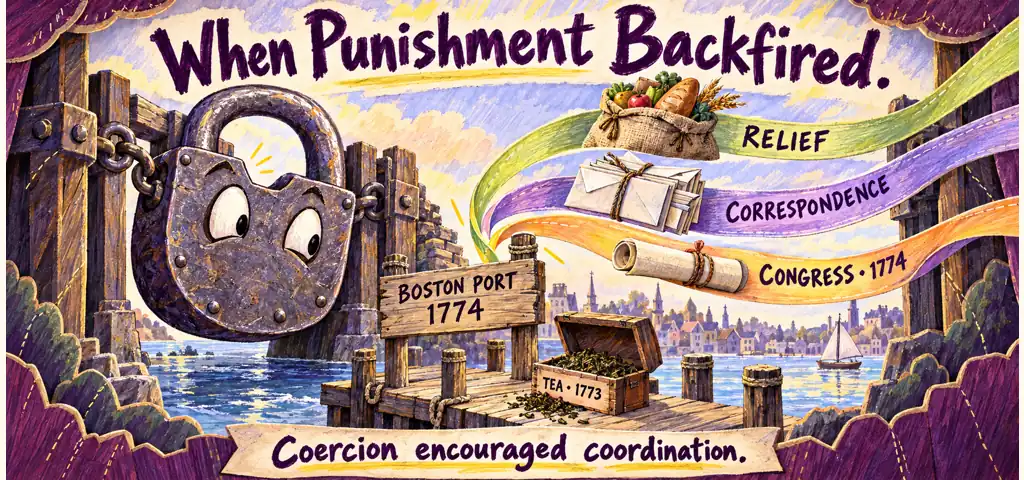
Lesson 5.5 of Chapter 5 of the U.S. History to 1877 study guide on Effortless Math covers CLEP U.S. History I 026: Tea, Coercion, and Intercolonial Resistance: the key terms, the core ideas, and worked examples showing how this topic is tested on the exam.
U.S. History to 1877 | Chapter 5 | Lesson 5.5
After several quieter years, Parliament’s Tea Act of 1773 allowed the struggling East India Company to sell tea through selected colonial agents. The measure could lower the price of legal tea, but it preserved the parliamentary duty and threatened established merchants. Patriots feared that buying cheap tea would concede Parliament’s right to tax them.
In several ports, pressure forced ships or agents to withdraw. In Boston, Governor Thomas Hutchinson insisted that ships follow the law. On December 16, protesters disguised in ways meant to evoke Native identity boarded vessels and dumped tea into the harbor. The Boston Tea Party was disciplined property destruction, not an attack on crew, but it deliberately challenged imperial authority.
Parliament answered with the Coercive Acts of 1774, called the Intolerable Acts by colonists. They closed Boston’s port until compensation, altered Massachusetts government, expanded provisions for quartering troops, and allowed some royal officials accused of crimes to be tried elsewhere. A related Quebec Act was not punishment for Boston, but colonists grouped it with the measures because it extended Quebec and protected Catholic practice.
Instead of isolating Massachusetts, coercion encouraged solidarity. Colonies sent relief to Boston, revived committees of correspondence, and met in the First Continental Congress. The Congress endorsed rights, organized a Continental Association to enforce boycotts, and petitioned the king. Delegates still disagreed about objectives. Many sought constitutional repair, not independence. Local committees, however, increasingly assumed governing power. By trying to restore authority, Parliament accelerated intercolonial organization.
See the history take shape
Use this lesson from Mr. Carrillo to review the period and its central historical problem. Pause when the video reaches the turning point named above.
Video: The Boston Tea Party, Intolerable Acts & First Continental Congress, Mr. Carrillo.
Check your understanding
- Patriots opposed the Tea Act even though tea could be cheaper because purchase might
- confirm that colonial merchants possessed an exclusive right to distribute Company tea
- remove the East India Company from the regulated imperial market
- establish direct colonial representation in Parliament through licensed tea agents
- confirm that Parliament had repealed the remaining duty on imported tea
- concede Parliament’s authority to tax the colonies by paying the retained duty
- The First Continental Congress initially sought mainly to
- declare independence and draft a permanent national constitution
- establish an executive capable of commanding colonial armies
- coordinate intercolonial resistance, petition, and defense of claimed rights
- secure a military alliance with France against Britain
- assume authority to appoint and remove royal governors
- Select all that apply. Coercive Acts measures included
- closing Boston’s port
- altering Massachusetts government
- repealing all tea duties
- quartering provisions
- changing trial provisions
- Explain why intercolonial resistance after 1774 did not yet equal unanimous support for independence.
Write a brief response using a named fact from the lesson.
Open the answers and reasoning
Independent preparation. CLEP is a registered trademark of the College Board, which does not endorse this lesson.

Related to This Article
More math articles
- Free Grade 5 English Worksheets for North Dakota Students
- Free Grade 4 English Worksheets for Massachusetts Students
- Empirical and Molecular Formulas: Turning Composition into Atom Ratios
- Top 10 SIFT Math Practice Questions
- How to Solve Mixture Word Problems: Step-by-Step Guide for 2026
- Cultural Lag, Modernization, and Globalization
- Cabinet departments
- Algebra Puzzle – Challenge 36
- How to Discovering Patterns: Using Graphs to Find Rules
- Grade 3 Math: Division Facts

















What people say about "Tea, Coercion and Intercolonial Resistance"?
No one replied yet.