CLEP U.S. History I 033: State Constitutions and Republican Experiments
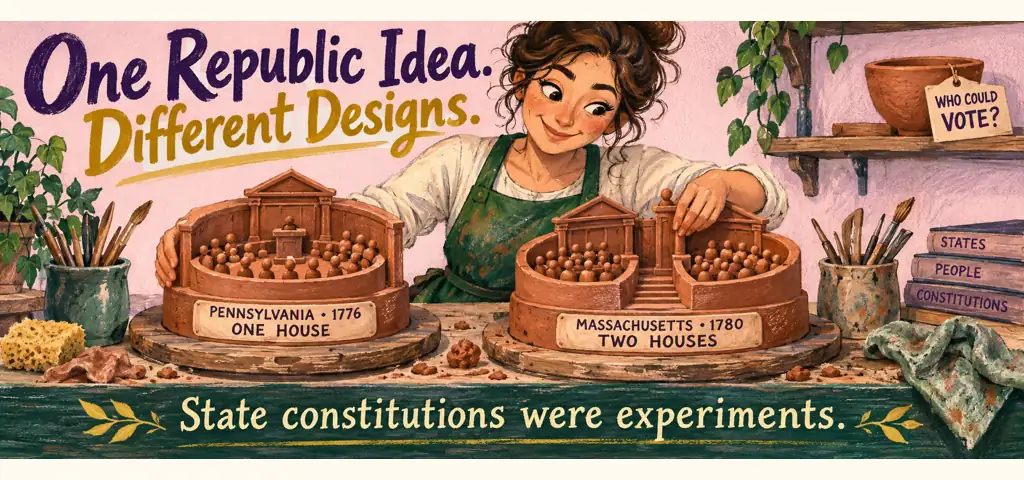
Lesson 7.1 of Chapter 7 of the U.S. History to 1877 study guide on Effortless Math covers CLEP U.S. History I 033: State Constitutions and Republican Experiments: the key terms, the core ideas, and worked examples showing how this topic is tested on the exam.
U.S. History to 1877 | Chapter 7 | Lesson 7.1
Before Americans framed a national constitution, states wrote republican governments. Most separated legislative, executive, and judicial functions, but they distributed power differently. Fear of governors led many states to create strong legislatures and weak executives. Pennsylvania’s 1776 constitution used a unicameral legislature and a plural executive council, widened white male suffrage beyond property ownership to taxpayers, and required frequent elections. Massachusetts’s 1780 constitution created a stronger governor, bicameral legislature, and independent judiciary.
Written constitutions treated government as a deliberate creation authorized by the people rather than an accumulation of inherited custom. Massachusetts voters elected a special convention to draft its constitution, helping establish the principle that fundamental law should come from a body distinct from an ordinary legislature. Declarations of rights protected principles such as jury trial, press freedom, and religious conscience in varying forms.
Participation remained bounded. Some states relaxed property requirements for white men. Others retained them. New Jersey’s constitution initially allowed property-qualified “inhabitants,” enabling some women and free Black people to vote before lawmakers restricted voting to white men in 1807. Slavery survived, though northern petitions, court cases, and gradual abolition laws began dismantling it. State constitutions therefore opened political experimentation while defining citizenship unequally.
Legislative power raised new concerns. Debtor majorities could press for paper money or relief. Elected bodies could violate rights as well as protect them. By the mid-1780s, some reformers feared “legislative tyranny” more than executive tyranny. The national Constitution’s checks and balances emerged partly from this state-level experience.
A focused video lesson
Watch this account from TheApexamreview with one question in mind: which evidence makes the lesson's strongest claim hold up?
Video: APUSH: Chapter 6: The Republican Experiment Pt 1/2, TheApexamreview.
Check your understanding
- Early state constitutions generally reflected greatest suspicion of
- juries exercising local authority
- elected legislatures as such
- concentrated executive power
- written limits on government
- frequent elections
- A special constitutional convention reinforced the idea that
- fundamental law came from the people
- ordinary legislative majorities could alter fundamental law at will
- executive officers inherited constitution-making power
- Parliament supplied the source of state constitutions
- judges could write constitutions without popular authorization
- Select all that apply. State experiments included
- unicameral and bicameral legislatures
- varying suffrage rules
- declarations of rights
- different executive strength
- universal adult citizenship
- Compare Pennsylvania and Massachusetts as two different answers to the same republican problem.
Write a brief response using a named fact from the lesson.
Open the answers and reasoning
Independent preparation. CLEP is a registered trademark of the College Board, which does not endorse this lesson.

Related to This Article
More math articles
- Illinois Grade 2 Math Worksheets — Free Printable PDFs
- Accuplacer Math Worksheets: FREE & Printable
- The Best Grade 3 Math Book for Arizona Students
- The Digital Revolution, Education, and the Changing Workplace
- The Best Grade 3 Math Book for Washington Students
- Deciphering Change: Differential Equations in Daily Life
- Top 10 Tips to Overcome PSAT Math Anxiety
- CHSPE Math Formulas
- Sex, Gender, and Aging
- The Best Grade 8 ELA Practice Tests for West Virginia Students



What people say about "State Constitutions and Republican Experiments"?
No one replied yet.