YOUR HSPT STUDY COMPANION
What Kind of Math Is on the HSPT Test?
The HSPT (The High School Placement Test), also known as the STS-HSPT, is an admissions test designed to determine students’ ability to get admission to a parochial high school. This test is formulated by the Scholastic Testing Service (STS). Participating in…
The HSPT (The High School Placement Test), also known as the STS-HSPT, is an admissions test designed to determine students’ ability to get admission to a parochial high school. This test is formulated by the Scholastic Testing Service (STS). Participating in this test can be very important for people who are looking for admission to many private schools.
Quick answer: The HSPT tests math in two sections. Quantitative Skills (52 questions) covers number series, geometric comparison, non-geometric comparison and number manipulation. Mathematics (64 questions in 45 minutes) covers arithmetic, fractions, decimals and percents, basic algebra, geometry, measurement and word problems. It is mostly middle school math, so steady review and timed practice go a long way.
The HSPT test consists of five multiple-choice sections:
Verbal skills, quantitative skills, reading, mathematics, and language.
In the HSPT test, quantitative skills and mathematics are different parts. In the quantitative skills section, test takers must answer 52 questions, including Number Series, Geometric Comparison, Non-Geometric Comparison, and Number Manipulation. In the mathematics section, students’ mathematical knowledge is assessed. The math section of the test includes arithmetic, geometry, algebra, and word problems.
Quantitative skills
Number Series
In this section, identifying a pattern is very important for solving sequence problems. You should be able to determine the relationship between letters, numbers, and symbols in a specific sequence. You are actually given a set of numbers, and you should be able to find a number that has a significant relationship with the sequence.
Geometric Comparison
To answer the questions in this section, you must use your geometry skills, compare geometric shapes and shaded areas, and find the best answer.
Non-Geometric Comparison
The questions in this section involve comparing and solving multi-step equations that do not include geometry. In this section, you should read and understand the question well and then answer the questions using your math skills.
Number Manipulation
In this area, you have to use different mathematical steps to be able to solve given problems by manipulating numbers and solutions.
Mathematics
Arithmetic
This section focuses on concepts such as Addition, Subtraction, Decimals, Multiplication, Division, Fractions, Order of Operations, and Percentages. Understanding the basic concepts in this section is essential. The purpose of including such questions in this section is to measure your ability to perform calculations in these areas.
Geometry
The math section of the HSPT exam does not go into the geometry section in-depth, and you will rarely encounter complex and advanced geometry questions. The geometry section tests your knowledge of topics such as Angles, Graphing, Plane Figures, and Volume of Solid Figures.
Algebra
As it turns out, in this section, you are more faced with algebraic equations and how to solve problems. In algebra, you should assign variables to unknowns instead of spaces or question marks, and use algebraic rules to solve algebraic expressions.
Word problems
In the math section of the HSPT test, you may also encounter more basic math concepts such as Word Problems: Distance, Rate, Time. Therefore, mastering these mathematical concepts is a necessity for success in this part of the HSPT Math test.
| math sections | topics | Number of questions | |
| #1 | Number Series | The ability to determine the relationship between numbers, letters, and/or symbols in a sequence. | 18 |
| #2 | Geometric Comparison | Compare geometric shapes and shaded areas | 9 |
| #3 | Non-Geometric Comparison | comparing and solving multi-step equations | 8 |
| #4 | Number Manipulation | Using different mathematical steps to solve given problems | 17 |
| #5 | arithmetic | Simplifying Fractions, Adding and Subtracting Fractions, Multiplying and Dividing Fractions, Adding Mixed Numbers, Subtracting Mixed Numbers, Multiplying and Dividing Mixed Numbers, Dividing Mixed Numbers, Adding and Subtracting Decimals, Multiplying and Dividing Decimals, Comparing Decimals, Rounding Decimals, Factoring Numbers, Greatest Common Factor, Least Common Multiple, Adding and Subtracting Integers, Multiplying and Dividing Integers, Order of Operations, Ordering Integers and Numbers, Integers and Absolute Value, Simplifying Ratios, Proportional Ratios, Similarity and Ratios, Percentage Calculations, Percent Problems, Discount, Tax and Tip, Percent of Increase and Decrease Simple Interest | 14-16 |
| #6 | geometry | Pythagorean Theorem, Triangles, Polygons, Trapezoids, Circles, Cubes, Rectangular Prism, Cylinder | 10-12 |
| #7 | algebra | Simplifying Variable Expressions, Simplifying Polynomial Expressions, Translate Phrases into an Algebraic Statement, The Distributive Property, Evaluating One Variable Expression, Evaluating Two Variables Expressions, Combining like Terms, Multiplication Property of Exponents, Division Property of Exponents, Zero and Negative Exponents, Powers of Products and Quotients, Negative, Exponents and Negative Bases, Scientific Notation, Radicals, Polynomials, Function Notation, and calculation, Adding and Subtracting Functions, Multiplying and Dividing Functions, Composition of Functions | 16-20 |
| #8 | word problems | Word problems are related to rate, time, distance, and work problems (two or more workers performing at different rates). | 22-24 |
Best HSPT Math Prep Resource for 2026
Complete List of HSPT Math Topics
Fractions and Decimals
- Simplifying Fractions
- Adding and Subtracting Fractions
- Multiplying and Dividing Fractions
- Adding Mixed Numbers
- Subtracting Mixed Numbers
- Multiplying Mixed Numbers
- Dividing Mixed Numbers
- Adding and Subtracting Decimals
- Multiplying and Dividing Decimals
- Comparing Decimals
- Rounding Decimals
- Factoring Numbers
- Greatest Common Factor
- Least Common Multiple
Real Numbers and Integers
- Adding and Subtracting Integers
- Multiplying and Dividing Integers
- Order of Operations
- Ordering Integers and Numbers
- Integers and Absolute Value
Proportions, Ratios, and Percentages
- Simplifying Ratios
- Proportional Ratios
- Similarity and Ratios
- Percentage Calculations
- Percent Problems
- Discount, Tax and Tip
- Percent of Increase and Decrease
- Simple Interest
Algebraic Expressions
- Simplifying Variable Expressions
- Simplifying Polynomial Expressions
- Translate Phrases into an Algebraic Statement
- The Distributive Property
- Evaluating One Variable Expressions
- Evaluating Two Variables Expressions
- Combining like Terms
Equations and Inequalities
- One-Step Equations
- Multi-Step Equations
- Graphing Single, Variable Inequalities
- One-Step Inequalities
- Multi-Step Inequalities
- Systems of Equations
Linear Functions
- Finding Slope
- Graphing Lines Using Standard Form
- Graphing Lines Using Slope-Intercept Form
- Writing Linear Equations
- Graphing Linear Inequalities
- Finding Midpoint
- Finding Distance of Two Points
Exponents and Radicals
- Multiplication Property of Exponents
- Division Property of Exponents
- Zero and Negative Exponents
- Powers of Products and Quotients
- Negative Exponents and Negative Bases
- Scientific Notation
- Radicals
Polynomials
- Writing Polynomials in Standard Form
- Simplifying Polynomials
- Adding and Subtracting Polynomials
- Multiplying Monomials
- Multiplying and Dividing Monomials
- Multiplying a Polynomial and a Monomial
- Multiplying Binomials
- Factoring Trinomials
- Operations with Polynomials
Geometry and Solid Figures
Statistics and Probability
- Mean, Median, Mode, and Range
- Histograms
- Pie Graph
- Probability Problems
- Combinations and Permutations
Functions
- Function Notation
- Adding and Subtracting Functions
- Multiplying and Dividing Functions
- Composition of Functions
FAQs:
Is the HSPT Math test hard?
The HSPT test is one of the easiest tests. However, it can be very challenging if you are not prepared enough for the test.
How do I study for the HSPT Math?
How you prepare for the HSPT Math test is very important. You can use good prep books to prepare well for the HSPT Math test. You can also use online practice tests for further practice after studying the HSPT exam courses.
Can I bring a calculator to the HSPT test?
Some schools allow students to use basic calculators when taking the HSPT test.
How is the HSPT Test Scored?
The HSPT scores are reported in percentiles. The 76th to 99th percentiles are considered high. 24th to 75th percentiles are average, and 1st to 23rd percentiles are low. For more information, you can check here.
The Only Resource Your student Will Ever Need to ace the HSPT Math Test
More from Effortless Math for HSPT Test …
Do you need sample practice questions to assess your math skills for the HSPT test?
Look no further! Here’s what you want: HSPT Math FREE Sample Practice Questions
Do you not know how to reduce the stress of the HSPT math test and pass the test well?
Get rid of test stress with just a few tips: Top 10 Tips to Overcome HSPT Math Anxiety
Having trouble memorizing HSPT math test formulas?
This is a problem for many test-takers. It is best to always have a list of HSPT Math Formulas with you to better memorize them.
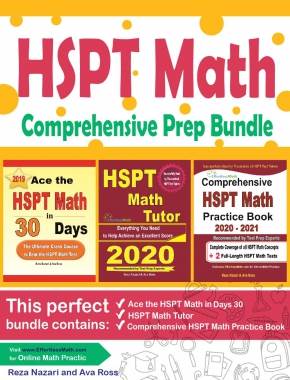
The Best Books to Ace the HSPT Test
Do you have any questions about the HSPT Test?
Write your questions about the HSPT or any other topics below, and we’ll reply!
Need more HSPT Math practice?
Use the free HSPT Math Worksheet Creator to make a fresh one-skill worksheet with answers and step-by-step explanations. It is a good next step after a lesson, a formula review, or a missed practice-test question.
Open the worksheet creatorOpen full page
For a complete study path: pair this printable practice with HSPT Math for Beginners and HSPT Math Preparation Bundle.
Examples of Each Quantitative Skills Question Type
These question types look different from regular math class, so seeing one of each helps.
- Number series: find the next number. In 3, 6, 12, 24, … each number doubles, so the next is 48.
- Geometric comparison: you compare shaded parts of shapes or lengths in a figure. If one square has half of it shaded and another has two of its four equal parts shaded, the shaded amounts are equal.
- Non-geometric comparison: compare values such as (a) 20% of 50, (b) 50% of 20, (c) ¼ of 40. Each one equals 10, so all three are equal.
- Number manipulation: a short calculation in words. What number is 6 more than half of 30? Half of 30 is 15, and 15 + 6 = 21.
Tip: for number series, write the change between each pair of numbers above the list. The pattern is usually adding, subtracting, multiplying or an alternating mix.
How the HSPT Quantitative and Math Sections Work
| Section | Questions | Main topics |
|---|---|---|
| Quantitative Skills | 52 | Number series, geometric and non-geometric comparison, number manipulation |
| Mathematics | 64 (45 minutes) | Arithmetic, fractions and decimals, percents, ratios, basic algebra, geometry, measurement, word problems |
Frequently Asked Questions
Does the HSPT cover harder math than the SAT?
In most cases, no. Eighth graders take the HSPT to apply to Catholic and private high schools, so the math stays with middle school topics such as fractions, percents, basic algebra and geometry. The SAT goes into high school math, with more advanced algebra and some trigonometry. On the HSPT, the hard part is the pace, because there are many questions to answer quickly.
How many questions are in the HSPT Quantitative Skills and Mathematics sections?
Together the two sections hold 116 math-related questions: 52 in Quantitative Skills and 64 in Mathematics. The Mathematics section is limited to 45 minutes, or about 42 seconds per question. Timed practice matters here, so try a few sets with a clock running.
What is the difference between Quantitative Skills and Mathematics on the HSPT?
Quantitative Skills tests reasoning with numbers: finding patterns in a series, comparing amounts and doing quick mental calculations. Mathematics tests what you learned in class, like computing with fractions, solving equations, finding area and working through word problems. Both reward strong arithmetic.
What HSPT math topics should I study first?
Start with fractions, decimals and percents, since they appear in both math sections and in word problems. Then review ratios, basic equations and the area and perimeter of common shapes. Finish with practice on number series and comparison questions, which most students have not seen before.

Related to This Article
More math articles
- Understanding Fractions for 4th Grade
- Subtraction of Four-Digit Numbers
- The Best Grade 3 ELA Practice Tests for New Jersey Students
- The Best Algebra 1 Book for Delaware Students
- Joining organizations
- What Skills Do I Need for the TASC Math Test?
- Surface Area and Volume Formulas: Complete Reference for 2026
- Television, Advertising, Consumerism and Mass Culture
- Factoring Trinomials Worksheet with Answers
- Chapter 6: Federalism



What people say about "HSPT Math Topics: Quantitative and Mathematics Sections"?
No one replied yet.