YOUR ALEKS STUDY COMPANION
ALEKS Math Formulas: Study Reference and Examples
Use this ALEKS formula reference for study before your assessment. Review arithmetic, algebra and geometry, then choose advanced topics to match your placement goal.

ALEKS Formula Study Reference
Use this ALEKS formula reference for study before your assessment. Review arithmetic, algebra and geometry first; choose advanced topics to match your placement goal and school guidance.
How to use this page: review one formula group at a time, then practice that exact skill before moving on.
Use this reference during preparation, not during an assessment unless your institution explicitly permits it. Practice applying each formula and explaining the variables.
On this page: Number rules · Functions · Lines · Geometry · Exponents · Counting · Practice resources
ALEKS Math Formula List
Comparing Numbers Signs
Equal to \(=\)
Less than \( <\)
Greater than \(>\)
Greater than or equal \(≥\)
Less than or equal \(≤\)
Rounding
Putting a number up or down to the nearest whole number or the nearest hundred, etc.
Example: 64 rounded to the nearest ten is 60 because 64 is closer to 60 than to 70.
Whole Number
The numbers \( \{0,1,2,3,…\} \)
Estimates
Find a number close to the exact answer.
Decimals
A decimal represents a number using place values in powers of ten. For example, \(0.5=\frac{1}{2}\).
Mixed Numbers
A number is composed of a whole number and a fraction. Example: \(2 \frac{2}{ 3}\) Converting between improper fractions and mixed numbers: \(a \frac{c}{b}=a+\frac{c}{b}= \frac{ab+ c}{b}\)
Factoring Numbers
Factor a number means breaking it up into numbers that can be multiplied together to get the original number. Example:\(12=2×2×3\)
Divisibility Rules
Divisibility means that you are able to divide a number evenly. Example: 24 is divisible by 6, because \(24÷6=4\)
Greatest Common Factor
Multiply common prime factors
Example:\( 200=2×2×2×5×5 60=2×2×3×5\)
GCF \((200,60)=2×2×5=20\)
Least Common Multiple
Check multiples of the largest number
Example: LCM (200, 60): 200 (no), 400 (no), 600 (yes!)
Integers
\( \{…,-3,-2,-1,0,1,2,3,…\} \)
Includes: zero, counting numbers, and the negative of the counting numbers
Real Numbers
All numbers that are on a number line. Integers plus fractions, decimals, and irrationals, etc.) (\(\sqrt{2},\sqrt{3},π\), etc.)
Order of Operations
PEMDAS: Evaluate parentheses and other grouping first, then exponents. Multiply and divide from left to right; then add and subtract from left to right. Multiplication does not always come before division.
Absolute Value
Absolute value is distance from zero, so it is nonnegative: \(|-22|=22\) and \(|0|=0\). For \(n>0\), \(|x|
Ratios
A ratio is a comparison of two numbers by division.
Example: \(3 : 5\), or \(\frac{3}{5}\)
Percentages
Use the following formula to find part, whole, or percent
part \(=\frac{percent}{100}×whole\)
Proportional Ratios
A proportion means that two ratios are equal. It can be written in two ways:
\(\frac{a}{b}=\frac{c}{d}\), \(a: b = c: d \)
Percent of Change
For a nonzero positive original value, percent change is \(\frac{\text{new}-\text{original}}{\text{original}}\times100\%\). A negative result indicates a decrease; use its magnitude to report the percent decrease.
Markup
Markup \(=\) selling price \(-\) cost
Markup rate \(=\) markup divided by the cost
Discount
Multiply the regular price by the rate of discount
Selling price \(=\) original price \(-\) discount
Expressions and Variables
A variable is a symbol representing a number. Examples: \(2+a\) adds 2 and \(a\); \(y-3\) subtracts 3 from \(y\); \(4/x\) divides 4 by a nonzero \(x\); \(5a\) multiplies 5 by \(a\).
Tax
To find tax, multiply the tax rate by the taxable amount (income, property value, etc.)
Distributive Property
\(a(b+c)=ab+ac\)
Polynomial
A polynomial has nonnegative integer powers of its variable. For example, \(P(x)=a_nx^n+a_{n-1}x^{n-1}+\cdots+a_1x+a_0\), where the coefficients are constants and \(a_n\ne0\).
Systems of Equations
Two or more equations working together.
example: \( \begin{cases}-2x+2y=4\\-2x+y=3\end{cases} \)
Equations
The values of the two mathematical expressions are equal.
\(ax+b=c\)
Functions
A function assigns exactly one output to each input in its domain. Direct variation has the form \(y=kx\); inverse variation has the form \(y=k/x\), with \(x\ne0\). The graph of \(y=f(x-h)+k\) shifts \(f(x)\) right by \(h\) and up by \(k\). Thus \(f(x)+3\) shifts up 3, while \(f(x+3)\) shifts left 3.
Inequalities
Says that two values are not equal
\(a≠b\) a not equal to b
\(a<b\) a less than b
\(a>b\) a greater than b
\(a≥b\) a greater than or equal b
\(a≤b\) a less than or equal b
Solving Systems of Equations by Elimination
Add the equations \(x+2y=6\) and \(-x+y=3\) to eliminate \(x\): \(3y=9\), so \(y=3\). Substitute into the first equation: \(x+6=6\), giving \(x=0\). The solution is \((0,3)\).
Lines (Linear Functions)
Consider the line that goes through points \(A(x_{1},y_{1}) \) and \(B(x_{2},y_{2})\).
Distance from A to B:
\(\sqrt{(x_{1}-x_{2})^2+(y_{1}-y_{2})^2 }\)
Parallel and Perpendicular lines:
Distinct parallel nonvertical lines have equal slopes. Perpendicular nonvertical lines have slopes satisfying \(m_1m_2=-1\). Vertical lines are parallel to one another and perpendicular to horizontal lines; a vertical line has undefined slope.
Mid-point of the segment AB:
M (\(\frac{x_{1}+x_{2}}{2} , \frac{y_{1}+y_{2}}{2}\))
Slope of the line:
For two points with \(x_2\ne x_1\), slope is \(m=\frac{y_2-y_1}{x_2-x_1}=\frac{\text{rise}}{\text{run}}\). If \(x_2=x_1\) and the points are distinct, the line is vertical and its slope is undefined.
Point-slope form:
Given the slope m and a point \((x_{1},y_{1})\) on the line, the equation of the line is
\((y-y_{1})=m \ (x-x_{1})\).
Intersecting lines:
Opposite angles are equal. Also, each pair of angles along the same line add to \(180^\circ\). In the figure above, \(a+b=180^\circ\).
Slope-intercept form:
given the slope m and the y-intercept b, then the equation of the line is:
\(y=mx+b\).
Transversal: Parallel lines:
Eight angles are formed when a line crosses two parallel lines. The four big angles (a) are equal, and the four small angles (b) are equal.
Parabolas:
For \(y=ax^2+bx+c\) with \(a\ne0\), the parabola opens up if \(a>0\) and down if \(a<0\). Its y-intercept is \(c\), and the vertex has x-coordinate \(-b/(2a)\).
Factoring:
“FOIL”
\((x+a)(x+b)\)
\(=x^2+(b+a)x +ab\) “Difference of Squares”
\(a^2-b^2= (a+b)(a-b)\)
\(a^2+2ab+b^2=(a+b)(a+b) \)
\(a^2-2ab+b^2=(a-b)(a-b)\) “Reverse FOIL”
\(x^2+(b+a)x+ab=\) \((x+a)(x+b)\)
You can use Reverse FOIL to factor a polynomial by thinking about two numbers a and b which add to the number in front of the x, and which multiply to give the constant. For example, to factor \(x^2+5x+6\), the numbers add to 5 and multiply to 6, i.e.: \(a=2\) and \(b=3\), so that \(x^2+5x+6=(x+2)(x+3)\). To solve a quadratic such as \(x^2+bx+c=0\), first factor the left side to get \((x+a)(x+b)=0\), then set each part in parentheses equal to zero. For example, \(x^2+4x+3= (x+3)(x+1)=0\) so that \(x=-3\) or \(x=-1\).
To solve two linear equations in x and y: use the first equation to substitute for a variable in the second. E.g., suppose \(x+y=3\) and \(4x-y=2\). The first equation gives y=3-x, so the second equation becomes \(4x-(3-x)=2 ⇒ 5x-3=2\) \(⇒ x=1,y=2\).
Exponents:
Refers to the number of times a number is multiplied by itself.
\(8 = 2 × 2 × 2 = 2^3\)
Scientific Notation:
Scientific notation is \(m\times10^n\), where \(1\le |m|<10\) and \(n\) is an integer. Examples: \(5=5\times10^0\), \(-25{,}000=-2.5\times10^4\), \(0.5=5\times10^{-1}\), and \(2122.456=2.122456\times10^3\).
Square:
The square of a real number is that number multiplied by itself. Examples: \(2^2=4\) and \((1/2)^2=1/4\).
Square Roots:
A square root of \(x\) is a number r whose square is \(x : r^2=x\)
\(r\) is a square root of \(x\)
Pythagorean Theorem:
\(a^2+b^2=c^2\)

Triangles
Area: \(A=\frac{1}{2}bh\) where \(b\) is the base and \(h\) is the height.
Perimeter: \(P=a+b+c\) (sum of all three sides).
Pythagorean Theorem (right triangles): \(a^2+b^2=c^2\) where \(c\) is the hypotenuse.
Sum of interior angles: \(180°\)
Right triangles:
A good example of a right triangle is one with a=3, b=4, and c=5, also called a \( 3-4-5\) right triangle. Note that multiples of these numbers are also right triangles. For example, if you multiply these numbers by 2, you get a=6, b=8 and
\(c=10(6-8-10)\), which is also a right triangle.
All triangles:
Area \(=\frac{1}{2}\) b. H
Angles on the inside of any triangle add up to \(180^\circ\).
The length of one side of any triangle is always less than the sum and more than the difference between the lengths of the other two sides.
An exterior angle of any triangle is equal to the sum of the two remote interior angles. Other important triangles:
Equilateral:
These triangles have three equal sides, and all three angles are \(60^\circ\).
Isosceles:
An isosceles triangle has two equal sides. The “base” angles (the ones opposite the two sides) are equal (see the \(45^\circ\) triangle above).
Similar:
Similar triangles have equal corresponding angles and proportional corresponding sides. A 3-4-5 triangle and a 6-8-10 triangle are similar with corresponding side ratio \(1:2\).
Circles
Area \(=πr^2\)
Circumference \(=2πr\)
Full circle \(=360^\circ\)
Length Of Arc \(=(n^\circ/360^\circ).2πr\)
Area Of Sector \(=(n^\circ/360^\circ) .πr^2\)
Equation of the circle (above left figure): \((x-h)^2+(y-k)^2=r^2\).
Rectangles
A rectangle has area \(A=lw\) and perimeter \(P=2(l+w)\). It is a square when \(l=w\).
Parallelogram
A parallelogram has area \(A=bh\), where \(h\) is the perpendicular height, not a sloping side. A rhombus is a parallelogram with all four sides equal. For any simple convex n-sided polygon, the interior-angle sum is \((n-2)180^\circ\). A regular polygon also has all sides and angles equal.
Area of a parallelogram:
\(A = bh\)
Area of a trapezoid:
\(A =\frac{1}{2} h (b_{1}+b_{2})\)
Surface Area and Volume of a Rectangular/right prism:
For a right prism, \(SA=ph+2B\) and \(V=Bh\), where \(B\) is base area, \(p\) is base perimeter and \(h\) is perpendicular height.
Surface Area and Volume of a Cylinder:
\(SA =2πrh+2πr^2\)
\(V =πr^2 h \)
Surface Area and Volume of a Pyramid
For a regular pyramid, \(SA=\frac12p\ell+B\) and \(V=\frac13Bh\), where \(p\) is base perimeter, \(B\) is base area, \(\ell\) is slant height and \(h\) is perpendicular height.
Surface Area and Volume of a Cone
For a right circular cone, \(SA=\pi r\ell+\pi r^2\) and \(V=\frac13\pi r^2h\), with radius \(r\), slant height \(\ell\) and perpendicular height \(h\).
Surface Area and Volume of a Sphere
For a sphere of radius \(r\), \(SA=4\pi r^2\) and \(V=\frac43\pi r^3\).
Solids
Rectangular Solid
Volume =lwh
Area =2(lw+wh+lh)
Right Cylinder
Volume \(=πr^2 \ h\)
Area \(=2πr(r+h)\)
Quadratic formula:
For \(ax^2+bx+c=0\), with \(a\ne0\), the quadratic formula is \(x=\frac{-b\pm\sqrt{b^2-4ac}}{2a}\).
Simple interest:
\(I=prt\)
(I = interest, p = principal, r = rate, t = time)
mean:
The mean is \(\bar{x}=\frac{\text{sum of data values}}{\text{number of data values}}\), for a nonempty data set.
mode:
value in the list that appears most often
range:
largest value \(-\) smallest value
Median
The middle value in the list (which must be sorted)
Example: median of
\( \{3,10,9,27,50\} = 10\)
Example: median of
\( \{3,9,10,27\}=\frac{(9+10)}{2}=9.5 \)
Sum
average \(×\) (number of terms)
Average
\( \frac{sum \ of \ terms}{number \ of \ terms}\)
Average speed
\(\frac{total \ distance}{total \ time}\)
Probability
For equally likely outcomes, \(P(A)=\frac{\text{number of outcomes in }A}{\text{total number of outcomes}}\). For independent events, \(P(A\cap B)=P(A)P(B)\). Independence differs from mutual exclusivity: mutually exclusive events cannot occur together.
Powers, Exponents, Roots
For positive real bases, exponent laws include \(x^ax^b=x^{a+b}\), \(x^a/x^b=x^{a-b}\), \((x^a)^b=x^{ab}\), and \(x^{-b}=1/x^b\). Also \(x^0=1\) for \(x\ne0\). For real square roots, \(\sqrt{xy}=\sqrt{x}\sqrt{y}\) when \(x,y\ge0\). For integer \(n\), \((-1)^n\) is -1 when \(n\) is odd and 1 when it is even. If \(0
Interest
Simple Interest: \(I=Prt\)
where \(P\) = principal, \(r\) = annual interest rate (as a decimal), \(t\) = time in years.
Total amount: \(A=P+I=P(1+rt)\)
Compound Interest: \(A=P(1+\frac{r}{n})^{nt}\) where \(n\) is the number of times interest is compounded per year.
Simple Interest
The charge for borrowing money or the return for lending it.
Interest = principal \(×\) rate \(×\) time
OR
\(I=prt\)
Compound Interest
For annual compounding, \(A=P(1+r)^t\), where \(r\) is the annual rate as a decimal and \(t\) is the number of years. For \(n\) equal compounding periods per year, \(A=P(1+r/n)^{nt}\). These models assume a constant rate and no additional deposits or withdrawals.
Powers/ Exponents
For positive real bases, \(x^ax^b=x^{a+b}\), \(x^a/x^b=x^{a-b}\), \((x^a)^b=x^{ab}\), and \(x^{-a}=1/x^a\). The rule \(x^0=1\) requires \(x\ne0\). For a positive integer \(n\), \(x^{1/n}=\sqrt[n]{x}\); in the real numbers, an even root requires \(x\ge0\).
Positive Exponents
An exponent is simply shorthand for multiplying that number of identical factors. So \(4^3\) is the same as (4)(4)(4), three identical factors of 4. And \(x^3\) is just three factors of x, \((x)(x)(x)\).
Negative Exponents
A negative exponent means to divide by that number of factors instead of multiplying.
So \(4^{-3}\) is the same as \( \frac{1}{4^3}\) and
\(x^{-3}=\frac{1}{x^3}\)
Factorials
For a positive integer \(n\), \(n!=n(n-1)\cdots2\cdot1\); by definition, \(0!=1\). Examples: \(8!=40{,}320\), \(5!=120\) and \(2!=2\).
Multiplying Two Powers of the SAME Base
When the bases are the same, you find the new power by just adding the exponents
\(x^a .x^b=x^{a+b }\)
Powers of Powers
For power of a power: you multiply the exponents.
\((x^a)^b=x^{(ab)}\)
Dividing Powers
\(\frac{x^a}{x^b} =x^a x^{-b}= x^{a-b}\)
The Zero Exponent
For \(x\ne0\), \(x^0=1\). This rule does not assign a value to \(0^0\).
Permutation:
For \(r\) ordered selections from \(n\) distinct objects without repetition, \(P(n,r)=\frac{n!}{(n-r)!}\), where \(0\le r\le n\). Example: choosing a captain and deputy from 5 people gives \(P(5,2)=5\times4=20\).
Combination:
When order does not matter and repetition is not allowed, \(C(n,r)=\frac{n!}{r!(n-r)!}\), where \(0\le r\le n\). Choosing an unordered pair from 5 people gives \(C(5,2)=10\), half the 20 ordered pairs.
Laws of Logarithm
For \(a>0\), \(a\ne1\) and positive \(M,N\): \(\log_aN=x\) means \(a^x=N\); \(\log_a1=0\) and \(\log_aa=1\). The product, quotient and power rules are \(\log_a(MN)=\log_aM+\log_aN\), \(\log_a(M/N)=\log_aM-\log_aN\), and \(\log_a(N^m)=m\log_aN\). Also \(a^{\log_ax}=x\) for \(x>0\), and \(\log_a(a^x)=x\).
The Six Trig Ratios
For an acute angle in a right triangle, \(\sin\theta=\text{opposite}/\text{hypotenuse}\), \(\cos\theta=\text{adjacent}/\text{hypotenuse}\), and \(\tan\theta=\text{opposite}/\text{adjacent}\). Their reciprocals are \(\csc\theta\), \(\sec\theta\) and \(\cot\theta\), respectively.
Trig Functions relationships:
Where the denominators are nonzero, \(\tan x=\sin x/\cos x\), \(\csc x=1/\sin x\), \(\sec x=1/\cos x\), and \(\cot x=\cos x/\sin x\).
Looking for additional ALEKS math preparation?
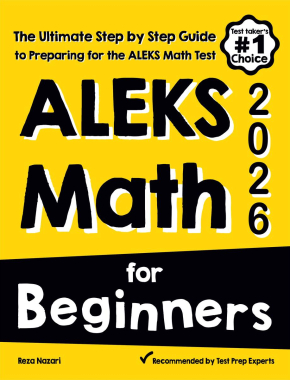
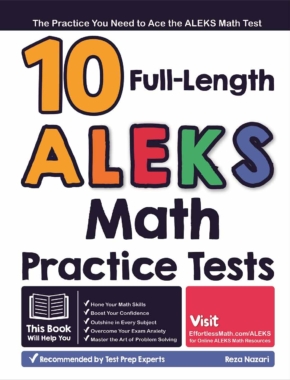
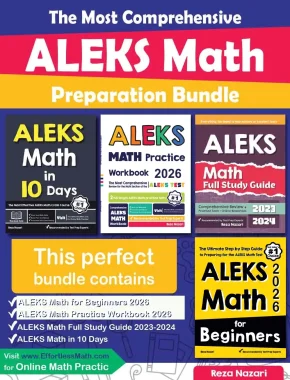
Compare the existing ALEKS study-book options below by your review needs and their public previews.
Recommended ALEKS Math Practice
More from Effortless Math for ALEKS Test …
Looking for additional ALEKS math preparation?
Try these 10 most common ALEKS Math questions to hone your mathematical skills.
If you want to know what is a good ALEKS score, read the following article: What is a Good ALEKS Score?
In This article, we talk about the tips that help you complete your ALEKS quickly: How to Get ALEKS Done Fast?
Have any questions about the ALEKS Test?
Use the linked ALEKS hub for further study resources and preparation guidance.
Recommended EffortlessMath Books
Compare ALEKS Math for Beginners (resource currently unavailable) and ALEKS Math Test Prep Bundle (resource currently unavailable). These two older shop links currently lead to unavailable pages. Use the current ALEKS Math for Beginners listing or the ALEKS hub’s study guides to compare current options and public previews. Check contents, format and fit before choosing.
Frequently Asked Questions
Does ALEKS give you a formula sheet?
Use this page as a study reference before assessment. During placement, follow your institution’s current rules about notes and other resources. Do not assume this page is an allowed test aid; on-screen tools and your school’s instructions determine what you may use.
What formulas should I memorize for ALEKS?
Begin with the formulas for skills you need to review: slope, linear equations, quadratic equations, geometry and exponent rules. Add logarithms and trigonometry if they match your intended course and preparation module. This page is a review collection, not a promise that every formula will appear.
What’s the quadratic formula?
For real coefficients and \(a\ne0\), \(x=\frac{-b\pm\sqrt{b^2-4ac}}{2a}\) solves \(ax^2+bx+c=0\). A positive discriminant gives two distinct real roots, zero gives one repeated real root, and a negative discriminant gives two nonreal complex roots.
What exponent rules do I need for ALEKS?
For positive real bases: \(x^ax^b=x^{a+b}\), \(x^a/x^b=x^{a-b}\), \((x^a)^b=x^{ab}\) and \(x^{-a}=1/x^a\). Also \(x^0=1\) for \(x\ne0\). For real even roots, the radicand must be nonnegative. Practice recognizing when a rule’s conditions apply.
What’s the formula for the area of a circle?
\(A=\pi r^2\), where \(r\) is the radius. For circumference, \(C=2\pi r\). Example: a circle with radius 5 has area \(\pi(5)^2=25\pi\approx 78.5\) square units and circumference \(2\pi(5)=10\pi\approx 31.4\) units.
What’s the distance formula?
\(d=\sqrt{(x_2-x_1)^2+(y_2-y_1)^2}\). It’s the Pythagorean theorem applied to two points in the coordinate plane. The midpoint of the same two points is \(\left(\frac{x_1+x_2}{2}, \frac{y_1+y_2}{2}\right)\).
What log properties do I need for ALEKS?
Use a common logarithm base in the product, quotient and power rules, with positive arguments. Change of base is \(\log_bx=\log_ax/\log_ab\), for \(x>0\), \(a,b>0\), and \(a,b\ne1\). Review these properties when your intended course or preparation module includes logarithms.
What trig formulas should I know?
For acute angles in right triangles: \(\sin\theta=\text{opp}/\text{hyp}\), \(\cos\theta=\text{adj}/\text{hyp}\), and \(\tan\theta=\text{opp}/\text{adj}\). The identity \(\sin^2\theta+\cos^2\theta=1\) holds for all real angles. Side ratios are \(1:\sqrt3:2\) for 30-60-90 triangles and \(1:1:\sqrt2\) for 45-45-90 triangles. Match further review to your course goal.
Is the ALEKS calculator available on every question?
ALEKS supplies an on-screen calculator for selected questions. Do not assume an external calculator or formula sheet is permitted; check your institution’s current assessment instructions.
How should I use these formulas for my ALEKS prep?
Choose one unfamiliar formula, explain each variable, and solve several examples without looking back at the reference. Then check your work. Use the personalized Prep and Learning Module available through your school to guide further review.
Related EffortlessMath Lessons
If a topic on this page feels rusty, these short lessons go deeper:
Sources and assessment instructions
See McGraw Hill’s ALEKS PPL overview for personalized preparation, and check your own school’s testing rules. Clark College’s assessment guidance illustrates restrictions on outside resources and calculator use. Mathematical references: OpenStax counting principles and function transformations.

Related to This Article
More math articles
- Plains Warfare, Reservations, and the Destruction of the Buffalo
- SAT Vs PSAT Tests
- Free Grade 5 Math Worksheet Library for Virginia (SOL): 49 Printable Skill Pages
- Free Grade 4 English Worksheets for SBAC Students
- Checks between branches
- The Best Grade 5 ELA Practice Tests for Washington Students
- How to Prepare for the TASC Math Test?
- The Best Grade 3 Math Book for Maryland Students
- Order of Operations Calculator (PEMDAS) with Steps
- 6 Best Pre-Algebra Study Guides










What people say about "ALEKS Math Formulas: Study Reference and Examples"?
No one replied yet.