Geometry Puzzle – Challenge 71
A box and its candy weigh 12 pounds together. After 2/3 of the candy is eaten, the box and remaining candy weigh 5 pounds. Set up two equations: B + C = 12 and B + (1/3)C = 5. Subtract: (2/3)C = 7, so C = 21/2 = 10.5. Then B = 12 - 10.5 = 1.5 pounds.
Key takeaways:
- Let B = weight of box, C = weight of candy.
- First condition: B + C = 12.
- After eating 2/3 of candy, remaining = (1/3)C. So B + (1/3)C = 5.
- Subtract the equations: C - (1/3)C = 7, so (2/3)C = 7, C = 10.5.
- B = 12 - 10.5 = 1.5 pounds.
This is a fun and engaging math puzzle to challenge even the smartest students and help them develop logic skills. For additional educational resources
Challenge:
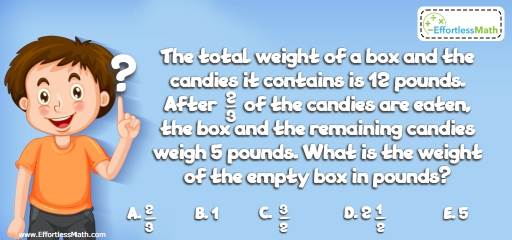
The total weight of a box and the candies it contains is 12 pounds. After \(\frac{2}{3}\) of the candies are eaten, the box and the remaining candies weigh 5 pounds. What is the weight of the empty box in pounds?
A- \(\frac{2}{3}\)
B- 1
C- \(\frac{3}{2}\)
D- \(2\frac{1}{2}\)
E- 5
The Absolute Best Book to challenge your Smart Student!

The correct answer is C.
Original price was: $27.99.$17.99Current price is: $17.99.
Let “B” be the weight of the box and “C” be the weight of the candies. So:
B + C = 12
After \(\frac{2}{3}\) of the candies are eaten, the box and the remaining candies weigh 5 pounds. So,
B + \(\frac{1}{3}\) C = 5
Solve the system of two equations:
B + C = 12 → B = 12, C
B + \(\frac{1}{3}\) C = 5 → 12, C + \(\frac{1}{3}\) C = 5 → 12, \(\frac{2}{3}\) C = 5 → C = 10.5
B = 12, C → B = 12 to 10.5 = 1.5
The weight of the box is 1.5 pounds.The Best Books to Ace Algebra
Frequently Asked Questions
How do I set up the system of equations?
Use B for the box weight and C for the candy weight. The two facts become B + C = 12 (original) and B + (1/3)C = 5 (after eating 2/3).
Why is the remaining candy (1/3)C?
After eating 2/3 of the candy, 1 – 2/3 = 1/3 of the candy remains. So the remaining candy weighs (1/3)C.
How do I solve the system?
Subtract the second equation from the first: (B + C) – (B + (1/3)C) = 12 – 5, so C – (1/3)C = 7, which gives (2/3)C = 7. Then C = 7 / (2/3) = 21/2 = 10.5.
How is the box weight calculated?
From B + C = 12 with C = 10.5: B = 12 – 10.5 = 1.5 pounds.
Why does subtracting the equations eliminate B?
Because both equations have B with coefficient 1. Subtracting cancels B and leaves an equation in just C.
Can I check the answer?
Yes. B + C = 1.5 + 10.5 = 12. B + (1/3)C = 1.5 + 3.5 = 5. Both check out.
What if 3/4 of the candy were eaten instead?
Remaining candy = (1/4)C. Equation: B + (1/4)C = 5. With B + C = 12, subtract: (3/4)C = 7, so C = 28/3 ≈ 9.33 lbs, B ≈ 2.67 lbs.
Why is this a useful kind of problem?
It introduces systems of two linear equations in a friendly context. Mixture problems, age problems, and rate problems all use the same structure.
What grade level?
Late middle school or early high school (Grades 7-9). The substitution and elimination methods are both Algebra I staples.
Where does this kind of math appear in real life?
Recipe scaling, inventory accounting (what is the container weight vs the contents), cost analysis (fixed vs variable costs), and any setting that separates a constant amount from a varying one.
Related Lessons You May Like
- How to find the area of rectangles
- How to find the perimeter of rectangles
- How to find the area of triangles
- How to solve systems of equations
- How to solve multi-step word problems
If your student enjoys these puzzles, Geometry for Beginners works the same relationships inside a full curriculum. Pre-Algebra for Beginners covers the algebra foundations.

Related to This Article
More math articles
- FREE 6th Grade PSSA Math Practice Test
- TASC Testing Accommodation and Support for Disabilities
- Grade 3 Math: Word Problems: Addition and Subtraction
- 49 Free New Mexico NM-MSSA Grade 5 Math Worksheets — Print, Practice, and Check the Answer Key
- The Ultimate Algebra 2 Course
- Economic conditions
- Division Dynamics: How to Solve Word Problems with Multi-digit Dividends and One-digit Divisors!”
- Free Grade 6 English Worksheets for Alabama Students
- Demographic influences
- Global Commodity Chains and Multinational Power










What people say about "Box and Candies Weight Puzzle Explained"?
No one replied yet.