Natural Rights and Social Contract Theory
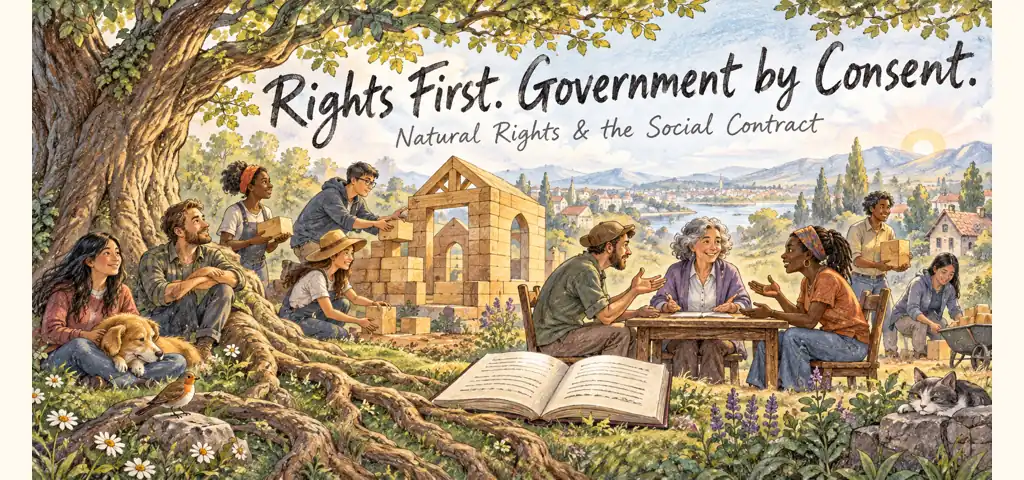
Natural rights are philosophical claims that people possess certain fundamental rights by virtue of being human, not because a ruler has chosen to grant them. In Locke’s account, people in a state of nature are free and equal and possess rights to life, liberty, and property. The state of nature is not necessarily constant warfare, but it lacks a common, impartial authority able to settle disputes and enforce judgments reliably. A person’s right may be real in moral theory yet insecure in practice. Protecting rights therefore supplies one influential purpose for creating government.
Social-contract theory explains the move from natural freedom to political authority. People consent to form a political community because common rules, impartial judging, and shared enforcement can protect them better than private force can. Government receives authority as a trust: it may make and enforce law for public purposes, but it does not acquire an unlimited ownership of the people or their rights. Consent grounds legitimate power, while the purposes of the trust limit that power. This is why Lockean theory can justify obedience to lawful government and also support resistance when a regime persistently replaces law with arbitrary domination.
Natural Rights and Social Contract Theory: the working rule
Consent does not mean that every person personally signs a document or agrees with every policy. A political system can rest on popular authorization while producing laws that many citizens oppose. Nor does one mistaken decision automatically dissolve government. Locke’s resistance argument concerns a sustained pattern showing that rulers have abandoned the purposes for which authority was entrusted. Ordinary disagreements should ordinarily be addressed through lawful politics. Systematic destruction of rights, representation, and legal remedies presents a more fundamental question of legitimacy.
Natural Rights and Social Contract Theory: limits and hard cases
A natural right and a legal right may protect the same interest, but they answer different questions. A natural-rights claim asks what a person is morally entitled to independent of official recognition. A legal-rights claim asks what a constitution, statute, regulation, or precedent recognizes and makes enforceable in a particular system. Freedom of expression, for example, can be defended as a natural liberty and protected as a constitutional right, but a court must identify the governing legal rule. Philosophical arguments can shape legal development without functioning as a substitute for enacted or authoritative law.
A new case involving natural rights and social contract theory
Explain why Locke’s natural-rights theory should not be reduced to the Declaration’s phrase “life, liberty, and the pursuit of happiness.” Give one example.
Check your reasoning
Locke described people as naturally free and equal, with rights to life, liberty, and property. A natural right is a moral claim a ruler does not create or withdraw at will. A constitutional or statutory right, by comparison, depends on recognition within a legal system and can be enforced through that system’s institutions.
Video lesson: Natural Rights and Social Contract Theory
Khan Academy gives a focused explanation of this topic in Natural rights, social contract, democracy, republicanism and limited government.
If the player does not load, watch this lesson directly on YouTube.
Connect this lesson to the larger course
For a broader map connecting natural rights and social contract theory to founding ideals, the Constitution, and federalism, use the AP U.S. Government and Politics learning hub.

Related to This Article
More math articles
- Your Coach’s Playbook: How to Understand Percent of Change
- 4th Grade K-PREP Math Worksheets: FREE & Printable
- Two-Column Proofs: How to Write Statements and Reasons
- Top 10 Tips to Create an ACT Math Study Plan
- Top 10 5th Grade OST Math Practice Questions
- The Illinois IAR Grade 5 Math Worksheet Pack — 49 Free Printable Pages with Solutions
- How to Find Discontinuities of Rational Functions?
- 7th Grade FSA Math FREE Sample Practice Questions
- 4th Grade Common Core Math Worksheets: FREE & Printable
- Party sorting, negative partisanship, and affective polarization




















What people say about "Natural Rights and Social Contract Theory"?
No one replied yet.