CPA AUD: Audit Risk vs Materiality in a Planning Scenario (2027 Prep)

Audit risk and materiality affect the same audit plan, but a change in one does not automatically establish a change in the other. Follow the changed fact.
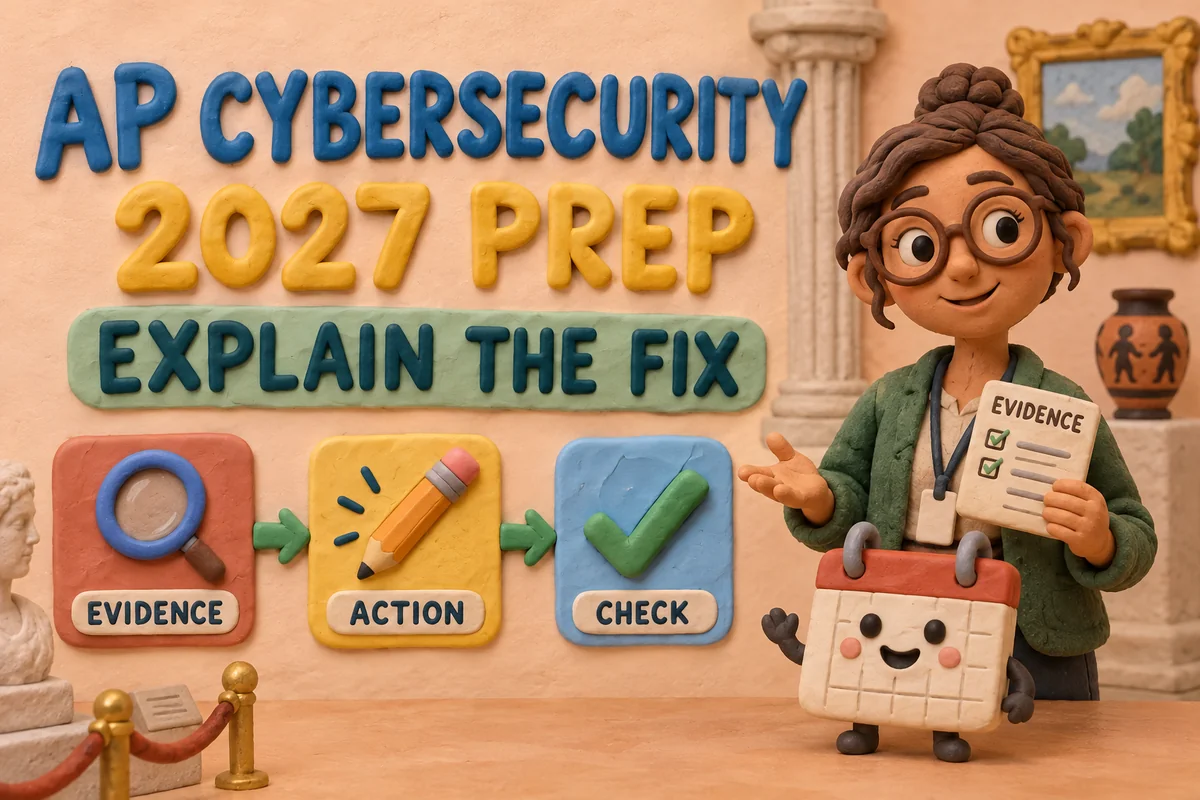
In this CPA AUD tutorial, two separate developments at a fictional company show why an auditor might revise an evidence plan or reconsider a dollar amount used in planning. Audit risk concerns an inappropriate opinion on materially misstated financial statements, while materiality concerns the significance of misstatements in their circumstances. Use the applicable standards. Our example expressly assumes a financial statement audit under PCAOB standards, so its terminology should not be transferred silently to a different engagement.
The worked planning comparison (CSV) keeps the two developments separate, and the illustrative calculations (CSV) file shows every input in the illustrative materiality calculation. Both are author-created teaching records. You can use the blank planning explanation record (CSV) to explain a planning change in your own study notes without copying exam questions or confidential engagement information.
Trace the risk assessment
PCAOB AS 1101, paragraphs .04 and .09-.11 distinguishes the risk of material misstatement from detection risk, which concerns an auditor's procedures missing an existing potentially material misstatement. Keep those roles separate. A higher assessed risk of material misstatement calls for lower detection risk to maintain appropriately low audit risk, with substantive evidence increasing as the required detection risk falls.
Suppose Marlin Components is the fictional company under audit. Its earlier planning record describes an automated review of invoice dates, but a later system report shows that the review stopped operating for six weeks near year-end.
The missing review raises a control-reliance issue that requires evaluation, rather than proving that any particular invoice is wrong. The changed fact concerns the evidence supporting the earlier risk assessment. Record that connection first. Simply replacing a materiality amount would leave the unexamined control failure and its implications for the planned work unexplained.
Explain what the evidence plan needs to address
Under AS 2301, paragraphs .08-.09 and .42, procedures must respond to assessed risks and relevant assertions, and higher assessed risk requires more persuasive evidence. More items alone may be inadequate.
Increasing a procedure's extent cannot compensate for evidence that is unreliable or irrelevant to the misstatement being investigated. For Marlin's invoice-date issue, a proposed planning note identifies the affected period and asks the team to reconsider control reliance and substantive work addressing sales cutoff. It remains a proposal. Whether a recorded sale belongs in the correct reporting period cannot be established by inspecting an unrelated customer address field, however many address records are examined.
The example leaves the final procedures, sample size and engagement conclusion unresolved. Those require further facts and professional judgment. Our comparison record therefore separates a possible response from an approved audit plan, with actual work performed and results left blank.
Work through a separate materiality change
In a separate branch of the same fictional engagement, preliminary profit before tax is 2,000,000 dollars and later information revises that figure to 1,200,000 dollars. Hold the earlier control story aside. This branch illustrates changed financial information, and it does not assume that the six-week control failure caused the profit revision.
For arithmetic only, assume a five-percent profit benchmark and a tolerable-misstatement amount equal to sixty percent of the resulting overall amount. These percentages are invented inputs. They are not PCAOB rules, recommended settings or a substitute for judging whether profit is an appropriate benchmark for the particular company.
Initially, 2,000,000 times 0.05 equals 100,000 dollars. Multiplying 100,000 by 0.60 gives 60,000 dollars. With the revised profit input, 1,200,000 times 0.05 equals 60,000 dollars, and 60,000 times 0.60 gives 36,000 dollars for the illustrative tolerable-misstatement amount.
Notice that 60,000 appears twice. Label each occurrence. It is initially the illustrative tolerable-misstatement amount, then the revised overall amount, so the number by itself does not tell you which planning judgment the record describes.
Reconsider the plan when the amount changes
PCAOB AS 2105, paragraphs .07-.08 and .11-.12 requires reconsideration when changed circumstances or information make materially different amounts relevant to investors. A lower amount also requires evaluating the effect on risk assessments and procedures. Tolerable misstatement is below overall materiality, and qualitative considerations can make smaller amounts important for particular accounts or disclosures. In the calculation record, the overall amount falls by 40,000 dollars and the illustrative tolerable-misstatement amount falls by 24,000 dollars.
Revisit the planned work. The arithmetic demonstrates changed inputs and amounts, but it cannot determine a revised sample size or establish that work already completed is sufficient.
A learner might describe both branches as needing additional audit attention. That observation is incomplete. The control branch begins with evidence about a failed review, while the profit branch begins with financial information affecting the assumed benchmark calculation, and the planning explanation should preserve those different starting points.
| Branch | Changed fact | Planning issue |
|---|---|---|
| Control | Review stopped | Risk and evidence |
| Profit | Lower estimate | Materiality and plan |
Avoid turning the comparison into an automatic rule
An increased risk assessment does not, by itself, justify a particular replacement dollar amount for materiality. Explain the judgment that changed. Likewise, a lower illustrative materiality amount does not establish that the company introduced a new control failure or that the auditor can accept a higher risk of an inappropriate opinion.
Keep qualitative issues visible. A dollar comparison is insufficient when the circumstances surrounding a disclosure make a smaller amount important, and our profit calculation has no information about such circumstances. Mark that limitation in your notes instead of assuming that every amount below 100,000 dollars can be ignored. Our table records only the information supplied in the two fictional branches.
Neither branch proves a misstatement, fraud or a reporting conclusion. In a study explanation, identifying what remains unknown is part of connecting the evidence to the proposed response.
Use current exam resources for the broader study plan
AICPA's exam-content page lists separate blueprint downloads effective January 1, 2026 and January 1, 2027. Check your intended testing date.
When you revisit your notes, state the engagement framework, changed fact and resulting planning issue before adding a proposed response. Keep the original source reference nearby. Then compare your explanation with current authorized instruction, especially when deciding whether your materials use PCAOB terminology or the requirements for a different engagement. This article has not inspected those PDFs or verified a detailed AUD task crosswalk, and the preparation year in its title does not establish when a particular pronouncement becomes testable.
2027 preparation edition. Official public HTML checked October 12, 2026. Fictional Marlin Components and all numerical assumptions are author-created teaching material. Five-percent and sixty-percent inputs are not prescribed or recommended audit settings. PCAOB framework only, no silent AU-C substitution. Blueprint PDFs, worksheets and assessment destinations not inspected. No actual audit, sample-size prescription, reporting conclusion or professional advice. Qualified CPA subject review and current-source/live checks required before publication. Existing /cpa/ hub identifies FAR, so no AUD hub link has been represented as verified.

Related to This Article
More math articles
- TABE Math FREE Sample Practice Questions
- SSAT Upper Level Math Flashcards (Free Online: Formulas, Terms & Concepts)
- Integrals: Everything You Need To Know
- North Dakota NDSA Grade 6 Math Free Worksheets: Free Printable Grade 6 Math PDFs, No Signup
- What does TSI Test Stand for?
- Math Mastery: Effortless Math Learning
- How to Define Product-to-Sum and Sum-to-Product Formulas
- 3rd Grade OSTP Math Worksheets: FREE & Printable
- SHSAT Math Practice Test Questions
- Least Common Denominator Calculator: Fractions and Steps















What people say about "CPA AUD: Audit Risk vs Materiality in a Planning Scenario (2027 Prep) - Effortless Math"?
No one replied yet.