Free Grade 7 English Worksheets for California Students
A new study from the National Assessment of Educational Progress confirmed what middle-school teachers had been describing for a decade: the largest single jump in expected reading density inside the K-12 curriculum happens between sixth and seventh grade. Not between elementary and middle school. Not between middle and high. Between two consecutive years that look almost identical on the schedule but ask very different things of a reader.
That density is at the heart of California’s seventh-grade ELA standards. Inference now requires several pieces of evidence rather than one. Argument writing now requires a counterclaim. Vocabulary work now includes allusions, references to myth, the Bible, and classic literature that a seventh grader is expected to recognize on sight. None of these moves existed at Grade 6. All of them are now mandatory.
This page collects forty-three free printable worksheets, each one aligned to a single California Common Core ELA standard at Grade 7. The format does the thing that paid sites usually fail at: it is short, it is targeted, and it is free without an email gate.
What’s on this page
Every worksheet uses a three-page shape. Page one is a Quick Review your seventh grader can read independently. Pages two or three hold the practice items. The last page is the answer key, written for the student, not the parent, and it explains why the wrong options were designed to look correct.
Print them on regular paper. Work through them on whatever surface is clear. Move on.
Reading: Literature
- Citing Several Pieces of Textual Evidence, [RL.7.1] practice gathering two or three quotes that all support the same inference
- Theme and Its Development Over the Text, [RL.7.2] state the theme as a full sentence and trace it across the text
- How Setting, Character, and Plot Interact, [RL.7.3] describe how setting constrains and how character moves the plot
- Word Choice, Figurative Language, and Tone, [RL.7.4] denotation, connotation, and the mood a word plants
- How Form Shapes Meaning in Drama and Poetry, [RL.7.5] line breaks, stanzas, and stage directions carry meaning
- Developing and Contrasting Points of View, [RL.7.6] analyze two perspectives an author deliberately puts in tension
- Comparing a Story to Its Audio, Film, or Stage Version, [RL.7.7] what each medium can and cannot do
- Comparing Fictional and Historical Portrayals, [RL.7.9] separate the documented past from the novelist’s invention
Reading: Informational Text
- Citing Several Pieces of Evidence in Nonfiction, [RI.7.1] anchor an inference in two or more article details
- Two or More Central Ideas and Their Development, [RI.7.2] articles built around multiple big ideas working together
- How Individuals, Events, and Ideas Interact, [RI.7.3] people shape ideas and ideas shape people
- Word Meaning in Nonfiction: Figurative, Connotative, Technical, [RI.7.4] three jobs a single word can do in nonfiction
- How Text Structure Develops the Author’s Ideas, [RI.7.5] see the writer’s blueprint and what it accomplishes
- Author’s Point of View and How They Distinguish It, [RI.7.6] locate the writer’s stance and the techniques that mark it
- Comparing a Text to Its Audio or Video Version, [RI.7.7] what each medium emphasizes vs. Strips out
- Evaluating an Argument: Reasoning and Evidence, [RI.7.8] weigh claims against the reasons and evidence behind them
- How Two Authors Shape Their Presentation of the Same Topic, [RI.7.9] same subject, different choices, different effects
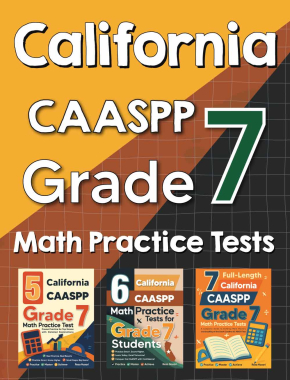
Working on Math Too? Try the California CAASPP Grade 7 Math Bundle
Many third graders are getting ready for the CAASPP in both subjects. If your child also needs math practice that matches the same standards, this companion bundle is the shortest path, workbook, study guide, and full practice tests in one download.
Writing
- Argument Writing: Claims, Reasons, Evidence, and Counterclaims, [W.7.1] the brand-new Grade 7 move: counterclaim, then refutation
- Informative and Explanatory Writing, [W.7.2] thesis, ordered sections, transitions, real conclusion
- Narrative Writing, [W.7.3] pacing, dialogue, sensory detail, ending that lands
- Coherent Writing for Task, Purpose, and Audience, [W.7.4] same idea for three different readers
- Planning, Revising, and Editing, [W.7.5] when revising means starting over, not polishing
- Short Research Projects: Question and Refocus, [W.7.7] let early findings narrow the question
- Gathering, Evaluating, and Citing Sources, [W.7.8] author, date, publisher, citation done right
Speaking & Listening
- Collaborative Discussions, [SL.7.1] show up prepared, listen actively, build on what others said
- Analyzing Information in Diverse Media, [SL.7.2] read text, image, chart, and clip as one combined message
- Evaluating a Speaker’s Argument, [SL.7.3] claim, reasons, evidence, soft spots
- Presenting Claims with Focus and Coherence, [SL.7.4] open clean, preview the order, stay in it
- Adapting Speech to Context, [SL.7.6] formal vs. Informal as a deliberate choice
Grammar
- Phrases and Clauses: Placement and Function, [L.7.1a] name what each chunk of a sentence is doing
- Sentence Structures: Simple, Compound, Complex, Compound-Complex, [L.7.1b] count the clauses, then label the structure
- Avoiding Dangling and Misplaced Modifiers, [L.7.1c] Grade 7’s quietest sentence error, exposed and fixed
Conventions: Punctuation, Spelling
- Commas with Coordinate Adjectives, [L.7.2a] when two adjectives need a comma and when they do not
- Spelling Grade-Appropriate Words, [L.7.2b] homophones, doubled letters, and the seventh-grade favorites
Knowledge of Language and Style
- Precise and Concise Language, [L.7.3a] cut filler, choose the exact word
Vocabulary and Word Study
- Using Context Clues, [L.7.4a] name the type of clue before using it
- Greek and Latin Roots and Affixes, [L.7.4b] break long words apart and unlock whole word families
- Using Reference Materials Effectively, [L.7.4c] dictionary, thesaurus, glossary, pick the right tool
- Verifying Word Meaning, [L.7.4d] confirm the guess before trusting it
- Allusions and Figures of Speech, [L.7.5a] the new L.7.5a standard, Achilles’ heel, the writing on the wall, etc.
- Word Relationships: Synonyms, Antonyms, Analogies, [L.7.5b] name the relationship before picking an answer
- Connotation and Denotation, [L.7.5c] same fact, different emotional weight
- Academic and Domain-Specific Vocabulary, [L.7.6] Tier 2 cross-subject words and Tier 3 field words
How to use these worksheets at home
California seventh-grade life is varied. A family in Bakersfield does not have the same Tuesday night as a family in San Francisco, and a family in Eureka does not have the same evenings as one in El Centro. The worksheets on this page were built for whatever evening shows up.
Set a small goal: one PDF in a sitting, twelve to fifteen minutes. Have your seventh grader read the Quick Review aloud before starting the practice. Saying the rule out loud activates the rule. After the practice items, hand over the answer key and let your child grade their own work, the self-grade is often where the actual learning happens, because the student has to read the explanation as if it is for them, not for the parent looking over their shoulder.
Rotate. Use the same worksheet again two weeks later and see what has stuck. Grade 7 reading and writing skills, multi-evidence inference, theme development, allusion recognition, counterclaim drafting, are slow-build skills. They reward spacing far more than they reward intensity.
A note about CAASPP Smarter Balanced ELA
The CAASPP, California Assessment of Student Performance and Progress, administers the Smarter Balanced English Language Arts test each spring. The state’s testing window typically opens in early spring and stays open through May or early June, with each district scheduling its own dates inside that window. The Grade 7 portion is aligned to the California Common Core ELA Standards, which means the standards your child has been studying in class all year are the standards being assessed.
Expect a computer-based test that includes a reading section drawing from both literary and informational passages, a writing section with extended-response prompts, and a performance task that combines reading, research, and writing. The reading items routinely ask for several pieces of textual evidence (RL.7.1, RI.7.1), the writing prompts require organized responses with claims and counterclaims, and the language items test grammar conventions like phrases, clauses, and modifier placement. Worksheets on this page are aligned to those exact expectations.
Want everything in one bundle?
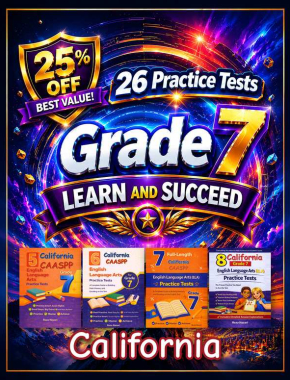
Some California families would rather work through a single structured program than navigate a long page of individual PDFs. The Grade 7 ELA Preparation Bundle is built for that, full-length practice tests that mirror the shape of the CAASPP, answer keys with student-facing explanations, and a structured progression that touches every Grade 7 standard.
California Grade 7 ELA Preparation Bundle, four practice-test books, 26 unique full-length tests, complete answer keys with explanations.
A short closing
The seventh-grade year in California is built from many small reading and writing moments, not from any single test, and not from any single subject area. Bookmark this page, pull a PDF when there are a few free minutes between dinner and homework, and let one skill at a time accumulate into the reader and writer your child is becoming over the course of an entire school year. That is what CAASPP readiness actually looks like in practice: steady, regular, and built one short worksheet at a time.
Best Bundle to Ace the California CAASPP Grade 7 ELA
Looking for the best resource to help your kid ace the California CAASPP? Try this bundle, four full practice-test books (5 + 6 + 7 + 8 tests) covering the same Grade 7 reading, writing, and language skills your child is already learning. Instant PDF download, answer keys included.

Related to This Article
More math articles
- ACT Math Formulas
- Skip Counting & Number Line Game — Click the Right Number
- CPA FAR Blueprint: What to Recheck in a Course (2027 Prep)
- The Best Grade 8 Math Book for Colorado Students
- Full-Length ATI TEAS 7 Math Practice Test
- Labeling, Stigma, and Secondary Deviance
- Comprehensive Tests for Convergence and Divergence of Infinite Series
- 6th Grade Georgia Milestones Assessment System Math FREE Sample Practice Questions
- Florida Algebra 1 EOC Practice Test PDF with Answers for 2026
- Top Math Websites for Online Classes






What people say about "Free Grade 7 English Worksheets for California"?
No one replied yet.