Competing Visions of Modernity: The New Woman, Mass Entertainment, and the Lost Generation
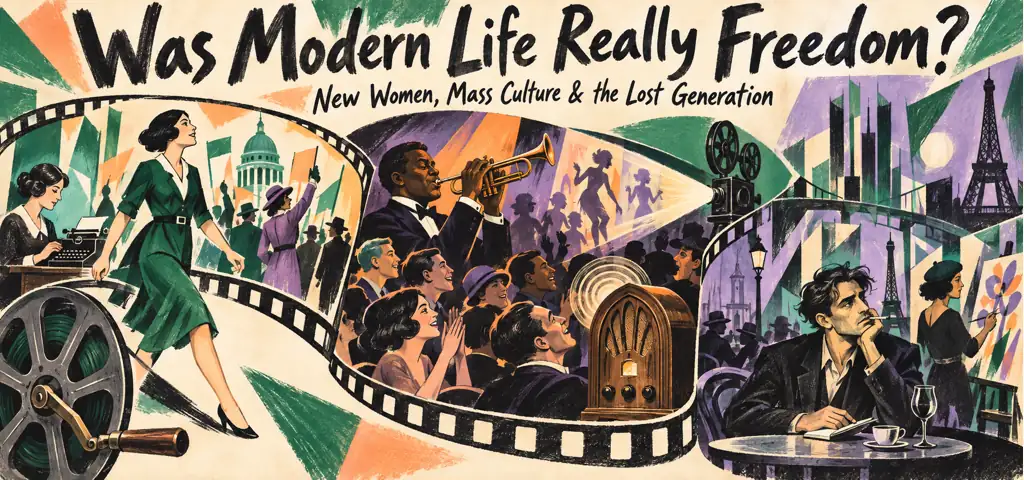
Chapter 8 of the CLEP History of the United States II study guide on Effortless Math covers Competing Visions of Modernity: The New Woman, Mass Entertainment, and the Lost Generation: the key terms, the core ideas, and worked examples showing how this topic is tested on the exam.
CLEP History of the United States II, Chapter 8
Modernity was an argument, not one lifestyle
Electric light, automobiles, clerical work, birth control campaigns, advertising, radio, movies, skyscrapers, and new art changed how Americans imagined time, privacy, authority, and identity. Celebrants saw freedom, efficiency, and national connection. Critics saw conformity, manipulation, danger, or loss of community. "Modern" therefore describes competing responses to new institutions, not a single march from tradition to liberation. The flapper, the radio sponsor, the expatriate writer, and the factory painter could all symbolize different modernities.
The New Woman joined rights to uneven opportunity
The Nineteenth Amendment placed women in the national electorate, and clerical, teaching, nursing, sales, and professional work expanded. Young unmarried white women became especially visible in offices and stores. Married women did not become a majority of women wage earners during the 1920s, and Black women remained concentrated in domestic, agricultural, and service work. A modern image could register real change while concealing race, marital status, class, and occupation.
Dating and consumption altered courtship
Automobiles, dance halls, restaurants, amusement parks, and movie theaters gave young people commercial spaces outside the family parlor. The "flapper" image emphasized short skirts, bobbed hair, smoking, dancing, and sexual independence. Most women did not live the advertising ideal, yet the image shifted public expectations. Companionate marriage placed greater emphasis on affection and sexual compatibility while continuing to assign wives primary responsibility for home and children.
Birth control became a claim to bodily autonomy
Margaret Sanger opened a birth control clinic in Brooklyn's Brownsville neighborhood in 1916; police raided it, and she served jail time. She argued that a woman could not be free unless she could decide whether and when to bear children. Sanger later pursued medical and legal respectability, while sometimes using eugenic language common among reformers. Birth control was not the same as abortion, and her campaign did not make contraception immediately legal or equally available.
Home economics dignified labor while reinforcing roles
Ellen Swallow Richards and colleagues organized home economics around the proposition that household work was applied science. Nutrition, sanitation, budgeting, child development, and efficient equipment could improve family health and create professional careers for women. The field valued work often dismissed as instinct, yet it could also treat women's domestic responsibility as natural. Professionalization and gender limitation could exist in the same reform.
The Radium Girls exposed industrial knowledge and power
Young women painted luminous watch and instrument dials in New Jersey and Illinois and were instructed to shape brushes with their lips. They swallowed radium paint and later developed jaw necrosis, anemia, and cancers. Employers had access to warnings before fully protecting workers and resisted liability claims. The workers' litigation and publicity helped establish that occupational disease could be traced to corporate practice. Their experience belongs to women's work and industrial health, not to the Harlem Renaissance.
Radio created simultaneity and a sponsored audience
KDKA's 1920 election-night broadcast became a landmark of commercial radio. Networks linked stations, and advertisers bought time or sponsored programs, allowing listeners to receive content without a British-style household license fee. Radio carried news, comedy, music, sports, and advertising into homes at the same moment. Television did not become a household national medium until after World War II. Radio could create common experience while centralizing control over schedules and access to audiences.
Popular psychology changed permissible discussion
Sigmund Freud's specialized theories reached American readers through lectures, journalism, advertising, and popular simplification. Talk of unconscious motives, repression, and sexuality became more acceptable among many educated and urban Americans. Popular "Freudian" language rarely reproduced clinical psychoanalysis accurately, but it widened the vocabulary used to discuss desire and behavior. The change was cultural reception, not replacement of advertising with laboratory testing or a new federal licensing system for therapy.
Recorded sound crossed space and racial markets
Phonograph records and radio carried jazz beyond live venues. Mamie Smith's "Crazy Blues" revealed a Black record market, while white bands and publishers also profited from Black musical innovation. The Grand Ole Opry, named in 1927, used Nashville station WSM's clear-channel signal to turn southern rural performance into a broad commercial genre. National circulation did not erase segregated marketing, unequal compensation, or regional sources.
Movies became narrative industry
Feature filmmaking developed before the 1920s. D. W. Griffith's The Birth of a Nation (1915) advanced editing and large-scale narrative while glorifying the Ku Klux Klan and falsifying Reconstruction. The Jazz Singer (1927) was not the first story film, but its synchronized dialogue and songs convinced studios to convert rapidly to sound. Technical achievement and harmful representation can coexist; judging one does not cancel the other.
Studios integrated production and distribution
Major Hollywood companies placed performers under long-term contracts, produced films on studio lots, distributed pictures, owned theater chains, and used block booking to require exhibitors to take packages. This vertically integrated studio system took shape in the 1920s and dominated the 1930s. The Motion Picture Production Code was adopted in 1930 and enforced rigorously from 1934 to prevent external censorship by regulating content. The code and studio system were related institutions, not the same thing.
Athletes became national personalities through media systems
Babe Ruth, Jack Dempsey, Gertrude Ederle, Helen Wills, and other athletes gained audiences far beyond those present at events. Radio, wire services, newspapers, newsreels, mass magazines, and large stadiums made the same performance and personality nationally visible. Celebrity resulted from distribution as well as athletic achievement. Shorter hours mattered for leisure, but most fans did not need to attend in person to join the event.
Lippmann questioned how a mass public knows
In Public Opinion (1922), Walter Lippmann argued that citizens act on simplified "pictures" of a complex world beyond direct experience. News routines and stereotypes shaped the pseudo-environment in which judgment occurred. He placed greater trust in trained experts and organized intelligence than in spontaneous public competence. John Dewey replied that expert knowledge required communication and participatory communities. Their disagreement concerned how democracy could know enough to govern in a mass society.
separate medium, message, and ownership
Suppose an item connects jazz, sponsored radio, and the studio system.
Writers used modern form to criticize modern life
Sinclair Lewis satirized small-town conformity in Main Street and business boosterism in Babbitt. Eugene O'Neill treated sailors, farmers, Black characters, and outcasts as subjects of serious drama. Willa Cather's My Antonia (1918) remembered immigrant homesteaders on the Nebraska plains; Abraham Cahan's The Rise of David Levinsky (1917) followed an immigrant's rise in New York's garment economy. Modern literature included regional memory and immigrant capitalism, expatriates in Paris.
The Lost Generation named postwar disillusionment
Gertrude Stein's phrase, popularized by Ernest Hemingway, came to identify writers shaped by the First World War, including Hemingway and F. Scott Fitzgerald. Some lived in Paris and portrayed emotional damage, restless consumption, failed ideals, or the emptiness beneath wealth. Fitzgerald's The Great Gatsby and Hemingway's The Sun Also Rises differed in style and subject, yet each complicated triumphal accounts of prosperity and war. "Lost" was a cultural description, not a formal membership list.
Modern art selected different American subjects
Georgia O'Keeffe simplified flowers, city forms, and desert bones; Edward Hopper used stark light and solitary figures in American scenes. Charles Sheeler made factories and machines monumental subjects, including Ford's River Rouge complex. These artists did not share one technique. Their work shows that modernism could find abstraction in nature, psychological distance in ordinary places, or geometric order in industry. Diego Rivera's Detroit murals in 1932-1933 extended the factory-as-monument theme into the Depression era.
test liberation against distribution
A prompt says that women voted, dated in commercial spaces, and entered offices, then asks whether the decade achieved equality.
Buildings made competing modernities visible
The Woolworth Building opened in 1913 with Gothic ornament on a steel frame. The Empire State Building, completed in 1931, turned setback massing and extraordinary height into a machine-age icon. Levittown's first occupied houses in 1947 represented standardized suburban production, while the Seagram Building of 1958 used a bronze-and-glass modernist tower and plaza. The sequence-Woolworth, Empire State, Levittown, Seagram-shows modernity moving through corporate city, Depression-era monument, mass suburb, and postwar international style.
Modern culture united audiences while multiplying conflict
Mass media created shared celebrities, sounds, images, and consumer desires. The same systems reproduced racial caricature, segregated markets, gender ideals, and concentrated ownership. Artists used new forms to celebrate machines or reveal loneliness. Women used new opportunities while confronting occupational hazards and inherited roles. The decade's signature is not consensus about the modern world. It is the speed with which new institutions made competing visions visible to one another.
Watch the history in motion
This short lesson adds voices, images, and chronology to the ideas you just studied.
Video: The Roaring 20's: Crash Course US History #32, CrashCourse.
Try four CLEP-style questions
- Company doctors assure dial painters that luminous paint is safe while managers possess evidence of serious danger. What power relationship does the episode reveal?
- Employees controlled the scientific records and exposure standards used to define workplace safety.
- Federal regulators had prohibited radium use before the companies hired the dial painters.
- Occupational disease resulted chiefly from workers rejecting protective equipment supplied by management.
- Employers controlled safety evidence and shifted hidden risks and illness costs onto exposed workers.
- Public enthusiasm for new technology guaranteed independent medical review within industrial plants.
- A radio network offers nationally synchronized entertainment but finances programs by selling audiences to sponsors. Which interpretation best fits both facts?
- Radio united national audiences while sponsors shaped commercial programming and access to listeners.
- Sponsorship transferred ownership of network stations to consumers purchasing advertised products.
- National simultaneity insulated programming decisions from commercial influence and audience measurement.
- Networks relied primarily on federal taxes rather than firms purchasing access to listeners.
- Advertising kept broadcasting local by preventing stations from sharing national network schedules.
- Which distinction between the studio system and the Production Code is correct?
- The system applied to radio networks, while the code governed recorded-music companies.
- The system censored dialogue and costume, while the code financed theater-chain ownership.
- The system began after 1954, while code enforcement ended with synchronized sound in 1927.
- The studio system governed ownership and distribution; the Production Code regulated screen content.
- The system was federal antitrust law, while the code was a constitutional amendment.
- What issue most clearly separated Lippmann's response to mass public opinion from Dewey's?
- Whether national newspapers could supply identical political knowledge to rural and urban readers
- Whether experts or participatory communication best answered citizens' limited knowledge of a complex society
- Whether First Amendment protections applied equally to newspapers and commercial motion pictures
- Whether radio networks should carry jazz, sermons, and sponsored entertainment on shared schedules
- Whether state governments could require children to attend public rather than private schools
Check your answers and reasoning
Independent preparation. CLEP is a registered trademark of the College Board, which does not endorse this lesson.

Related to This Article
More math articles
- Judicial review
- What Socialization Is and Is Not
- How to Prepare for the CHSPE Math Test?
- The Best Grade 3 ELA Practice Tests for South Dakota Students
- The Best Grade 7 Math Book for Nebraska Students
- A Comprehensive Collection of FREE ACT Math Practice Tests
- Grade 2 Math Practice for North Carolina Second Graders
- Can You Cheat on the ALEKS Test?
- Top 10 6th Grade Common Core Math Practice Questions
- Political tolerance
















What people say about "The New Woman and Mass Entertainment"?
No one replied yet.