The Harlem Renaissance and Garveyism
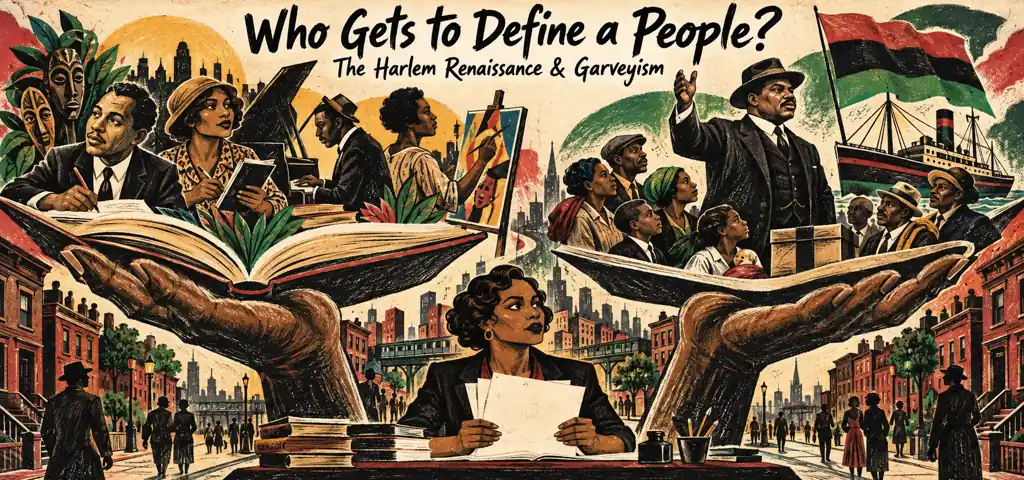
Chapter 8 of the CLEP History of the United States II study guide on Effortless Math covers The Harlem Renaissance and Garveyism: the key terms, the core ideas, and worked examples showing how this topic is tested on the exam.
CLEP History of the United States II, Chapter 8
Harlem became a center through migration and institutions
The Great Migration brought hundreds of thousands of Black southerners to northern cities, while immigrants from the Caribbean added different political and cultural traditions. Harlem contained churches, newspapers, fraternal organizations, businesses, theaters, nightclubs, and political groups. It was not the sole site of Black creativity; Chicago, Washington, Philadelphia, and other cities mattered. Harlem's concentration of artists, editors, patrons, performers, and audiences made it a powerful center and symbol.
The New Negro announced self-definition
Alain Locke edited The New Negro in 1925, presenting essays, fiction, poetry, art, and music as evidence of a transformed Black consciousness. The phrase emphasized self-respect, cultural confidence, and freedom from stereotypes imposed by white society. It did not name one political platform. Contributors disagreed over audience, class, folk culture, protest, sexuality, and the obligations of art. Their shared intervention was the claim that Black experience and expression must be represented on their own terms.
Writers turned varied Black life into modern art
Langston Hughes drew on blues and jazz rhythms and defended the beauty of ordinary Black life. Claude McKay's poetry voiced defiance, while his fiction explored urban and transnational experience. Countee Cullen worked within established poetic forms; Jean Toomer's Cane joined poetry, prose, rural Georgia, and urban modernism. Nella Larsen examined race, gender, and passing. A movement containing these differences cannot be reduced to one style or a rejection of the rural South.
Hurston joined anthropology to literary craft
Zora Neale Hurston studied anthropology under Franz Boas and collected folklore in the South and Caribbean. Her fiction used Black speech, storytelling, gender conflict, and community life, culminating later in Their Eyes Were Watching God (1937). Some contemporaries objected that her work did not foreground explicit racial protest; later readers recognized how voice and cultural authority challenged external definitions. Her method shows that recording folk tradition could be a modern intellectual project.
Music and recording created opportunity and distortion
Jazz musicians transformed rhythm, improvisation, and ensemble performance in New Orleans, Chicago, New York, and beyond. Duke Ellington's orchestra gained fame at Harlem's Cotton Club, where Black musicians performed for largely white audiences under segregated conditions. Mamie Smith's 1920 "Crazy Blues" revealed a large Black consumer market, prompting companies to build "race record" catalogs of blues, jazz, and gospel. Commercial media expanded circulation while labels and venues imposed racial categories.
Patronage could support and constrain
White publishers, philanthropists, editors, and patrons helped some Black artists reach national audiences. Jessie Fauset at The Crisis and Charles S. Johnson at Opportunity also cultivated talent through Black institutional networks. Patronage supplied money and access, yet a patron might expect exotic, "primitive," or politically safe work. Artists negotiated rather than escaped markets. The question is not whether outside support invalidated the Renaissance, but how resources affected which voices were published and rewarded.
Garvey built a mass political movement
Jamaican-born Marcus Garvey led the Universal Negro Improvement Association, which claimed millions of supporters at its height. Through the newspaper Negro World, parades, uniforms, speeches, and conventions, the UNIA promoted racial pride, African redemption, economic self-reliance, and global Black solidarity. Garveyism was a political and organizational project, not simply another literary style within the Harlem Renaissance. Its mass base extended far beyond artists and intellectuals in New York.
The Black Star Line embodied economic nationalism
The UNIA sold shares to ordinary supporters in the Black Star Line, intended to carry passengers and freight in Black-owned and operated ships and connect people of African descent. Poor management, overvalued vessels, inadequate capital, and internal conflict undermined the company. The line's failure did not erase its symbolic appeal: ownership and transportation represented independence from white-controlled commerce. It was not designed chiefly as a litigation fund, school endowment, or antilynching lobby.
Garvey and Du Bois disagreed about leadership and strategy
W. E. B. Du Bois and other Black leaders criticized Garvey's finances, rhetoric, and willingness to meet with Ku Klux Klan leaders over a shared belief in racial separation. Garvey accused established civil-rights leaders of elitism. Both opposed white supremacy, but Du Bois pursued integration, legal and political rights, and Pan-African congresses, while Garvey emphasized mass racial nationalism and independent enterprise. "Pan-African" does not erase this strategic conflict.
Federal prosecution ended Garvey's American leadership
Garvey was convicted of mail fraud in 1923 over promotion of Black Star Line stock. After imprisonment, President Coolidge commuted his sentence in 1927, and Garvey was deported as a noncitizen. The prosecution rested on use of the mails in a fraudulent stock scheme, though federal surveillance and hostility toward Black radicalism formed the larger setting. Deportation weakened the UNIA in the United States but Garvey's ideas continued across the African diaspora.
distinguish cultural autonomy from territorial separation
A question contrasts Locke's anthology with the Black Star Line.
The Renaissance changed the national cultural field
Black artists claimed folk traditions, urban life, sexuality, migration, African heritage, and modern experiment as subjects worthy of serious art. Recordings and radio carried some forms nationally, even as white-controlled industries profited and segregated markets. Later Black writers, including Gwendolyn Brooks, inherited institutions and debates without simply repeating the 1920s. The Renaissance's significance lies in changed authority over representation, not a claim that discrimination disappeared when Black art found wider audiences.
The Crash altered resources, not the movement's meaning overnight
The stock-market collapse and Depression weakened publishing, patronage, clubs, and consumer markets. Some major works appeared in the 1930s, including Hurston's best-known novel, so a strict 1929 endpoint is misleading. Federal arts programs later provided different institutional support. Period labels organize change; they should not turn artistic life off on a date. The Harlem Renaissance grew from the postwar migration era and continued into a harsher economic setting.
Watch the history in motion
This short lesson adds voices, images, and chronology to the ideas you just studied.
Video: APUSH Radio | The Harlem Renaissance & Marcus Garvey, Sam Spigarelli.
Try four CLEP-style questions
- Hurston records southern Black speech and folklore, then transforms those materials through fiction. What does her method most strongly assert?
- Anthropology requires writers to remove voice, performance, and storytelling from valid cultural evidence.
- Folk material acquires value only after translation into standardized speech approved by elite publishers.
- Literary craft and ethnographic attention belong to separate works with incompatible standards of evidence.
- Black vernacular could serve as modern artistic form and cultural knowledge.
- Southern folklore belongs outside modern art because its rural origin prevents formal experimentation.
- A wealthy patron funds a writer but pressures the writer to produce the kind of racial subject the patron expects. What tension does the relationship expose?
- Patronage directs supported writers toward private circulation rather than commercial publication.
- Patronage offered resources while donor expectations constrained artistic autonomy.
- Supported artists remain legally independent and therefore face little pressure over subject or audience.
- Funding gives patrons contractual ownership only of manuscripts written during the grant period.
- Private support reduces market pressure while increasing editorial independence from the donor.
- Which contrast best distinguishes Garvey's leadership strategy from Du Bois's during the early 1920s?
- Both treated elite literary patronage as a substitute for dues-paying membership organizations.
- Garvey centered federal civil-rights litigation, while Du Bois managed a transatlantic shipping corporation.
- Garvey built mass diasporic nationalism and enterprise; Du Bois pursued integrationist rights politics.
- Du Bois urged permanent racial separation, while Garvey opposed independent Black enterprise.
- Both rejected international organizing and confined political action to municipal Harlem elections.
- Which distinction between Locke's New Negro project and Garveyism is most accurate?
- Locke rejected racial pride, while Garvey promoted it.
- Locke demanded return to Africa, while Garvey opposed transnational organization.
- Locke foregrounded cultural self-representation, while Garvey built mass racial-nationalist organization and enterprise.
- Both were primarily shipping enterprises with literary branches.
- Garvey worked only through elite patrons, while Locke organized a mass dues-paying movement.
Check your answers and reasoning
Independent preparation. CLEP is a registered trademark of the College Board, which does not endorse this lesson.

Related to This Article
More math articles
- What Is the Best Calculator for Geometry?
- Bonding and Molecules
- The Best Grade 8 ELA Practice Tests for Maine Students
- Preparing For SAT Math? DON’T Make These Big Mistakes!
- Libel and slander
- Iowa ISASP Grade 6 Math Free Worksheets: Printable PDF Practice for Algebra, Geometry & Data
- Free Grade 6 English Worksheets for South Carolina Students
- The Best Grade 8 Math Book for Maine Students
- Organizing the Products: How to Sorting Results from Multiplying Fractions and Whole Numbers
- Spaulding Classification and Disinfectant Selection
















What people say about "The Harlem Renaissance and Garveyism"?
No one replied yet.