HiSET Math Flashcards (Free Online: Formulas, Terms & Concepts)
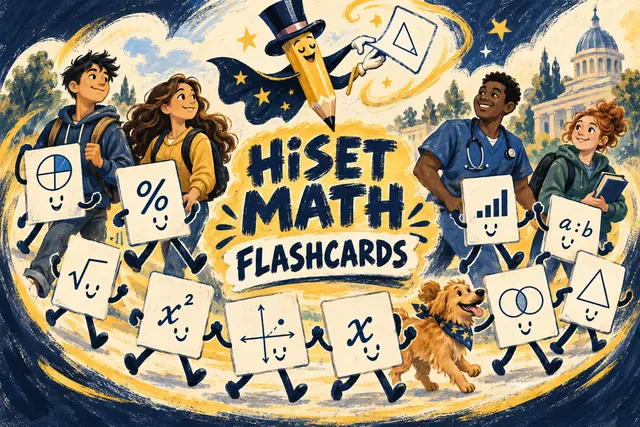
HiSET Math Flashcards: a free, printable set covering the topics you will see on the test, with answer keys included, so you can practice each topic one skill at a time and check your own work before test day.
HiSET Math Flashcards: a free, printable set covering the topics you will see on the test, with answer keys included, so you can practice each topic one skill at a time and check your own work before test day.
Free HiSET Math review
Lock in every key HiSET Math formula, term, and concept with a free, interactive flashcard deck covering numbers, fractions and percents, ratios and proportions, exponents and roots, algebra, functions, coordinate geometry, geometry, data and statistics.
Filter by topic or card type, and many cards include a quick diagram. Each card shows the rule or definition, a short explanation, and many include a quick diagram. Flip a card, filter by topic or card type, shuffle, and mark what you know so the cards you miss come back for review.
$114.96Original price was: $114.96.$59.99Current price is: $59.99.
Embed this calculator on your site
Free to use on class pages, blogs and course pages. Copy the code below and paste it into your page:
What These HiSET Math Flashcards Cover
This free deck collects the formulas, key terms, and concepts students use across the whole HiSET Math course, organized into 10 topics. Use the dropdown to study one topic at a time, or shuffle the full deck for mixed review before a test.
13 cards. Integers, real numbers, absolute value, factors and primes, GCF and LCM, order of operations, the distributive property, and factorials.
Fractions & Percents
8 cards. Converting mixed numbers and improper fractions, adding, subtracting, multiplying and dividing fractions, percent of a number, percent of change, and fraction, decimal, and percent conversions.
Ratios & Proportions
5 cards. Ratios, proportions, unit conversions, simple interest, and average speed.
Exponents & Roots
11 cards. The exponent rules, including product, quotient, power, zero, negative, and fractional exponents, plus square roots, simplifying radicals, and scientific notation.
Algebra
15 cards. Variables and expressions, solving one and two step equations, combining like terms, FOIL and special products, factoring, the quadratic formula, systems, and inequalities.
Functions
5 cards. Function notation and evaluation, domain and range, composition, inverses, and transformations of graphs.
Coordinate Geometry
7 cards. Slope, slope-intercept and point-slope form, the distance and midpoint formulas, and parallel and perpendicular lines.
Geometry
18 cards. Area, perimeter, and volume formulas for common shapes, the Pythagorean theorem and triples, angle rules, and polygon interior angles.
Data & Statistics
8 cards. Mean, median, mode, and range, reading graphs and tables, probability, and basic statistics.
Test Facts
4 cards. Quick facts about the HiSET Math test, the math question types, and the calculator policy.
How to Use These HiSET Math Flashcards
1
Pick one topic
Use the topic dropdown instead of facing all 94 cards at once. Start with the topics you find hardest.
2
Flip, then mark
Read the front, say the rule or definition out loud, then flip. Mark Know it only when you can explain it, not just recognize it.
3
Practice right away
After a set, solve a few problems that use those rules. Flashcards build recall; worked practice turns them into test-day tools.
Best Order for Studying
If the deck feels like a lot, study the foundational topics first, such as numbers, fractions and percents, and exponents, then move on to algebra, geometry, and data, and review the test facts last. This moves from the skills every other topic builds on to the ones that appear in specific problem types.
Most Important Formulas and Facts to Know First
Order of operations: the sequence that keeps every calculation consistent.
Exponent rules: product, quotient, power, zero, and negative exponents.
Fraction operations: and converting between fractions, decimals, and percents.
Percent of a number and percent of change: the backbone of word problems.
Slope and slope-intercept form: for reading and writing linear graphs.
Area, perimeter, and volume: the core geometry formulas.
The Pythagorean theorem: for right triangles and distance.
Factoring and the quadratic formula: for solving quadratics.
Mean, median, mode, and range: the four measures that summarize data.
Probability of an event: favorable outcomes over total outcomes.
Common Mistakes These Cards Help Fix
Ignoring order of operations and simply working left to right.
Adding or subtracting fractions without a common denominator.
Confusing area with perimeter, or surface area with volume.
Flipping an inequality sign at the wrong time, instead of only when multiplying or dividing by a negative.
Mixing up mean, median, and mode.
Treating a negative exponent as a negative number instead of a reciprocal.
Applying the Pythagorean theorem to triangles that are not right triangles.
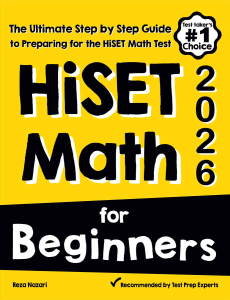
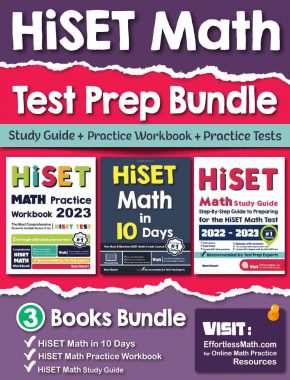
HiSET Math for Beginners 2026: The Ultimate Step by Step Guide to Preparing for the HiSET Math Test
Recommended when a student needs more than flashcards: a step-by-step HiSET Math study path with lessons, worked examples, and practice to use alongside the deck.
Every topic taught from the ground up, not just listed.
Pairs naturally with these flashcards and the free practice tests.
Yes. This HiSET math deck is free online, with 94 cards in 10 topics, from numbers and fractions to functions, geometry, and data and statistics, and 27 cards include a diagram. Filter by topic, shuffle for mixed review, and mark each card as Know it or Review again, and your progress is saved in your browser.
What should I study with HiSET math flashcards?
Start with the skills that appear across the HiSET math test: fraction and percent operations, ratios and unit rates, solving linear equations, and reading data from tables and graphs. Then move to functions, exponents and geometry. A good card to master early is percent of change: (new − old) ÷ old × 100, so going from 40 to 50 is a 25% increase.
Is there a free HiSET math practice test?
Yes. Free HiSET math practice tests and worksheets are available through the HiSET Math hub linked from this deck. Use the flashcards to review a topic, then take a practice set to see whether you can apply the rules in word problems, which is how most HiSET math questions are written.
Is there a free HiSET math practice test with answers?
Yes, the HiSET math practice tests on Effortless Math come with answers and explanations so you can check your work. When you miss a question, find the matching flashcard, such as the Pythagorean theorem or slope formula, mark it Review again, and redo a similar problem a day later to make the fix stick.
All 105 Flashcards, Text Version
Every card from the deck above, listed as text so you can read, search, or print it without the flip player.
Numbers
Front
Back
Integers
The set { …, −3, −2, −1, 0, 1, 2, 3, … } — zero, the counting numbers, and their negatives.
Real numbers
Every number on the number line: integers, fractions, decimals, and irrationals like √2, √3, and π.
Absolute value
A number’s distance from 0 on the number line, so it is never negative. |−22| = 22.
Absolute-value inequalities
|x| < n means −n < x < n. |x| > n means x < −n or x > n.
Rewrite over a common denominator, add or subtract the numerators, then simplify.
Multiply fractions
Multiply the numerators together and the denominators together, then simplify. (a/b)(c/d) = ac/bd.
Divide fractions
Keep the first fraction, flip the second, and multiply (multiply by the reciprocal).
Percent: find the part
part = (percent ÷ 100) × whole. Example: 20% of 80 = 0.20 × 80 = 16.
Percent of change
(New Value − Old Value) ÷ Old Value × 100%. Positive = increase, negative = decrease.
Fraction → percent
Divide to get a decimal, then multiply by 100. 3/4 = 0.75 = 75%.
Decimal → fraction
Write the digits over their place value, then simplify. 0.6 = 6/10 = 3/5.
Ratios & Proportions
Front
Back
Ratio
A comparison of two numbers by division, written 3 : 5 or 3/5.
Proportion
Two equal ratios: a/b = c/d, also written a : b = c : d. Solve by cross-multiplying: a·d = b·c.
Simple interest
I = prt (Interest = principal × rate × time). Use the rate as a decimal.
Average speed
Average speed = total distance ÷ total time.
Convert units
Multiply by the conversion factor. 1 ft = 12 in, so 5 ft = 5 × 12 = 60 in.
Exponents & Roots
Front
Back
Product of powers
xᵃ · xᵇ = xᵃ⁺ᵇ. Same base → add the exponents.
Quotient of powers
xᵃ ÷ xᵇ = xᵃ⁻ᵇ. Same base → subtract the exponents.
Power of a power
(xᵃ)ᵇ = xᵃᵇ. Multiply the exponents.
Power of a product
(xy)ᵃ = xᵃ · yᵃ. The exponent applies to each factor.
Zero exponent
x⁰ = 1 for any nonzero x.
Negative exponent
x⁻ᵃ = 1/xᵃ. A negative exponent means divide instead of multiply.
Fractional exponent
x^(1/n) = ⁿ√x. Example: 8^(1/3) = ³√8 = 2.
Square root
√x is the number r with r² = x. √36 = 6.
Simplify a radical
√(xy) = √x · √y. Pull out the largest perfect square: √72 = √36 · √2 = 6√2.
Scientific notation
Write as m × 10ⁿ with 1 ≤ |m| < 10. 25,000 = 2.5 × 10⁴; 0.5 = 5 × 10⁻¹.
Powers of a fraction between 0 and 1
If 0 < x < 1, then x² < x. Raising a proper fraction to a higher power makes it smaller.
Algebra
Front
Back
Variable
A letter that stands for an unknown number, such as x.
Expression vs. equation
An expression has no equals sign (2x + 3); an equation sets two expressions equal (2x + 3 = 11).
Solve a one-step equation
Undo the operation with its inverse. 3x = 12 → divide by 3 → x = 4.
Solve a two-step equation
Undo addition/subtraction first, then multiplication/division. 2x + 3 = 11 → 2x = 8 → x = 4.
Combine like terms
Add the coefficients of terms with the same variable and power. 3x + 5 + 2x − 1 = 5x + 4.
Evaluate an expression
Substitute the given value for the variable, then simplify using order of operations.
FOIL (multiply binomials)
(x + a)(x + b) = x² + (a + b)x + ab. First, Outer, Inner, Last.
Difference of squares
a² − b² = (a + b)(a − b).
Perfect-square trinomials
a² + 2ab + b² = (a + b)² and a² − 2ab + b² = (a − b)².
Factor x² + bx + c (Reverse FOIL)
Find two numbers that ADD to b and MULTIPLY to c. x² + 5x + 6 = (x + 2)(x + 3).
Quadratic formula
For ax² + bx + c = 0: x = (−b ± √(b² − 4ac)) / (2a). NOT on the HiSET sheet — memorize it.
Discriminant
b² − 4ac. Positive → two real solutions; zero → one; negative → no real solutions.
Solve a quadratic by factoring
Factor to (x + a)(x + b) = 0, then set each factor to 0. x² + 4x + 3 = 0 → x = −3 or x = −1.
Solve a system by substitution
Solve one equation for a variable, substitute it into the other, then solve for both.
Inequality sign flip
When you multiply or divide both sides by a negative, flip the inequality. −2x > 4 → x < −2.
Functions
Front
Back
Function
A rule that assigns exactly one output to each input. Each x-value has only one y-value.
Function notation f(x)
f(x) is the output for input x. If f(x) = 2x + 1, then f(3) = 2(3) + 1 = 7.
Domain and range
Domain = all allowed inputs (x-values). Range = all resulting outputs (y-values).
Linear vs. quadratic function
Linear: y = mx + b, graphs as a straight line. Quadratic: y = ax² + bx + c, graphs as a parabola.
Rate of change
How fast the output changes per unit of input. For a line it equals the slope, m.
Coordinate Geometry
Front
Back
Slope of a line
m = (y₂ − y₁) / (x₂ − x₁) = rise / run.
Slope-intercept form
y = mx + b, where m is the slope and b is the y-intercept.
Point-slope form
y − y₁ = m(x − x₁), using the slope m and a point (x₁, y₁) on the line.
Special slopes
A horizontal line has slope 0; a vertical line has undefined slope.
Distance formula
d = √((x₂ − x₁)² + (y₂ − y₁)²).
Midpoint formula
M = ((x₁ + x₂)/2, (y₁ + y₂)/2).
Parallel vs. perpendicular lines
Parallel lines have equal slopes. Perpendicular slopes are negative reciprocals: m₁ · m₂ = −1.
Geometry
Front
Back
Rectangle
Area = l × w. Perimeter = 2l + 2w. (Square when l = w.)
Square
Area = s². Perimeter = 4s.
Triangle area
A = ½ × b × h (base × height).
Triangle: perimeter & angles
Perimeter = a + b + c. The interior angles always add to 180°.
Parallelogram area
A = b × h (base × height).
Trapezoid area
A = ½ × h × (b₁ + b₂).
Circle
Area = πr². Circumference = 2πr = πd. A full circle is 360°. (π ≈ 3.14)
Pythagorean theorem
a² + b² = c², where c is the hypotenuse. So c = √(a² + b²) and a = √(c² − b²).
Pythagorean triples
Whole-number right-triangle sides: 3-4-5, 5-12-13, 8-15-17, 7-24-25 (and their multiples).
Rectangular prism
Volume = Bh = l × w × h. Surface area = 2lw + 2lh + 2wh = ph + 2B (p = base perimeter).
Cylinder
Volume = πr²h. Surface area = 2πrh + 2πr².
Cone
Volume = ⅓πr²h. Surface area = πrs + πr² (s = slant height).
Pyramid
Volume = ⅓ × (base area) × h.
Sphere
Volume = (4/3)πr³. Surface area = 4πr².
Equilateral & isosceles triangles
Equilateral: 3 equal sides, all angles 60°. Isosceles: 2 equal sides and equal base angles.
Polygon interior angles
The interior angles of an n-sided polygon add to (n − 2) × 180°.
Triangle inequality
Each side of a triangle is shorter than the sum, and longer than the difference, of the other two.
Exterior angle of a triangle
An exterior angle equals the sum of the two remote (non-adjacent) interior angles.
Data & Statistics
Front
Back
Mean (average)
Mean = (sum of the values) ÷ (number of values).
Median
The middle value of a sorted list. With an even count, average the two middle values.
Mode
The value that appears most often in the data set.
Range
Range = largest value − smallest value.
Probability of an event
P = (number of desired outcomes) ÷ (number of total outcomes).
Probability of A and B
For independent events: P(A and B) = P(A) × P(B).
Counting principle
If one choice has m options and another has n, there are m × n ways together.
Find a missing value from the mean
Total = mean × number of values. Subtract the known values to find the missing one.
Test Facts
Front
Back
HiSET Math: length & format
The Mathematics subtest has 55 multiple-choice questions and a 90-minute time limit.
HiSET Math: scoring
Each subtest uses a 1–20 scale. Passing requires at least 8 on each subtest, at least 45 across all five, and at least 2 of 6 on the Writing essay. Check additional state requirements.
HiSET Math: calculator
Do not bring your own calculator to a test center. Calculator access is provided by the testing program or center; confirm the permitted type with your center and state.
HiSET Math: the formula sheet
A formula sheet is provided, but not every formula is supplied. The official guidance excludes distance = rate × time, the Pythagorean theorem, and the quadratic formula. Review the official sheet before test day.
Reasoning
Front
Back
Estimate before calculating
Predict the size and sign of an answer first. The estimate helps catch a misplaced decimal, wrong operation, or impossible result.
Check with an inverse operation
Undo the operation when possible: addition with subtraction, multiplication with division, and squaring with a square root plus a sign check.
Use units as evidence
Carry units through the work. A final unit that does not match the question often reveals an incorrect setup.
Translate one phrase at a time
Name the unknown, translate each relationship, and only then combine the pieces into an equation or expression.
Test a simple case
Use an easy valid number to check whether a rule or algebraic statement behaves the way you expect.
Eliminate impossible choices
Reject answers with the wrong sign, scale, unit, domain, or relationship before doing detailed arithmetic.
Distinguish exact and approximate
Keep exact forms such as fractions and radicals during the work; round only when the question or context requires it.
Read every label
For a table, graph, diagram, or formula, identify the title, variables, units, scale, and restrictions before calculating.
Find the hidden constraint
Check for limits such as positive length, nonzero denominator, integer count, defined radical, or realistic time.
Explain the deciding step
After solving, state why the method fits. A short explanation reveals whether the answer came from understanding or a lucky pattern.
Number Sense
Front
Back
Percent as a multiplier
An increase of r% multiplies by 1+r/100; a decrease multiplies by 1-r/100. Repeated changes use repeated multiplication.
Official source: what the HiSET covers, how the five subtests are structured and how the credential works are published by PSI, which administers the exam, at hiset.org.
by: Effortless Math Team about
(category: Articles)







What people say about "HiSET Math Flashcards: Free Online Practice"?
No one replied yet.