CLEP U.S. History I 002: Environment, Agriculture, and Regional Adaptation
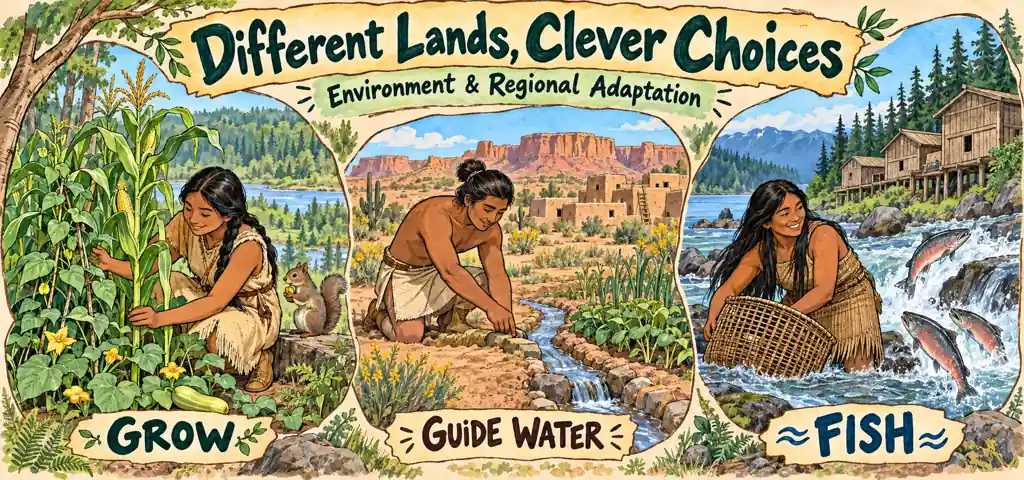
Lesson 1.2 of Chapter 1 of the U.S. History to 1877 study guide on Effortless Math covers CLEP U.S. History I 002: Environment, Agriculture, and Regional Adaptation: the key terms, the core ideas, and worked examples showing how this topic is tested on the exam.
U.S. History to 1877 | Chapter 1 | Lesson 1.2
Environment provided possibilities and constraints. People decided how to respond. The spread of maize agriculture from Mesoamerica transformed many North American communities because maize, beans, and squash could support denser populations than hunting and gathering alone. Farmers selected seed varieties, developed irrigation or raised fields, and organized seasonal labor. In the eastern woodlands, controlled burning cleared undergrowth, improved hunting habitat, and encouraged useful plants. Along the Pacific Northwest coast, abundant fisheries supported substantial settled communities without dependence on maize. These examples show that agriculture was important but not the only path to permanence or surplus.
Regional adaptation also changed over time. Drought could encourage migration or political reorganization in the Southwest. The horse, introduced by Europeans and acquired through trade and raiding, later reshaped life on the Plains by increasing mobility and the efficiency of buffalo hunting. That later transformation is a reminder that cultures are not frozen in a precontact past. Communities adopted useful technologies while preserving or remaking their own political identities.
Land use carried political meaning. Many peoples understood territory through overlapping rights: a community might plant particular fields, hunt within a negotiated range, and share access to rivers or forests. English colonists increasingly treated land as a commodity that could be permanently alienated through a deed. Neither system was merely an abstract belief. Each served an economy and a social order. When colonists claimed that land was “unused,” they converted a cultural misunderstanding into a legal weapon.
Climate and geography therefore help explain historical patterns, but environmental determinism fails. A river does not automatically create a particular government. Human choices about labor, trade, kinship, warfare, and ritual connect resources to institutions. Similar environments can support different societies, and societies can alter environments. The useful historical question is not “What did nature cause?” but “How did people interpret and manage the opportunities and risks around them?”
See the history take shape
Khan Academy offers a visual route through this topic. As you watch, compare its explanation with the source limits in the written lesson.
Video: Native American societies before contact | Period 1: 1491-1607 | AP US History | Khan Academy, Khan Academy.
Check your understanding
- Controlled burning in eastern woodlands is best interpreted as evidence that communities
- used naturally occurring wildfire as the principal means of opening fields
- managed woodlands mainly by extending cultivated fields into forest zones
- deliberately changed habitats to encourage selected plants and game
- treated individual ownership as a prerequisite for managing hunting grounds
- responded to plant succession more than they actively shaped it
- Which comparison most directly separates permanent settlement from dependence on maize farming?
- two Pueblo towns following different irrigation schedules
- two Mississippian centers with different mound arrangements
- two Eastern Woodlands farming villages using different councils
- a Northwest salmon village and a Mississippian maize town
- Plains hunters before and after the spread of horses
- Select all that apply. Which developments could redirect a community’s regional adaptation?
- a multiyear drought altering water and crop choices
- a productive new crop changing seasonal labor
- an existing calendar count marking a customary harvest interval
- broader horse access changing travel and hunting
- negotiated change in hunting-territory access
- Explain why environment should be treated as a constraint and opportunity rather than a complete cause.
Write a brief response using a named fact from the lesson.
Open the answers and reasoning
Independent preparation. CLEP is a registered trademark of the College Board, which does not endorse this lesson.

Related to This Article
More math articles
- Metric Units
- How Students Can Understand Math for Free
- The Endocrine System
- The Art of Numerical Literacy: Helping Children Master Real-World Math
- The Role of Math in Developing Strategic Thinking for iGaming
- The Best Algebra 1 Book for Arizona Students
- Draft Needs a Boost? A Guide to the Best AI Essay Rewriters for Students
- Devolution
- Free Grade 2 English Worksheets for California Kids
- Top 10 STAAR Grade 8 Math Books: A Comprehenisve Review

















What people say about "Environment, Agriculture and Regional Adaptation"?
No one replied yet.