CLEP U.S. History I 003: Spanish Conquest and Colonial Systems
Lesson 1.3 of Chapter 1 of the U.S. History to 1877 study guide on Effortless Math covers CLEP U.S. History I 003: Spanish Conquest and Colonial Systems: the key terms, the core ideas, and worked examples showing how this topic is tested on the exam.
U.S. History to 1877 | Chapter 1 | Lesson 1.3
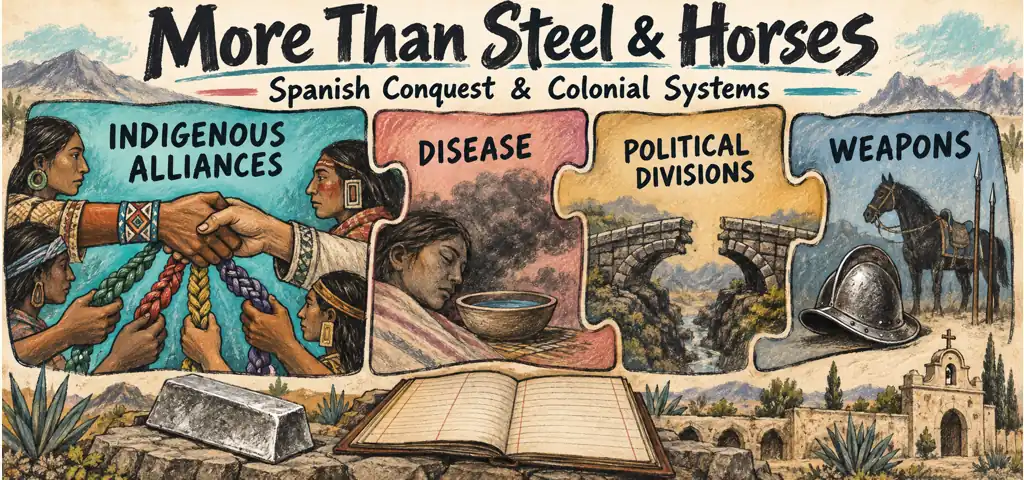
Spanish expansion joined private ambition to royal and religious claims. Christopher Columbus’s voyages initiated sustained contact, but conquest was not the work of a few Europeans acting alone. Hern’an Cortes defeated the Mexica, or Aztec, Empire with necessary assistance from Indigenous enemies of Mexica rule, especially Tlaxcalans, as well as the effects of smallpox and Spanish military technology. Francisco Pizarro entered the Inca world during a civil war and exploited political divisions. Steel weapons, cavalry, and firearms mattered, but alliances, intelligence, timing, and epidemic disease were at least as important.
Conquerors sought wealth and status. The crown attempted to govern their gains through viceroyalties, courts, missions, and officials. Under the encomienda system, Spaniards received claims to Indigenous tribute and labor, supposedly in exchange for protection and Christian instruction. Abuse and population collapse led the monarchy to limit encomienda, but coercion persisted through systems such as repartimiento and the draft labor used in mining. Silver from Mexico and Potosi entered a global economy linking the Americas, Europe, Africa, and Asia.
Missions were simultaneously religious communities, imperial outposts, and workplaces. Missionaries learned Native languages and sometimes denounced extreme exploitation. They also pressed people to abandon spiritual practices, settlement patterns, and family customs. Indigenous responses ranged from selective conversion and negotiation to flight and armed revolt. The Pueblo Revolt of 1680 temporarily drove Spaniards from New Mexico, demonstrating that colonial authority remained contestable.
Spanish America produced new racial and social categories. Intermarriage and coercive relationships created mixed populations, while officials described a hierarchy of Spaniards, Indigenous people, Africans, and people of mixed ancestry. In practice, wealth, reputation, birthplace, and local negotiation could complicate those labels. Yet the system still distributed power unequally. Understanding Spanish colonization requires holding two facts together: imperial institutions were formidable, and colonized peoples continuously altered, resisted, and sometimes defeated them.
Watch, then test the claim
Watch this account from Heimler's History with one question in mind: which evidence makes the lesson's strongest claim hold up?
Video: Columbian Exchange & Spanish Conquest [APUSH Review], Heimler's History.
Check your understanding
- What did an encomienda grant most directly authorize a colonist to demand?
- ownership of a tributary community’s occupied land
- Indigenous tribute and labor under a royal grant
- election to a municipal cabildo without Crown approval
- exemption from clerical oversight throughout a province
- local sovereignty over mission settlements under the grant
- Which inference from the Pueblo Revolt of 1680 is best supported?
- Mission conversion had dissolved Pueblo networks before the revolt.
- Coordinated Indigenous resistance could expel colonists and interrupt imperial rule for years.
- Spanish power depended chiefly on epidemic mortality rather than local institutions.
- Spain chose long-term abandonment of New Mexico after 1680.
- Mission institutions lacked a political or labor role in colonial rule.
- Select all that apply. Which factors aided Spanish conquests?
- Indigenous alliances adding troops and intelligence
- sustained Spanish numerical advantage in coalition armies
- epidemic disease disrupting defending communities
- steel weapons and cavalry changing battlefield tactics
- imperial rivalries and existing political divisions
- Rank the two most important causes of Spanish conquest and defend your ranking with specific evidence.
Write a brief response using a named fact from the lesson.
Open the answers and reasoning
Independent preparation. CLEP is a registered trademark of the College Board, which does not endorse this lesson.

Related to This Article
More math articles
- 6th Grade IAR Math Practice Test Questions
- Multiple-Meaning Words
- Grants-in-aid
- The Ultimate ISEE Lower-Level Math Course (+FREE Worksheets & Tests)
- The Ultimate 7th Grade IAR Math Course (+FREE Worksheets)
- Wrapping, Closures, and External Indicators
- Division
- Relevance of Evidence
- Maryland MCAP Grade 6 Math Free Worksheets: 72 Free Printable Worksheets with Worked Answers
- The Binomial Theorem












What people say about "Spanish Conquest and Colonial Systems"?
No one replied yet.