CLEP U.S. History I 001: Diverse Indigenous Societies before 1500
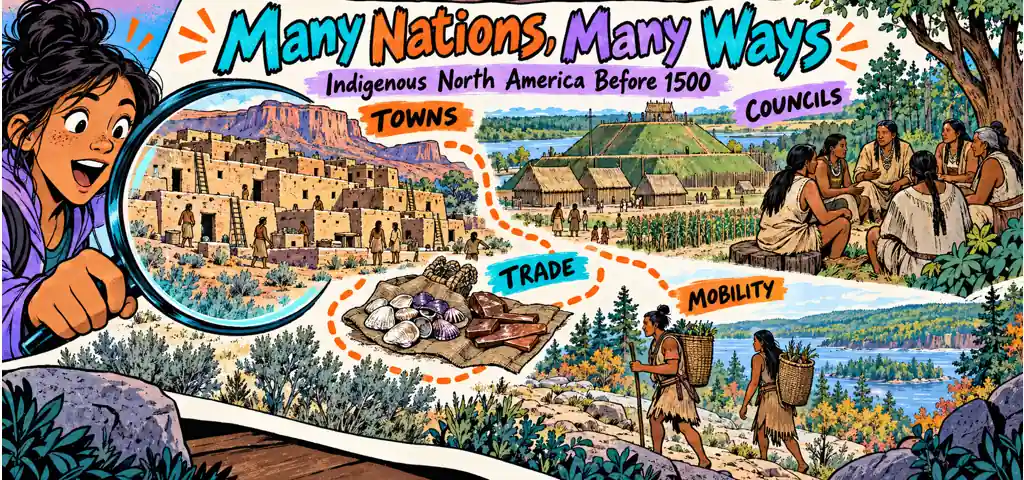
Lesson 1.1 of Chapter 1 of the U.S. History to 1877 study guide on Effortless Math covers CLEP U.S. History I 001: Diverse Indigenous Societies before 1500: the key terms, the core ideas, and worked examples showing how this topic is tested on the exam.
U.S. History to 1877 | Chapter 1 | Lesson 1.1
North America before European colonization contained hundreds of sovereign peoples with distinct languages, political traditions, economies, and sacred geographies. In the Southwest, Ancestral Pueblo communities had developed irrigated agriculture and multistory settlements. Later Pueblo peoples maintained town-based societies suited to an arid climate. In the Mississippi Valley, the earlier Mississippian tradition produced mound-building urban centers such as Cahokia, whose population and trading reach reveal organized labor, political leadership, and regional exchange. Across the eastern woodlands, nations built councils, alliances, and confederated diplomacy. The Haudenosaunee Confederacy became an especially durable example, although its founding date is debated and should not be assigned a single uncontested year. Many Algonquian-speaking peoples organized authority through towns, kin networks, and alliances. On the Great Plains and in the Great Basin, mobility was a rational adaptation to seasonal resources, not evidence of social simplicity.
The central correction for a beginning student is to replace the false category “the Indians” with a map of varied nations. Political scale differed. Some communities vested authority in hereditary leaders. Others required councils and broad consent. Kinship could be matrilineal, tracing membership and property through women, even when men often held particular diplomatic or military roles. Trade connected shell, copper, food, hides, and ceremonial goods across long distances. Warfare occurred, but so did diplomacy, adoption, intermarriage, and confederation. No single description captures this range.
European observers often misunderstood what they saw. They assumed that fenced fields, permanent individual deeds, and male-headed households were universal signs of “civilization.” Yet Native land use could combine town fields, family planting rights, shared hunting territories, and diplomatic claims. A landscape that looked uncultivated to an English visitor might have been carefully managed through burning, planting, and seasonal harvest. The observer’s category could erase the evidence in front of him.
A focused video lesson
Use this lesson from Heimler's History to review the period and its central historical problem. Pause when the video reaches the turning point named above.
Video: Native American Societies BEFORE Europeans [APUSH Review], Heimler's History.
Check your understanding
- Which evidence most directly demonstrates political coordination across multiple autonomous Native nations?
- Haudenosaunee councils coordinated diplomacy among autonomous member nations through shared procedures.
- Pueblo irrigation systems organized labor within communities sharing scarce water.
- Mississippian exchange carried shell and copper between distant settlements.
- Plains hunting bands adjusted seasonal movement to animal migrations.
- Eastern woodland communities used fire to manage plant and animal habitats.
- Which statement defines matrilineal kinship without assuming that women held every office?
- Descent passed through the mother’s line, though offices could vary.
- Clan identity normally followed the father’s descent line after marriage.
- Village councils determined clan membership through political appointment.
- A child’s ceremonial role determined descent rather than kinship.
- Matrilocal residence and matrilineal descent meant the same practice.
- Select all that apply. Which features existed among at least some Indigenous peoples before 1500?
- horse-supported bison hunting on the Great Plains
- regional exchange of shell, copper, and food
- confederated diplomacy among autonomous nations
- mound-centered towns among Ancestral Pueblo communities
- irrigation agriculture in arid Southwest communities
- In three or four sentences, use two contrasting regions to explain why “Native society” is too broad a category for historical analysis.
Write a brief response using a named fact from the lesson.
Open the answers and reasoning
Independent preparation. CLEP is a registered trademark of the College Board, which does not endorse this lesson.

Related to This Article
More math articles
- Oklahoma OSTP Grade 3 Math Prep, the Calm Way: 49 Free Single-Skill Worksheet PDFs
- Economic conditions
- Free Grade 7 English Worksheets for Georgia Students
- Sufficiency and Quality of Evidence
- Georgia Georgia Milestones Algebra 1 Free Worksheets: Free Printable Algebra 1 PDFs Covering Every Skill
- Distributing Decimals: How to Multiply with a 1-digit Whole Number
- The Best Grade 6 ELA Practice Tests for Pennsylvania Students
- Math for Nurses: Dosage, Conversions, and IV Calculations for 2026
- The Best Grade 3 ELA Practice Tests for Hawaii Students
- How to Find Errors in Number Patterns















What people say about "Diverse Indigenous Societies Before 1500"?
No one replied yet.