Electricity and Simple Circuits
Electricity is the flow of tiny charged particles — usually electrons — through a material. When those charges flow in a loop, you have a circuit, the basis of everything from flashlights to phones. This lesson covers the core electrical quantities and how a simple circuit works.
Current, Voltage, and Resistance
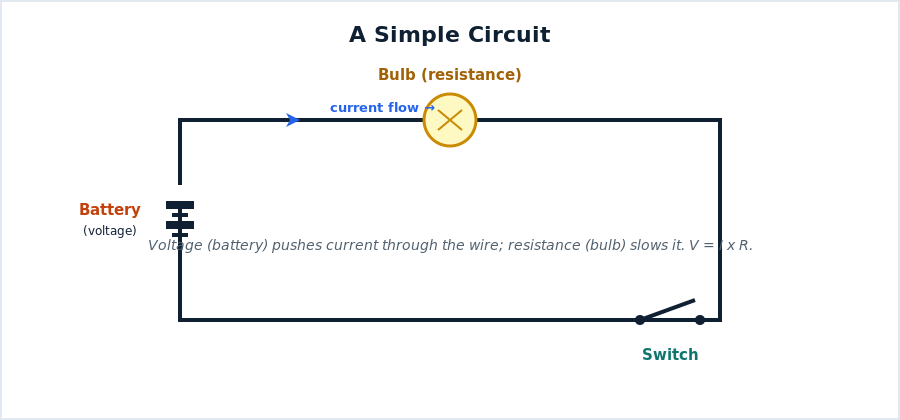
Three quantities describe electricity. Current is the flow of charge, measured in amperes (amps). Voltage is the push that drives the current, measured in volts — think of it as electrical pressure from a battery. Resistance is how much a material opposes the flow, measured in ohms. They are tied together by Ohm’s law: \[ V = I \times R, \] where \(V\) is voltage, \(I\) is current, and \(R\) is resistance. If you know two of them, you can find the third.
A Simple Circuit
A basic circuit needs a source of voltage (a battery), a path for the current (wires), and something that uses the energy (a bulb, called a load). A switch opens or closes the loop. When the switch is closed, current flows all the way around and the bulb lights. When it is open, the loop is broken and no current flows. For current to flow, the loop must be complete.
Series and Parallel
Components can be wired two ways. In a series circuit, everything is on one single loop, so if one bulb burns out, the whole circuit stops — like old holiday lights. In a parallel circuit, components are on separate branches, so if one fails, the others keep working — like the outlets in your home. Recognizing which type a diagram shows helps you predict what happens when part of the circuit breaks.
Watch: A Short Video Lesson
The Physics Channel with Kenny Lee walks through this skill clearly in a few minutes. It is a helpful companion to the reading above:
A Routine for Electricity Questions
- Current = flow of charge; voltage = the push; resistance = the opposition.
- Ohm’s law: \(V = I \times R\); solve for any missing value.
- Current flows only when the loop is complete (switch closed).
- Series = one loop (one break stops all); parallel = branches (others keep working).
Practice
- What is electric current?
- Write Ohm’s law.
- A circuit has \(12\) volts and \(3\) ohms of resistance. What is the current?
- What happens to a series circuit if one bulb burns out?
- What must be true for current to flow in a circuit?
- Which circuit keeps working if one branch fails: series or parallel?
Answers
- The flow of charged particles (usually electrons).
- \(V = I \times R\).
- \(I = \dfrac{V}{R} = \dfrac{12}{3} = 4 \text{ amps}\).
- The whole circuit stops working.
- The loop must be complete (closed).
- Parallel.
Where This Fits in Your Science Prep
Electricity uses the same formula skills as units and formulas and connects to energy, since circuits transfer electrical energy. See all topics on the Science Topics Hub.

Related to This Article
More math articles
- Geometry Puzzle – Challenge 60
- How to Find Missing Angels in Quadrilateral Shapes? (+FREE Worksheet!)
- The AEF, the Armistice, and the Human Cost of War
- Independent & Dependent Variables in Tables and Graphs
- First Amendment Freedom of the Press
- Why a 100% Casino Bonus Is Rarely Worth What It Sounds Like
- Free Grade 4 English Worksheets for Arkansas Students
- Package Integrity and Method Verification
- How to Solve Finite Geometric Series? (+FREE Worksheet!)
- The Best Grade 3 Math Book for Delaware Students





















What people say about "Electricity and Simple Circuits"?
No one replied yet.