Earth’s Layers and Plate Tectonics
The ground feels solid and still, but Earth is layered like an onion and its surface is slowly moving. Two ideas explain a lot of earth science: the layers of the Earth and plate tectonics. Together they account for mountains, earthquakes, and volcanoes.
The Layers of the Earth
Earth has four main layers. The crust is the thin, rocky surface we live on. Below it is the mantle, a thick layer of hot rock that flows very slowly. Deeper still is the outer core, made of liquid metal, and at the center is the inner core, solid metal and the hottest part of all. Each layer is hotter than the one above it.
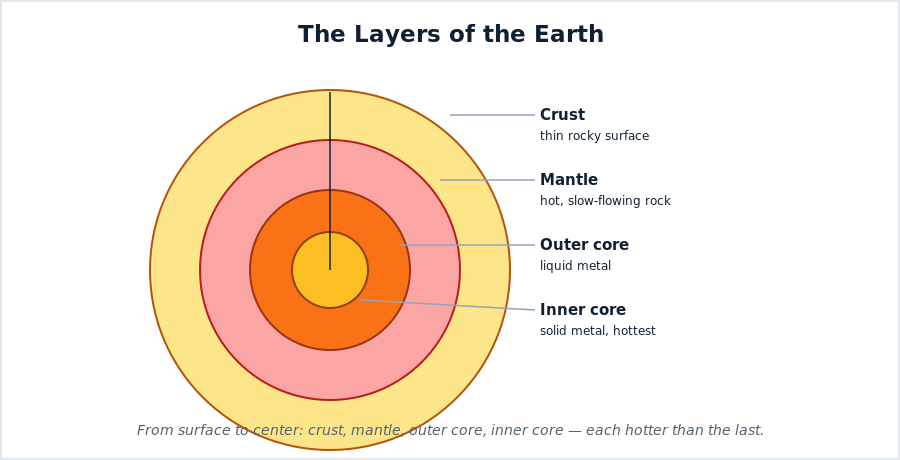
Plate Tectonics
The crust is not one solid shell — it is broken into large pieces called tectonic plates that float on the flowing mantle and slowly move. Where plates meet, big things happen. Plates can pull apart, push together, or slide past each other, and these boundaries are where most earthquakes and volcanoes occur. When plates collide, they can push up mountains over millions of years.
Why It Matters
Plate tectonics ties together many earth-science facts. Earthquakes happen when plates suddenly slip. Volcanoes form where magma rises at plate boundaries. Mountains grow where plates crash together. So when a question asks what causes these events, the answer usually traces back to moving plates on top of the mantle.
Watch: A Short Video Lesson
John Lanser walks through this skill clearly in a few minutes. It is a helpful companion to the reading above:
A Routine for These Questions
- Order the layers: crust, mantle, outer core, inner core (hotter toward the center).
- The crust is broken into tectonic plates that float on the mantle.
- Plate boundaries produce earthquakes, volcanoes, and mountains.
- Colliding plates build mountains over long times.
Practice
- What is the thin outer layer of Earth called?
- Which layer is made of slowly flowing hot rock?
- What is the hottest layer?
- What are the large moving pieces of crust called?
- Name one event that happens at plate boundaries.
- What forms when two plates collide?
Answers
- The crust.
- The mantle.
- The inner core.
- Tectonic plates.
- Earthquakes or volcanoes.
- Mountains.
Where This Fits in Your Science Prep
Earth’s structure connects to rocks and the rock cycle and to natural hazards and the age of Earth. See all topics on the Science Topics Hub.

Related to This Article
More math articles
- Top 10 CLEP College Algebra Practice Questions
- The Hidden Arithmetic That Breaks the Martingale System Every Time
- Congressional control of the budget
- How to Use Number Lines to Graph Fractions as Decimals
- How to Understand Random Sampling and Variation in Samples?
- Solve equilibrium equations without losing the economics
- The Best Standingff Desks for Online Teachersf
- Free Grade 5 Math Worksheets for Massachusetts Fifth Graders: 49 MCAS-Aligned PDFs with Solutions
- Prime Factorization Calculator (Factor Tree, Free)
- Vises and Clamps: Holding Work Safely





















What people say about "Earth's Layers and Plate Tectonics"?
No one replied yet.