The Best Grade 2 English Worksheets for Illinois Kids
The Best Grade 2 English Worksheets for Illinois Kids: a free, printable set you can download and use right away, with answer keys, organized by topic so students can practice one skill at a time and teachers can assign exactly what a lesson needs.
54 free, printable ELA worksheets with answer keys, built for the year before IAR testing.
Most parents can name the day their child learned to read. Far fewer notice the day reading turned into something more, the day a second grader closed a book and said, “I think the fox was just lonely.” Nobody taught that sentence directly. It’s what happens when a child reads enough, thinks enough, and starts caring about why things happen in a story.
This page gathers free English worksheets for Illinois second graders, made for that thoughtful, building year. There are short stories and short nonfiction passages, plus phonics, grammar, punctuation, and the first real writing, opinions, small reports, and stories with a clear shape.
Everything here is free. Each worksheet is a printable PDF with an answer key, and there’s no sign-up wall, no email box, no account required. Click the title, the PDF opens, you print it. Use one at home tonight or copy a set for the whole class.
The skills below follow the Grade 2 English Language Arts standards Illinois has adopted, which is just a precise way of saying these worksheets cover what your child’s teacher is working on this year.
How the collection is set up
The worksheets are sorted into eight strands, the way a second-grade reading block usually runs. Reading literature and reading nonfiction. The foundational decoding skills beneath smooth reading. Writing. Speaking and listening. Grammar. Capitalization and punctuation. And vocabulary.
Each worksheet covers one skill on purpose. A single focused page on irregular plural nouns, with a quick conversation afterward, teaches more than a fat packet rushed before dinner. Browse the list, take what your child needs, and leave the rest for later. Nothing has to be done in order.
Reading: Literature
- Asking and Answering Questions About Stories, answering the who, what, and why a story raises
- Central Message, Lesson, or Moral, figuring out the lesson a story is built around
- How Characters Respond to Events, tracking how a character feels and acts when something happens
- Rhythm and Meaning in Stories, Poems, and Songs, hearing beat and rhyme, and what they add to meaning
- The Structure of a Story, how the beginning, middle, and end work together
- Points of View of Characters, seeing that characters can read the same event differently
- Using Illustrations to Understand Stories, reading the pictures, not just the words
- Comparing Two Versions of the Same Story, placing two tellings of one tale side by side
Reading: Nonfiction
- Asking and Answering Questions About Nonfiction, pulling real answers from a fact-based text
- Main Topic and Focus of Paragraphs, naming what a paragraph is mostly about
- Connections Between Events, Ideas, and Steps, seeing how one idea leads to the next
- Nonfiction Vocabulary, the special words that turn up in science and social studies
- Text Features, using headings, bold words, and captions as tools
- The Author’s Main Purpose, deciding whether the writer meant to inform, entertain, or persuade
- How Images Help a Text, when a photo or diagram explains what the words don’t
- How Reasons Support the Author’s Points, spotting the reasons a writer gives for an idea
- Comparing Two Texts on the Same Topic, two articles, one subject, comparing what each says
Foundational Reading Skills
- Long and Short Vowels, the difference between tap and tape
- Vowel Teams, pairs of vowels working together, as in beach, trail, and boat
- Decoding Two-Syllable Words, breaking longer words into pieces that make sense
- Prefixes and Suffixes, how parts like un- and -less shift a word’s meaning
- Words with Tricky Spelling Patterns, the patterns that trip kids up
- Irregularly Spelled Words (Sight Words), the words that just have to be known by sight
- Reading Fluency: Accuracy, Rate, and Expression, reading correctly, at a good pace, with feeling
- Self-Correcting While You Read, catching a mistake and fixing it on your own
Writing
- Opinion Writing, stating what you think and backing it with a reason
- Informative and Explanatory Writing, explaining a topic clearly on paper
- Narrative Writing, telling a story in order, with details that bring it alive
- Revising and Editing, improving a draft one careful pass at a time
- Shared Research Projects, exploring a question together as a group
- Gathering Information to Answer a Question, collecting the facts that answer a real question
Speaking and Listening
- Recounting Ideas from a Read-Aloud, retelling the important parts after listening to a story
- Asking and Answering Questions About a Speaker, listening well enough to ask and answer thoughtfully
- Telling a Story or Sharing an Experience, speaking clearly so a listener can picture it
Grammar
- Collective Nouns, words that name a group, like crowd and flock
- Irregular Plural Nouns, when child becomes children and tooth becomes teeth
- Reflexive Pronouns, myself, herself, ourselves
- Past Tense of Irregular Verbs, verbs that don’t just add -ed, like run and ran
- Adjectives and Adverbs, words that describe nouns and words that describe verbs
- Expanding and Rearranging Sentences, stretching a plain sentence into a fuller one
Capitalization, Punctuation, and Spelling
- Capitalizing Holidays, Products, and Place Names, knowing which words take a capital letter
- Commas in Greetings and Closings of Letters, the commas in Dear Aunt Sue, and Your friend,
- Apostrophes: Contractions and Possessives, isn’t and Maria’s hat
- Spelling Patterns, the patterns that make spelling less of a guess
- Using Reference Materials to Check Spelling, checking a word instead of hoping it’s right
Vocabulary and Word Study
- Formal and Informal English, how language shifts between recess talk and a written report
- Context Clues, using nearby words to crack a new one
- Prefixes, the little beginnings that flip a word’s meaning
- Root Words and Word Endings, finding the base word and what’s stuck onto it
- Compound Words, two words joined into one, like raincoat and playground
- Using Glossaries and Dictionaries, looking up a word and its meaning
- Real-Life Word Connections, tying new words to everyday experience
- Shades of Meaning, the difference between big, large, and huge
- Using Describing Words and New Vocabulary, putting colorful new words to work in speaking and writing
Making the most of each worksheet
A worksheet is only as good as the way it’s used. Here’s what makes the real difference:
Pick one. Just one. It’s tempting to print a stack and feel ahead. Don’t. A single page, done with care and a real conversation afterward, beats six done in a blur.
Read the Quick Review box together first. That short box at the top is the lesson itself. Read it aloud, talk through the example, then hand over the pencil.
Go over the answer key together. The score isn’t the point. Sit side by side and look closely at the missed questions. Understanding why an answer is wrong is the moment that teaches.
Revisit weak skills after a week. If your child misses several questions on a skill, don’t redo it that night. Wait five or six days and try a fresh worksheet on the same skill. Spacing makes it stick.
What about the IAR?
Plenty of Illinois families find this page because of the Illinois Assessment of Readiness, the IAR. So here’s the honest picture. The IAR English Language Arts test starts in third grade. There is no IAR ELA test in second grade. That makes second grade the foundation year, the year your child builds the reading and writing skills the IAR will later measure.
So these worksheets aren’t test prep in the cram-the-week-before sense. They’re skill prep. A second grader who reads with understanding and writes a clear, organized paragraph is steadily becoming a student ready for the IAR, no last-minute scramble required. Build the skills calmly now, and the test takes care of itself later.
Common questions
Are these aligned with Illinois standards? Yes. Each worksheet targets a specific skill from the Grade 2 English Language Arts standards Illinois has adopted.
Is there an IAR test in second grade? No. The IAR ELA test begins in Grade 3. Second grade is about building the foundation.
My child reads above grade level. What should we try? Reach for Comparing Two Texts on the Same Topic and Points of View of Characters. Both push a strong reader without leaving the grade behind.
My child needs extra support. Where do we start? Begin with Vowel Teams and Context Clues. Steady decoding and the habit of using clues make the rest of reading easier.
Can homeschool families use these? Yes, completely. They work at a kitchen table as well as a classroom, as daily practice or a quick check after a longer lesson.
Which strand matters most? Honestly, reading and vocabulary carry the most weight. If you can only do a little, lean there.
One last thing
If tonight’s worksheet ends up half done, with a few stars drawn in the margin, that’s a normal second-grade evening. Try a shorter one tomorrow, or come back to that skill next week. The goal was never a finished page. It’s a child who keeps growing as a reader and writer. Keep the practice small and steady, and stop by anytime you need a new one.
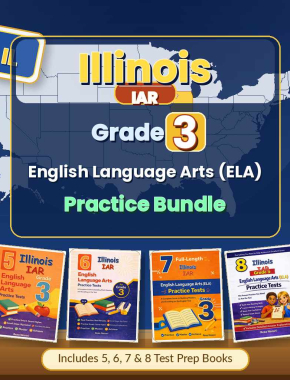
Ready for Grade 3 English? The Illinois IAR Grade 3 English Bundle
Second grade is the build-up year, and when your child is ready for what comes next, this bundle makes the jump to Grade 3 English feel easy. It includes four full practice-test books (5 + 6 + 7 + 8 tests) covering the Grade 3 reading, writing, and language skills just ahead, with explained answer keys and an instant PDF download.
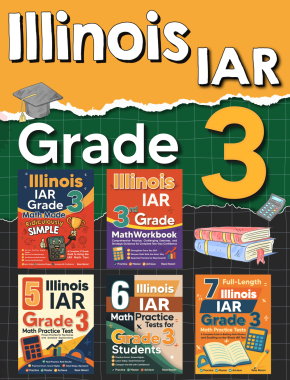
Getting Ready for Grade 3 Math, Too? The Illinois IAR Grade 3 Math Bundle
The same jump to Grade 3 happens in math. If your second grader could use a head start there as well, this Illinois IAR Grade 3 Math bundle is the shortest path, workbook, study guide, and full practice tests in one instant download, with answer keys throughout.

Related to This Article
More math articles
- The Best Grade 2 Math Worksheets for Florida Students
- Selecting and Integrating Evidence
- Top 10 Tips to Overcome CBEST Math Anxiety
- The Wonderful World of the Triangle Inequality Theorem
- Full-Length 6th Grade PSSA Math Practice Test
- Factors and Factor Pairs for 4th Grade
- The Ultimate ParaPro Math Formula Cheat Sheet
- A Deep Dive Into The World of Trigonometric Limits
- Economic Crises and Economic Freedom
- Warrants and probable cause












What people say about "Illinois Grade 2 English Worksheets: Free PDFs"?
No one replied yet.