The Muscular System
Students often see the muscular system as a cluster of new terms. A steadier route is to connect Skeletal muscle with Cardiac muscle, then place Smooth muscle and Antagonistic pair into the same working picture.
Definition: Muscle tissue contracts, meaning it shortens and produces force. Skeletal muscle moves bones under voluntary control, cardiac muscle pumps blood through the heart, and smooth muscle moves materials through hollow organs. Muscles pull rather than push, so body movements often depend on opposing muscle pairs.
What do you need to know about the muscular system?
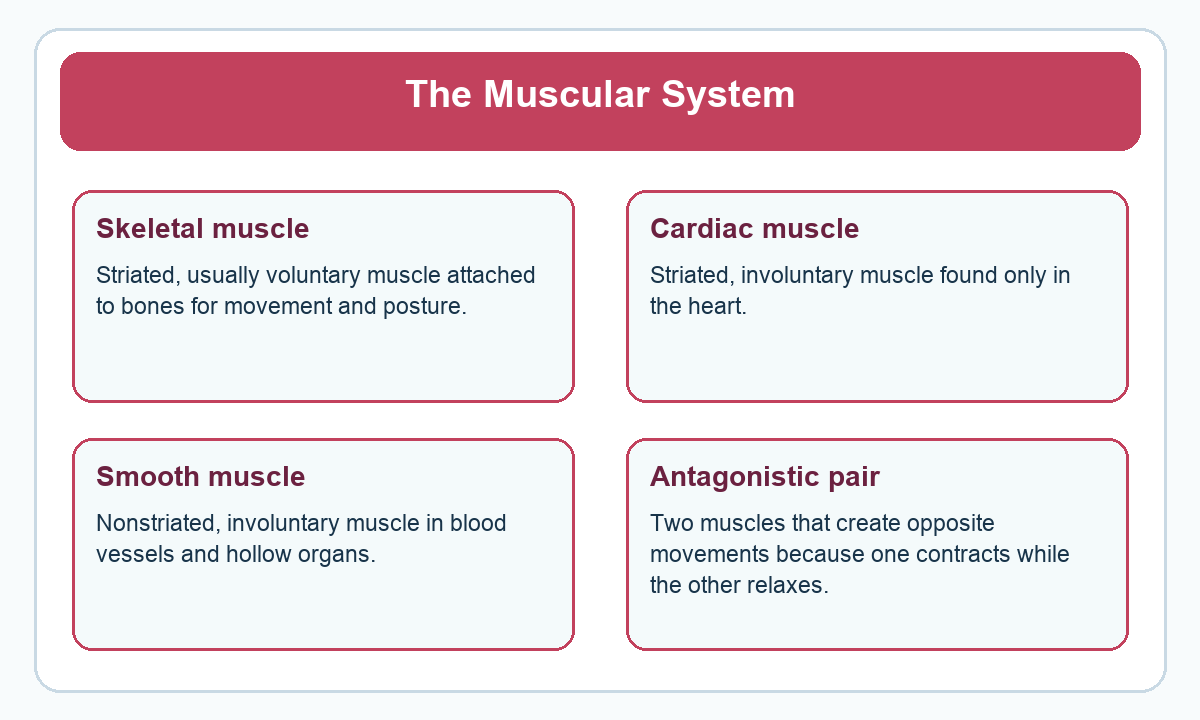
Use the visual as a recall tool: read the Skeletal muscle box, cover it, and explain it from memory. Repeat that move for Cardiac muscle, Smooth muscle, and Antagonistic pair; then explain how the four ideas connect.
What should you remember about the muscular system?
| Idea | What it means |
|---|---|
| Skeletal muscle | Striated, usually voluntary muscle attached to bones for movement and posture. |
| Cardiac muscle | Striated, involuntary muscle found only in the heart. |
| Smooth muscle | Nonstriated, involuntary muscle in blood vessels and hollow organs. |
| Antagonistic pair | Two muscles that create opposite movements because one contracts while the other relaxes. |
How can each anchor help you answer a question?
Skeletal muscle as a question clue
Striated, usually voluntary muscle attached to bones for movement and posture. A useful contrast is cardiac muscle: striated, involuntary muscle found only in the heart.
Cardiac muscle as a question clue
Striated, involuntary muscle found only in the heart. A useful contrast is smooth muscle: nonstriated, involuntary muscle in blood vessels and hollow organs.
Smooth muscle as a question clue
Nonstriated, involuntary muscle in blood vessels and hollow organs. A useful contrast is antagonistic pair: two muscles that create opposite movements because one contracts while the other relaxes.
Antagonistic pair as a question clue
Two muscles that create opposite movements because one contracts while the other relaxes. A useful contrast is skeletal muscle: striated, usually voluntary muscle attached to bones for movement and posture.
What else helps this topic make sense?
Contraction begins when a muscle cell receives a signal and uses energy to slide protein filaments past one another. The filaments do not disappear; their overlap changes and the muscle unit shortens. Calcium helps expose binding sites, while ATP supports repeated cycling and later relaxation. This molecular picture explains several larger facts at once: muscles require energy, nerve input controls many contractions, and fatigue can appear when demand outpaces the systems supplying fuel and removing by-products.
How does this idea work in a real question?
To bend the elbow, the biceps contracts while the triceps relaxes. To straighten the elbow, the triceps contracts while the biceps relaxes. Neither muscle pushes the forearm; each pulls through a tendon.
For this example, first identify which of the four anchors is changing or acting. Follow its effect through the situation and name the result before comparing choices. This keeps your reasoning tied to evidence rather than to a familiar-looking term.
What is a reliable way to reason through it?
- Decide whether the question is mainly about Skeletal muscle, Cardiac muscle, Smooth muscle, or Antagonistic pair.
- Restate the job of the named idea before reading the answer choices.
- Use the Skeletal muscle, Antagonistic pair map above to trace direction, cause, evidence, or outcome in the order supplied.
- Test the remaining choice against this specific warning: Voluntary does not mean a muscle works only when you consciously think about it. Skeletal muscles also maintain posture and can participate in reflexes.
What mistake should you watch for?
Voluntary does not mean a muscle works only when you consciously think about it. Skeletal muscles also maintain posture and can participate in reflexes.
If two choices survive, ask which one preserves the stated relationship between Skeletal muscle and Cardiac muscle. Then check it against Smooth muscle or Antagonistic pair if either appears in the prompt.
Watch a short lesson
The video shows how skeleton and muscle cooperate, which directly supports the pull-only rule and movement by opposing pairs. Pause the lesson when a diagram or process appears and connect it with the four anchors in this page’s visual.
Can you check your understanding?
Try these six checks from memory. Open an answer only after you have said or written your own response.
-
In your own words, what is the central idea in this lesson?
Check the answer
Muscle tissue contracts, meaning it shortens and produces force. Skeletal muscle moves bones under voluntary control, cardiac muscle pumps blood through the heart, and smooth muscle moves materials through hollow organs. Muscles pull rather than push, so body movements often depend on opposing muscle pairs.
-
What should you remember about skeletal muscle?
Check the answer
Striated, usually voluntary muscle attached to bones for movement and posture.
-
What should you remember about cardiac muscle?
Check the answer
Striated, involuntary muscle found only in the heart.
-
What should you remember about smooth muscle?
Check the answer
Nonstriated, involuntary muscle in blood vessels and hollow organs.
-
What should you remember about antagonistic pair?
Check the answer
Two muscles that create opposite movements because one contracts while the other relaxes.
-
What final check is most useful for a question about the muscular system?
Check the answer
Compare the choice with the relationship among Skeletal muscle, Cardiac muscle, Smooth muscle, and Antagonistic pair. Then apply this warning: Voluntary does not mean a muscle works only when you consciously think about it. Skeletal muscles also maintain posture and can participate in reflexes.
Where does this fit in your science review?
The ATI TEAS Science Study Hub places this lesson inside the larger anatomy and physiology review. Continue with these connected lessons:
Recommended ATI TEAS resources

Related to This Article
More math articles
- The Best Grade 4 ELA Practice Tests for Florida Students
- The Best Grade 4 Math Book for Louisiana Students
- 5th Grade MEAP Math Practice Test Questions
- CLEP U.S. History I 015: Quaker Pennsylvania and Negotiated Diversity
- Summer Math Slide: How to Prevent It (and Reverse It Fast)
- Top 5 Free Websites for Pre-Algebra Preparation
- Discovering the Magic of SSS and SAS Congruence in Triangles
- Waves, Sound, and Light: A CLEP Beginner’s Guide
- 8th Grade STAAR Math Worksheets: FREE & Printable
- CLEP College Algebra FREE Sample Practice Questions












What people say about "ATI TEAS 7: The Muscular System"?
No one replied yet.