CLEP U.S. History I 007: Powhatan Relations and Warfare
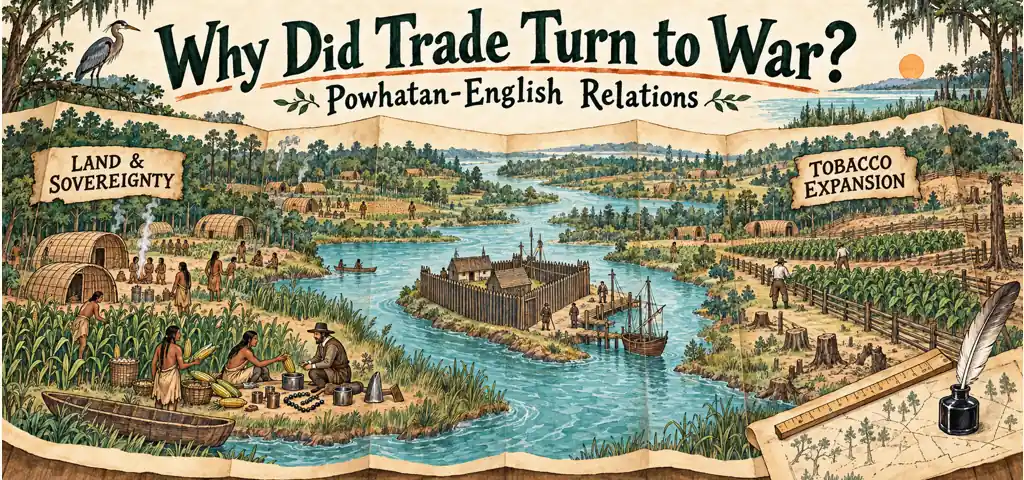
Lesson 2.2 of Chapter 2 of the U.S. History to 1877 study guide on Effortless Math covers CLEP U.S. History I 007: Powhatan Relations and Warfare: the key terms, the core ideas, and worked examples showing how this topic is tested on the exam.
U.S. History to 1877 | Chapter 2 | Lesson 2.2
The English arrived within the territory of a powerful alliance led by Wahunsenacawh, whom the English called Powhatan. He governed through relationships with tributary communities rather than a centralized European state. At first, exchange could benefit both sides. Colonists needed corn. Powhatan leaders could obtain metal goods and perhaps use the newcomers within regional rivalries. Each side, however, interpreted diplomacy through its own political expectations.
English settlement became harder to contain as tobacco pushed farms outward. Colonists often treated trade as an entitlement and land transfer as permanent alienation. Powhatan communities faced crop theft, armed pressure, and settlement on their lands. Violence alternated with fragile truces. Pocahontas’s marriage to John Rolfe in 1614 supported several years of peace, but it did not resolve the structural conflict between an expanding settler population and Native sovereignty.
After Powhatan’s death, Opechancanough led coordinated attacks on March 22, 1622. National Park Service summaries estimate approximately 350-400 English deaths among roughly 1,200 colonists, or about 29-33 percent. The familiar “one quarter” is traditional shorthand, not a mathematical rounding of those estimates. English authorities answered with a distinct decade-long war, crop destruction, and territorial seizure. Opechancanough launched another large assault in 1644, beginning a later conflict that ended with his capture and the 1646 treaty. That treaty imposed boundaries and tribute on surviving Native communities, marking a sharp decline in Powhatan political independence in the coastal region.
Older narratives described these wars as the natural result of “savage” hostility or as sudden betrayals. A better explanation asks what changed. Population, tobacco acreage, and English military capacity grew. The room for negotiated coexistence narrowed because settlers sought control of land rather than limited trade alone. Powhatan resistance was strategic defense of territory, even when Native leaders disagreed over how to respond.
Watch, then test the claim
TIMELINE offers a visual route through this topic. As you watch, compare its explanation with the source limits in the written lesson.
Video: Anglo-Powhatan Wars in Jamestown, Virginia 1610 | Pocahontas, John Smith & John Rolfe Chesapeake Bay, TIMELINE.
Check your understanding
- Which interpretation best explains why early Powhatan-English exchange could continue despite different political expectations?
- Each side believed that the first exchanges had settled the political hierarchy between them.
- Material exchange mattered because both communities could already supply their own food and military needs.
- Each side could seek material or strategic advantage without sharing the other’s interpretation.
- English military dominance made Powhatan influence unimportant from Jamestown’s first years.
- A mutually recognized boundary separated English planting from Powhatan land before regular exchange began.
- Which change most directly narrowed the space for negotiated coexistence?
- Tobacco farms spread along waterways and occupied more Powhatan land.
- English migrants increasingly became seasonal traders rather than settlers.
- Plantations moved away from river valleys and Native communities.
- The Crown enforced Powhatan jurisdiction over newly surveyed farms.
- English demand for corn fell as the colony abandoned export agriculture.
- Select all that apply. Which actions formed part of English responses to the major Powhatan wars?
- destruction of Powhatan cornfields
- retaliatory military campaigns
- seizure of additional territory
- treaty boundaries and tributary demands
- Powhatan authority over new English plantations
- Use change over time to explain why the peace associated with Pocahontas and John Rolfe did not last.
Write a brief response using a named fact from the lesson.
Open the answers and reasoning
Independent preparation. CLEP is a registered trademark of the College Board, which does not endorse this lesson.

Related to This Article
More math articles
- The Ultimate ParaPro Math Formula Cheat Sheet
- Grade 5 ELA Tests: A Clear Parent Guide to Reading, Writing, and Test-Day Readiness
- Voting-eligible population
- Pennsylvania PSSA Grade 8 Math Free Worksheets: Free Printable PDF Worksheets for Every Skill
- Multiplication Models: Area Models and Partial Products
- Difference Quotient Calculator (Free)
- The Best Calculators for Back to School 2026
- Electrostatics: Charge, Force, Field, and Potential
- Free Grade 3 English Worksheets for New Mexico Students
- Mississippi MAAP Grade 6 Math Free Worksheets: 72 Free Skill-by-Skill PDFs with Answer Keys













What people say about "Powhatan Relations and Warfare in Virginia"?
No one replied yet.