CLEP U.S. History I 006: Jamestown, Tobacco, and the Virginia Company
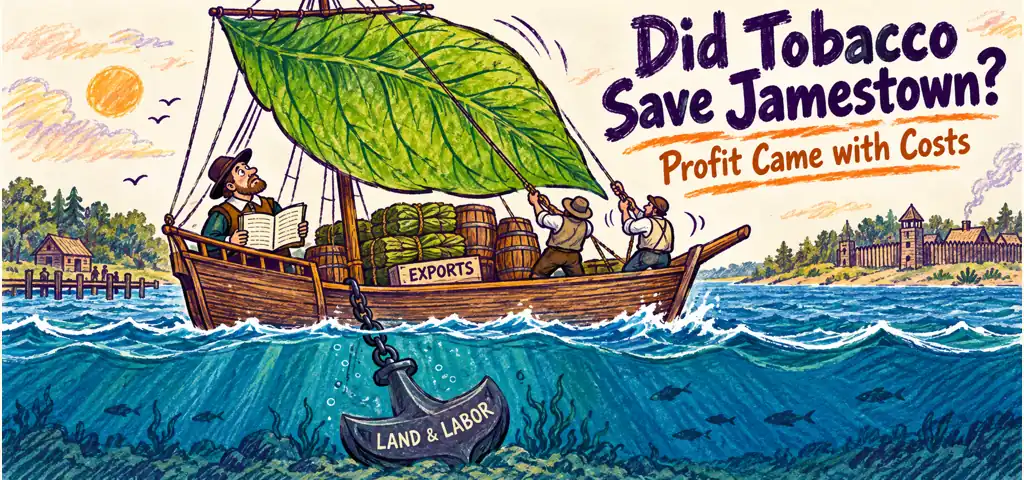
Lesson 2.1 of Chapter 2 of the U.S. History to 1877 study guide on Effortless Math covers CLEP U.S. History I 006: Jamestown, Tobacco, and the Virginia Company: the key terms, the core ideas, and worked examples showing how this topic is tested on the exam.
U.S. History to 1877 | Chapter 2 | Lesson 2.1
Jamestown was a business venture before it was a stable community. The Virginia Company expected valuable exports and a strategic foothold. Many first settlers searched for quick wealth instead of planting enough food. The low, swampy site was defensible from European ships but unhealthy, and drought worsened its water supply. Disease, hunger, weak preparation, and conflict brought extraordinary mortality. During the “starving time” of 1609-1610, the colony nearly collapsed.
Survival depended partly on the Powhatan chiefdom, whose communities traded corn while assessing whether the newcomers might become useful allies or dangerous intruders. English supply ships and stricter labor discipline also mattered. The decisive commercial development was John Rolfe’s cultivation of a tobacco variety appealing to English consumers. Tobacco created the profitable export investors wanted, but it demanded land and labor. Settlers spread along waterways, which carried leaf to Atlantic ships, and intruded further into Native territory.
The colony’s institutions evolved with its economy. The headright system granted land for financing migration, rewarding people who could bring servants. In 1619, the House of Burgesses gave some property-holding men a voice in local taxation and law. That representative body did not make Virginia democratic in a modern sense. Women, servants, enslaved people, Native people, and most propertyless men lacked formal power. The assembly instead helped local planters govern a commercial colony.
Jamestown’s story is not a clean movement from failure to success. Tobacco solved the company’s profit problem while creating new problems: dependence on one crop, constant demand for acreage, labor exploitation, and warfare. Institutions that later appeared durable emerged from the requirements and conflicts of a risky export economy.
See the history take shape
Use this lesson from Khan Academy to review the period and its central historical problem. Pause when the video reaches the turning point named above.
Video: Jamestown – life and labor in the Chesapeake, Khan Academy.
Check your understanding
- Which paired objective is most consistent with the Virginia Company’s 1606 charter?
- a Plymouth Separatist refuge joined to family subsistence
- a royal garrison joined to permanent tax support
- a mission colony joined to rejection of private investors
- investor profit joined to English imperial expansion
- an interior fur network joined to limited settlement
- Why did tobacco cultivation intensify pressure on Powhatan communities?
- It concentrated most planting within Jamestown’s defensive perimeter.
- It promoted riverside acreage expansion and greater labor demand.
- It shifted overseas exports from waterways to inland roads.
- It converted commercial fields into household subsistence plots.
- It stabilized a jointly recognized boundary around English farms.
- Select all that apply. Which paired conditions contributed directly to Jamestown’s early mortality?
- local grain output paired with export income
- corn exchange paired with negotiated planting boundaries
- disease paired with contaminated or brackish water
- agricultural specialists paired with freshwater wells
- drought paired with inadequate food supplies
- Explain how one institution and one environmental condition shaped early Jamestown.
Write a brief response using a named fact from the lesson.
Open the answers and reasoning
Independent preparation. CLEP is a registered trademark of the College Board, which does not endorse this lesson.

Related to This Article
More math articles
- How to Estimate Limit Values from the Graph?
- TExES Core Subjects Math- Test Day Tips
- Functionalist, Conflict, and Interactionist Views of Education
- Eliminate, Flag, and Review
- The Best Grade 8 ELA Practice Tests for Montana Students
- A payoff matrix must be read player by player
- Free Printable Grade 2 English Worksheets for Delaware
- Market supply adds quantities at each price
- The Best PERT Math Worksheets: FREE & Printable
- How to Understand Cost of Credit and Loans? (+FREE Worksheet!)












What people say about "Jamestown, Tobacco and the Virginia Company"?
No one replied yet.