The Integumentary System
Students often see the integumentary system as a cluster of new terms. A steadier route is to connect Epidermis with Dermis, then place Hypodermis and Temperature control into the same working picture.
Definition: The integumentary system includes the skin, hair, nails, sweat glands, and oil glands. It forms a protective boundary, helps control body temperature, limits water loss, provides sensation, and supports vitamin D production. Its layers have different structures and jobs rather than acting as one uniform covering.
What do you need to know about the integumentary system?
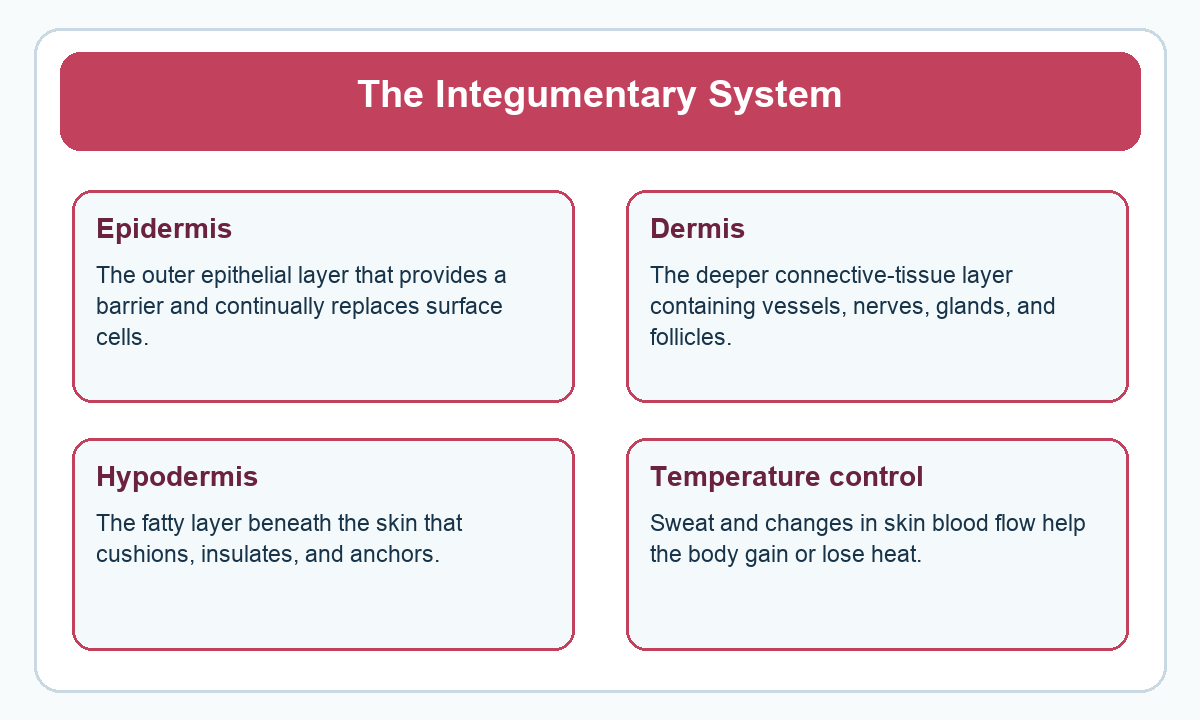
Use the visual as a recall tool: read the Epidermis box, cover it, and explain it from memory. Repeat that move for Dermis, Hypodermis, and Temperature control; then explain how the four ideas connect.
What should you remember about the integumentary system?
| Idea | What it means |
|---|---|
| Epidermis | The outer epithelial layer that provides a barrier and continually replaces surface cells. |
| Dermis | The deeper connective-tissue layer containing vessels, nerves, glands, and follicles. |
| Hypodermis | The fatty layer beneath the skin that cushions, insulates, and anchors. |
| Temperature control | Sweat and changes in skin blood flow help the body gain or lose heat. |
How can each anchor help you answer a question?
Epidermis as a question clue
The outer epithelial layer that provides a barrier and continually replaces surface cells. A useful contrast is dermis: the deeper connective-tissue layer containing vessels, nerves, glands, and follicles.
Dermis as a question clue
The deeper connective-tissue layer containing vessels, nerves, glands, and follicles. A useful contrast is hypodermis: the fatty layer beneath the skin that cushions, insulates, and anchors.
Hypodermis as a question clue
The fatty layer beneath the skin that cushions, insulates, and anchors. A useful contrast is temperature control: sweat and changes in skin blood flow help the body gain or lose heat.
Temperature control as a question clue
Sweat and changes in skin blood flow help the body gain or lose heat. A useful contrast is epidermis: the outer epithelial layer that provides a barrier and continually replaces surface cells.
What else helps this topic make sense?
Skin protection is both physical and biological. Closely joined epidermal cells and keratin slow water loss and block many outside materials. Slight acidity, normal microorganisms, and immune cells add chemical and cellular defense. Damage to a large skin area can therefore affect much more than appearance: fluid balance, temperature control, infection risk, and sensation may all change. Thinking in these connected functions explains why the skin is treated as an organ rather than as simple wrapping.
How does this idea work in a real question?
On a hot day, sweat reaches the skin surface and evaporates, carrying heat away. Blood vessels near the skin may widen so warm blood is closer to the environment. Both responses support temperature homeostasis.
For this example, first identify which of the four anchors is changing or acting. Follow its effect through the situation and name the result before comparing choices. This keeps your reasoning tied to evidence rather than to a familiar-looking term.
What is a reliable way to reason through it?
- Decide whether the question is mainly about Epidermis, Dermis, Hypodermis, or Temperature control.
- Restate the job of the named idea before reading the answer choices.
- Use the Epidermis, Temperature control map above to trace direction, cause, evidence, or outcome in the order supplied.
- Test the remaining choice against this specific warning: The hypodermis is closely associated with the skin but is not one of the two main skin layers. Keep epidermis and dermis separate from the tissue beneath them.
What mistake should you watch for?
The hypodermis is closely associated with the skin but is not one of the two main skin layers. Keep epidermis and dermis separate from the tissue beneath them.
If two choices survive, ask which one preserves the stated relationship between Epidermis and Dermis. Then check it against Hypodermis or Temperature control if either appears in the prompt.
Watch a short lesson
The urinary-system-and-skin video reviews the skin as a protective and regulatory organ and places it beside another system involved in waste and balance. Pause the lesson when a diagram or process appears and connect it with the four anchors in this page’s visual.
Can you check your understanding?
Try these six checks from memory. Open an answer only after you have said or written your own response.
-
In your own words, what is the central idea in this lesson?
Check the answer
The integumentary system includes the skin, hair, nails, sweat glands, and oil glands. It forms a protective boundary, helps control body temperature, limits water loss, provides sensation, and supports vitamin D production. Its layers have different structures and jobs rather than acting as one uniform covering.
-
What should you remember about epidermis?
Check the answer
The outer epithelial layer that provides a barrier and continually replaces surface cells.
-
What should you remember about dermis?
Check the answer
The deeper connective-tissue layer containing vessels, nerves, glands, and follicles.
-
What should you remember about hypodermis?
Check the answer
The fatty layer beneath the skin that cushions, insulates, and anchors.
-
What should you remember about temperature control?
Check the answer
Sweat and changes in skin blood flow help the body gain or lose heat.
-
What final check is most useful for a question about the integumentary system?
Check the answer
Compare the choice with the relationship among Epidermis, Dermis, Hypodermis, and Temperature control. Then apply this warning: The hypodermis is closely associated with the skin but is not one of the two main skin layers. Keep epidermis and dermis separate from the tissue beneath them.
Where does this fit in your science review?
The ATI TEAS Science Study Hub places this lesson inside the larger anatomy and physiology review. Continue with these connected lessons:
- Cells, Tissues, Organs, and Homeostasis
- The Skeletal System
- Anatomical Position and Body Organization
- The Muscular System
Recommended ATI TEAS resources

Related to This Article
More math articles
- The Ultimate 6th Grade TNReady Math Course (+FREE Worksheets)
- The Best Grade 4 ELA Practice Tests for South Carolina Students
- Heat, Temperature, and Pressure
- The Best Grade 4 ELA Practice Tests for California Students
- 10 Most Common 4th Grade PARCC Math Questions
- The Best Grade 7 ELA Practice Tests for Arkansas Students
- Number Properties Puzzle – Challenge 9
- From Equations To Innovation: Math Careers That Quietly Run The World
- FREE TABE Math Practice Test
- SHSAT Math Worksheets: FREE & Printable















What people say about "ATI TEAS 7: The Integumentary System"?
No one replied yet.