The Skeletal System
Students often see the skeletal system as a cluster of new terms. A steadier route is to connect Bone with Joint, then place Ligament and Tendon into the same working picture.
Definition: The skeletal system supports the body, protects organs, stores minerals, houses marrow that forms blood cells, and provides levers for movement. Bones are living tissues that remodel in response to stress. Joints connect bones, while cartilage, ligaments, and tendons contribute different kinds of support.
What do you need to know about the skeletal system?
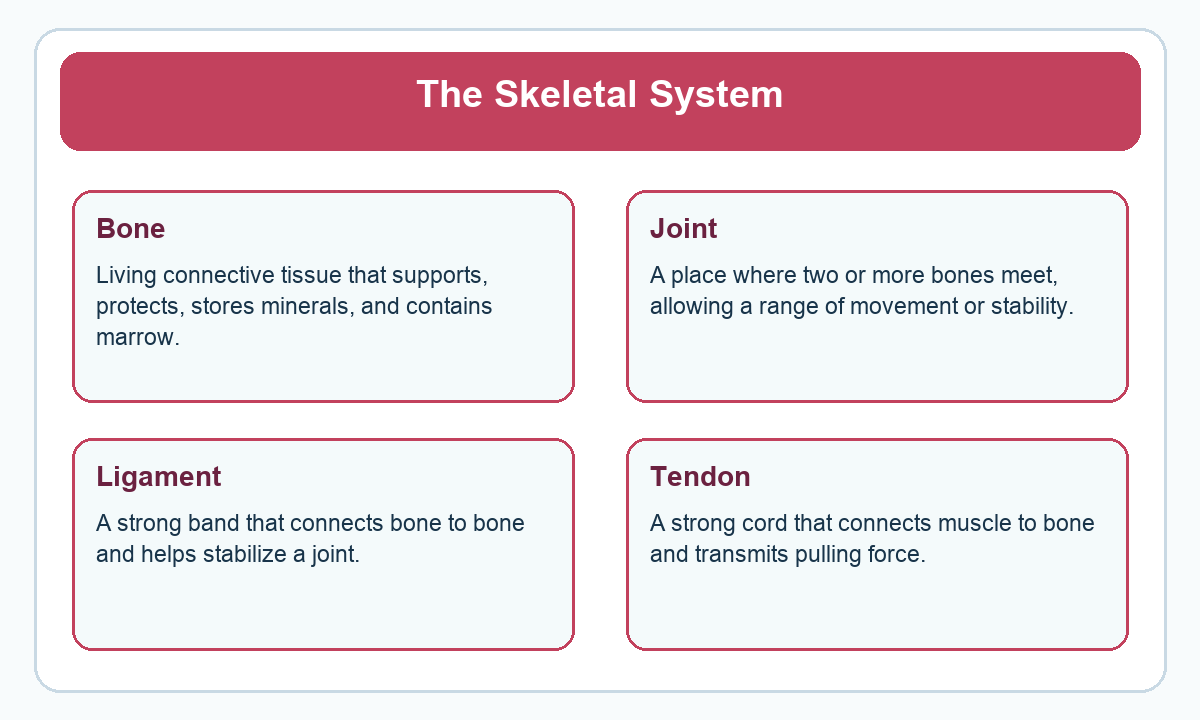
Use the visual as a recall tool: read the Bone box, cover it, and explain it from memory. Repeat that move for Joint, Ligament, and Tendon; then explain how the four ideas connect.
What should you remember about the skeletal system?
| Idea | What it means |
|---|---|
| Bone | Living connective tissue that supports, protects, stores minerals, and contains marrow. |
| Joint | A place where two or more bones meet, allowing a range of movement or stability. |
| Ligament | A strong band that connects bone to bone and helps stabilize a joint. |
| Tendon | A strong cord that connects muscle to bone and transmits pulling force. |
How can each anchor help you answer a question?
Bone as a question clue
Living connective tissue that supports, protects, stores minerals, and contains marrow. A useful contrast is joint: a place where two or more bones meet, allowing a range of movement or stability.
Joint as a question clue
A place where two or more bones meet, allowing a range of movement or stability. A useful contrast is ligament: a strong band that connects bone to bone and helps stabilize a joint.
Ligament as a question clue
A strong band that connects bone to bone and helps stabilize a joint. A useful contrast is tendon: a strong cord that connects muscle to bone and transmits pulling force.
Tendon as a question clue
A strong cord that connects muscle to bone and transmits pulling force. A useful contrast is bone: living connective tissue that supports, protects, stores minerals, and contains marrow.
What else helps this topic make sense?
Bone strength comes from a combination of flexible collagen fibers and hard mineral deposits. Remove too much mineral and bone bends too easily; remove the collagen framework and it becomes brittle. Bone is also continuously remodeled by cells that break down old matrix and cells that build new matrix. This activity helps repair small damage and adjust to repeated stress. It also explains why bone health depends on living cells, blood supply, minerals, hormones, and mechanical use.
How does this idea work in a real question?
When the biceps shortens, its tendon pulls on a forearm bone and the elbow bends. The bone acts as a lever, the joint acts as a pivot, and the muscle supplies the force. The systems work together rather than producing movement separately.
For this example, first identify which of the four anchors is changing or acting. Follow its effect through the situation and name the result before comparing choices. This keeps your reasoning tied to evidence rather than to a familiar-looking term.
What is a reliable way to reason through it?
- Decide whether the question is mainly about Bone, Joint, Ligament, or Tendon.
- Restate the job of the named idea before reading the answer choices.
- Use the Bone, Tendon map above to trace direction, cause, evidence, or outcome in the order supplied.
- Test the remaining choice against this specific warning: A ligament and a tendon are not interchangeable. Use the words connected by each: ligament links bone to bone; tendon links muscle to bone.
What mistake should you watch for?
A ligament and a tendon are not interchangeable. Use the words connected by each: ligament links bone to bone; tendon links muscle to bone.
If two choices survive, ask which one preserves the stated relationship between Bone and Joint. Then check it against Ligament or Tendon if either appears in the prompt.
Watch a short lesson
The video links homeostasis, bones, and muscles, reinforcing skeletal functions and the way the movement system works as a unit. Pause the lesson when a diagram or process appears and connect it with the four anchors in this page’s visual.
Can you check your understanding?
Try these six checks from memory. Open an answer only after you have said or written your own response.
-
In your own words, what is the central idea in this lesson?
Check the answer
The skeletal system supports the body, protects organs, stores minerals, houses marrow that forms blood cells, and provides levers for movement. Bones are living tissues that remodel in response to stress. Joints connect bones, while cartilage, ligaments, and tendons contribute different kinds of support.
-
What should you remember about bone?
Check the answer
Living connective tissue that supports, protects, stores minerals, and contains marrow.
-
What should you remember about joint?
Check the answer
A place where two or more bones meet, allowing a range of movement or stability.
-
What should you remember about ligament?
Check the answer
A strong band that connects bone to bone and helps stabilize a joint.
-
What should you remember about tendon?
Check the answer
A strong cord that connects muscle to bone and transmits pulling force.
-
What final check is most useful for a question about the skeletal system?
Check the answer
Compare the choice with the relationship among Bone, Joint, Ligament, and Tendon. Then apply this warning: A ligament and a tendon are not interchangeable. Use the words connected by each: ligament links bone to bone; tendon links muscle to bone.
Where does this fit in your science review?
The ATI TEAS Science Study Hub places this lesson inside the larger anatomy and physiology review. Continue with these connected lessons:
- The Integumentary System
- The Muscular System
- Cells, Tissues, Organs, and Homeostasis
- The Nervous System
Recommended ATI TEAS resources

Related to This Article
More math articles
- A Deep Dive Into The World of Trigonometric Limits
- The Best Grade 8 ELA Practice Tests for North Dakota Students
- 7th Grade OSTP Math Worksheets: FREE & Printable
- SIFT Math FREE Sample Practice Questions
- Grade 2 English Worksheets for Utah Students — Free PDFs
- The Best Grade 3 Math Book for Arkansas Students
- How to Use Area Models to Find Equivalent Fractions
- What Kind of Math Is on the CBEST Test?
- SSAT Middle-Level Math Worksheets: FREE & Printable
- 5th Grade PEAKS Math Worksheets: FREE & Printable











What people say about "ATI TEAS 7: The Skeletal System"?
No one replied yet.