The Nervous System
Students often see the nervous system as a cluster of new terms. A steadier route is to connect Sensory neuron with Interneuron, then place Motor neuron and Reflex arc into the same working picture.
Definition: The nervous system detects change, processes information, and produces rapid responses through electrical and chemical signals. The central nervous system includes the brain and spinal cord. The peripheral nervous system connects that center with receptors, muscles, glands, and organs throughout the body.
What do you need to know about the nervous system?
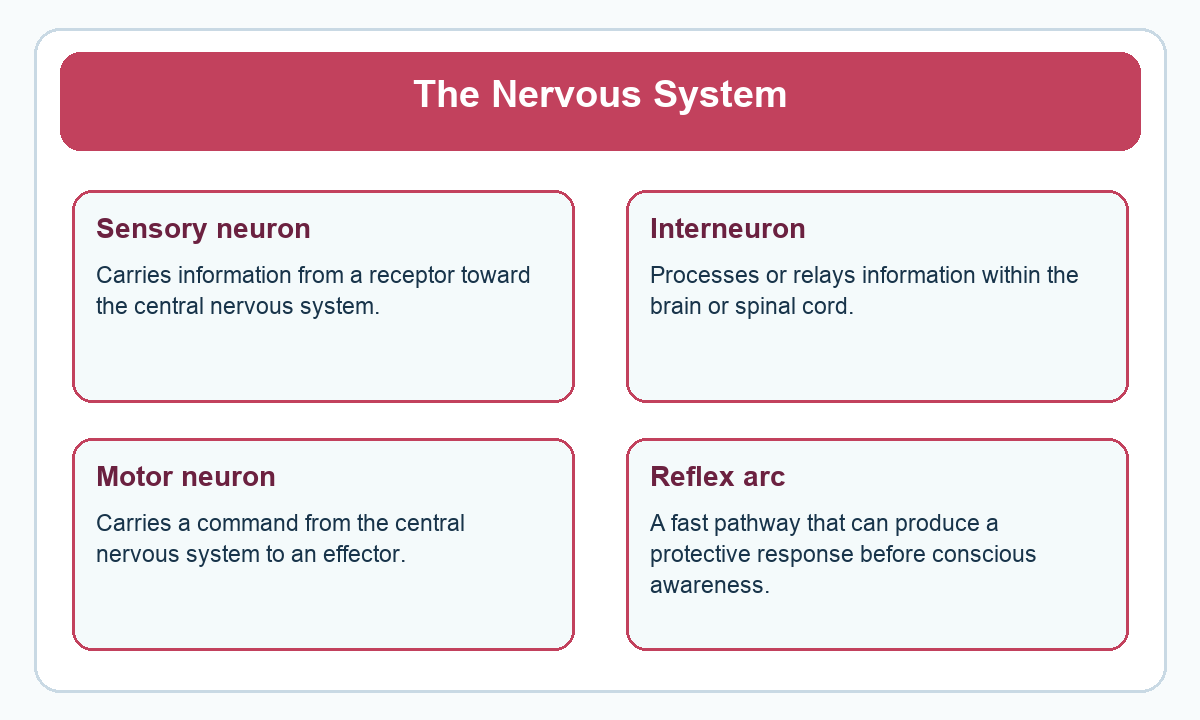
Use the visual as a recall tool: read the Sensory neuron box, cover it, and explain it from memory. Repeat that move for Interneuron, Motor neuron, and Reflex arc; then explain how the four ideas connect.
What should you remember about the nervous system?
| Idea | What it means |
|---|---|
| Sensory neuron | Carries information from a receptor toward the central nervous system. |
| Interneuron | Processes or relays information within the brain or spinal cord. |
| Motor neuron | Carries a command from the central nervous system to an effector. |
| Reflex arc | A fast pathway that can produce a protective response before conscious awareness. |
How can each anchor help you answer a question?
Sensory neuron as a question clue
Carries information from a receptor toward the central nervous system. A useful contrast is interneuron: processes or relays information within the brain or spinal cord.
Interneuron as a question clue
Processes or relays information within the brain or spinal cord. A useful contrast is motor neuron: carries a command from the central nervous system to an effector.
Motor neuron as a question clue
Carries a command from the central nervous system to an effector. A useful contrast is reflex arc: a fast pathway that can produce a protective response before conscious awareness.
Reflex arc as a question clue
A fast pathway that can produce a protective response before conscious awareness. A useful contrast is sensory neuron: carries information from a receptor toward the central nervous system.
What else helps this topic make sense?
The somatic and autonomic divisions organize different motor outputs. Somatic motor pathways mainly control skeletal muscle. Autonomic pathways regulate smooth muscle, cardiac muscle, and glands through sympathetic and parasympathetic branches. Sympathetic activity prepares the body for demanding action, while parasympathetic activity supports routine maintenance such as digestion. These branches often have opposing effects on the same organ, but they cooperate to match body function with changing conditions rather than acting as simple on and off switches.
How does this idea work in a real question?
Touching a hot surface activates skin receptors. A sensory neuron carries the signal to the spinal cord, interneurons organize a response, and a motor neuron activates muscles that withdraw the hand. The brain receives the information as the response begins.
For this example, first identify which of the four anchors is changing or acting. Follow its effect through the situation and name the result before comparing choices. This keeps your reasoning tied to evidence rather than to a familiar-looking term.
What is a reliable way to reason through it?
- Decide whether the question is mainly about Sensory neuron, Interneuron, Motor neuron, or Reflex arc.
- Restate the job of the named idea before reading the answer choices.
- Use the Sensory neuron, Reflex arc map above to trace direction, cause, evidence, or outcome in the order supplied.
- Test the remaining choice against this specific warning: A reflex is not a signal that skips the central nervous system. Many protective reflexes are integrated in the spinal cord rather than waiting for conscious processing in the brain.
What mistake should you watch for?
A reflex is not a signal that skips the central nervous system. Many protective reflexes are integrated in the spinal cord rather than waiting for conscious processing in the brain.
If two choices survive, ask which one preserves the stated relationship between Sensory neuron and Interneuron. Then check it against Motor neuron or Reflex arc if either appears in the prompt.
Watch a short lesson
The nervous-system-and-reflexes video follows signal pathways and protective responses, closely matching the lesson's beginner sequence. Pause the lesson when a diagram or process appears and connect it with the four anchors in this page’s visual.
Can you check your understanding?
Try these six checks from memory. Open an answer only after you have said or written your own response.
-
In your own words, what is the central idea in this lesson?
Check the answer
The nervous system detects change, processes information, and produces rapid responses through electrical and chemical signals. The central nervous system includes the brain and spinal cord. The peripheral nervous system connects that center with receptors, muscles, glands, and organs throughout the body.
-
What should you remember about sensory neuron?
Check the answer
Carries information from a receptor toward the central nervous system.
-
What should you remember about interneuron?
Check the answer
Processes or relays information within the brain or spinal cord.
-
What should you remember about motor neuron?
Check the answer
Carries a command from the central nervous system to an effector.
-
What should you remember about reflex arc?
Check the answer
A fast pathway that can produce a protective response before conscious awareness.
-
What final check is most useful for a question about the nervous system?
Check the answer
Compare the choice with the relationship among Sensory neuron, Interneuron, Motor neuron, and Reflex arc. Then apply this warning: A reflex is not a signal that skips the central nervous system. Many protective reflexes are integrated in the spinal cord rather than waiting for conscious processing in the brain.
Where does this fit in your science review?
The ATI TEAS Science Study Hub places this lesson inside the larger anatomy and physiology review. Continue with these connected lessons:
Recommended ATI TEAS resources

Related to This Article
More math articles
- Free Grade 6 English Worksheets for Alaska Students
- Economic conditions
- Mastering the Metrics of Chance: A Complete Guide to Understanding Random Variables
- Free Grade 7 English Worksheets for Alaska Students
- Smarter Balanced Grade 8 Math Free Worksheets: 72 Printable Standards-Aligned PDFs with Answer Keys
- Ratio, Proportion and Percentages Puzzle -Critical Thinking 10
- Top 10 Math Books for Grade 4: Empowering Young Minds to Discover Numbers
- Chapter 5: Separation of Powers and Checks and Balances
- 4th Grade WY-TOPP Math Worksheets: FREE & Printable
- CLEP U.S. History I 074: Romantic Nationalism in Art and Literature



















What people say about "ATI TEAS 7: The Nervous System"?
No one replied yet.