The Cardiovascular System
Students often see the cardiovascular system as a cluster of new terms. A steadier route is to connect Artery with Vein, then place Capillary and Cardiac cycle into the same working picture.
Definition: The cardiovascular system moves blood through the heart and vessels so cells receive oxygen, nutrients, hormones, and heat while wastes are carried away. The right side of the heart sends blood to the lungs; the left side sends blood to the body. Valves keep flow moving forward.
What do you need to know about the cardiovascular system?
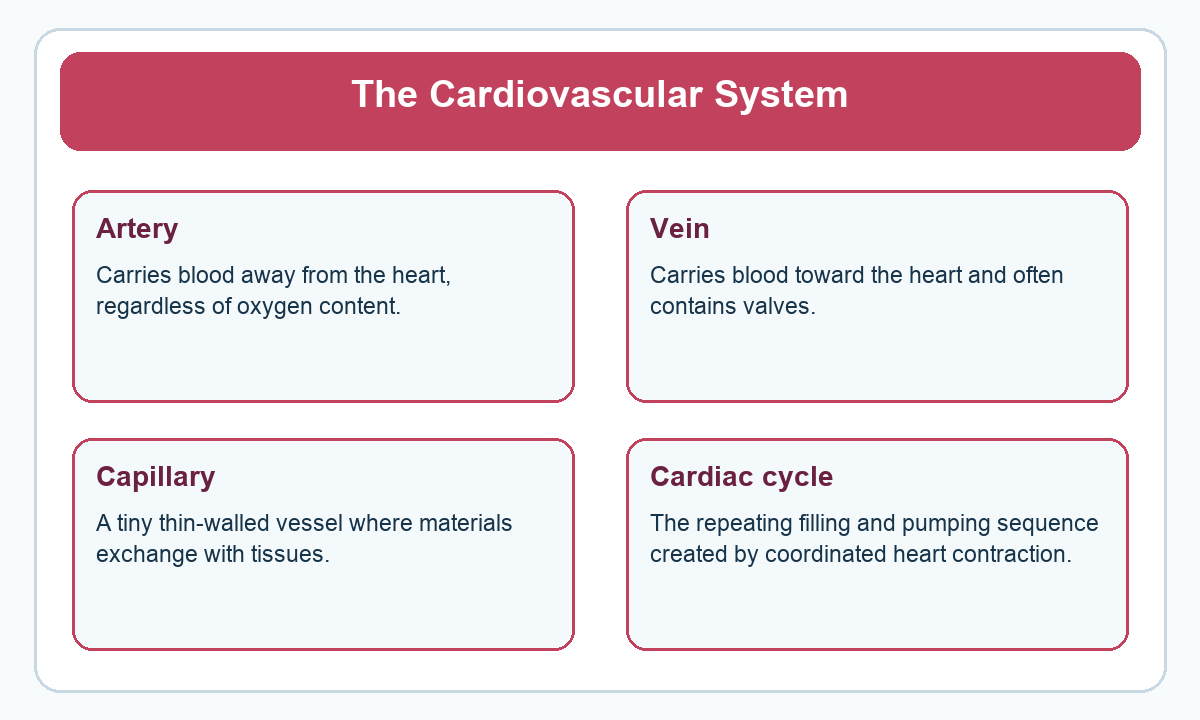
Use the visual as a recall tool: read the Artery box, cover it, and explain it from memory. Repeat that move for Vein, Capillary, and Cardiac cycle; then explain how the four ideas connect.
What should you remember about the cardiovascular system?
| Idea | What it means |
|---|---|
| Artery | Carries blood away from the heart, regardless of oxygen content. |
| Vein | Carries blood toward the heart and often contains valves. |
| Capillary | A tiny thin-walled vessel where materials exchange with tissues. |
| Cardiac cycle | The repeating filling and pumping sequence created by coordinated heart contraction. |
How can each anchor help you answer a question?
Artery as a question clue
Carries blood away from the heart, regardless of oxygen content. A useful contrast is vein: carries blood toward the heart and often contains valves.
Vein as a question clue
Carries blood toward the heart and often contains valves. A useful contrast is capillary: a tiny thin-walled vessel where materials exchange with tissues.
Capillary as a question clue
A tiny thin-walled vessel where materials exchange with tissues. A useful contrast is cardiac cycle: the repeating filling and pumping sequence created by coordinated heart contraction.
Cardiac cycle as a question clue
The repeating filling and pumping sequence created by coordinated heart contraction. A useful contrast is artery: carries blood away from the heart, regardless of oxygen content.
What else helps this topic make sense?
Blood pressure and exchange depend on vessel structure. Arteries have thick elastic walls that tolerate and smooth the pressure created by heart contractions. Veins operate at lower pressure and use valves plus skeletal-muscle movement to support return flow. Capillary walls are only one cell layer thick, shortening the diffusion distance for gases, nutrients, and wastes. Matching each wall to its job is more useful than memorizing vessel names without structure.
How does this idea work in a real question?
A red blood cell returning from the body enters the right side of the heart, travels to the lungs, picks up oxygen, returns to the left side, and is pumped through the aorta to the body. Trace direction before deciding oxygen level.
For this example, first identify which of the four anchors is changing or acting. Follow its effect through the situation and name the result before comparing choices. This keeps your reasoning tied to evidence rather than to a familiar-looking term.
What is a reliable way to reason through it?
- Decide whether the question is mainly about Artery, Vein, Capillary, or Cardiac cycle.
- Restate the job of the named idea before reading the answer choices.
- Use the Artery, Cardiac cycle map above to trace direction, cause, evidence, or outcome in the order supplied.
- Test the remaining choice against this specific warning: Artery does not mean oxygen-rich, and vein does not mean oxygen-poor. The pulmonary artery and pulmonary veins show why direction from or toward the heart is the reliable definition.
What mistake should you watch for?
Artery does not mean oxygen-rich, and vein does not mean oxygen-poor. The pulmonary artery and pulmonary veins show why direction from or toward the heart is the reliable definition.
If two choices survive, ask which one preserves the stated relationship between Artery and Vein. Then check it against Capillary or Cardiac cycle if either appears in the prompt.
Watch a short lesson
The heart-blood-and-vessels video reviews circulation as a connected pathway and supports direction-based vessel reasoning. Pause the lesson when a diagram or process appears and connect it with the four anchors in this page’s visual.
Can you check your understanding?
Try these six checks from memory. Open an answer only after you have said or written your own response.
-
In your own words, what is the central idea in this lesson?
Check the answer
The cardiovascular system moves blood through the heart and vessels so cells receive oxygen, nutrients, hormones, and heat while wastes are carried away. The right side of the heart sends blood to the lungs; the left side sends blood to the body. Valves keep flow moving forward.
-
What should you remember about artery?
Check the answer
Carries blood away from the heart, regardless of oxygen content.
-
What should you remember about vein?
Check the answer
Carries blood toward the heart and often contains valves.
-
What should you remember about capillary?
Check the answer
A tiny thin-walled vessel where materials exchange with tissues.
-
What should you remember about cardiac cycle?
Check the answer
The repeating filling and pumping sequence created by coordinated heart contraction.
-
What final check is most useful for a question about the cardiovascular system?
Check the answer
Compare the choice with the relationship among Artery, Vein, Capillary, and Cardiac cycle. Then apply this warning: Artery does not mean oxygen-rich, and vein does not mean oxygen-poor. The pulmonary artery and pulmonary veins show why direction from or toward the heart is the reliable definition.
Where does this fit in your science review?
The ATI TEAS Science Study Hub places this lesson inside the larger anatomy and physiology review. Continue with these connected lessons:
Recommended ATI TEAS resources

Related to This Article
More math articles
- The Best Grade 4 Math Book for Utah Students
- Free Grade 3 English Worksheets for Iowa Students
- Wyoming WY-TOPP Grade 7 Math Worksheets: 95 Free Printable PDFs with Step-by-Step Keys
- Top 10 TASC Math Prep Books (Our 2023 Favorite Picks)
- Massive Resistance and Little Rock
- Top 10 Tips for Managing Time Effectively on the ACT Math
- Oregon OSAS Grade 4 Math Free Worksheets: Printable Grade 4 Math Practice with Answer Keys
- Chapter 14: Bureaucratic Accountability
- The Best Grade 4 ELA Practice Tests for Arizona Students
- How to Pass the ASVAB Math Section & Boost Your AFQT (2026)



















What people say about "ATI TEAS 7: The Cardiovascular System"?
No one replied yet.