THEA Math Flashcards (Free Online: Formulas, Terms & Concepts)
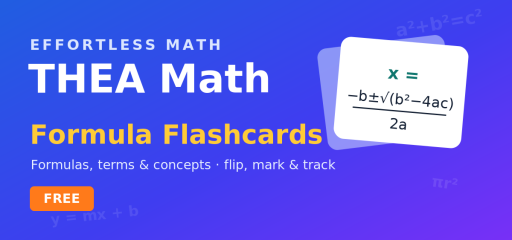
THEA Math Flashcards: a free, printable set covering the topics you will see on the test, with answer keys included, so you can practice each topic one skill at a time and check your own work before test day.
Free THEA Math review
Lock in every key THEA Math formula, term, and concept with a free, interactive flashcard deck covering numbers and operations, fractions and decimals, percent, ratios and proportions, exponents and roots, algebra, linear equations, quadratics, geometry, coordinate geometry, statistics and probability, measurement and conversion.
Flip, shuffle, and track what you know. Each card shows the rule or definition, a short explanation, and many include a quick diagram. Flip a card, filter by topic or card type, shuffle, and mark what you know so the cards you miss come back for review.
76flashcards
13topics covered
46formula cards
Freeonline, progress saved
What These THEA Math Flashcards Cover
This free deck collects the formulas, key terms, and concepts students use across the whole THEA Math course, organized into 13 topics. Use the dropdown to study one topic at a time, or shuffle the full deck for mixed review before a test.
| Topic | Cards | What students review |
|---|---|---|
| Numbers & Operations | 7 cards | Integers, order of operations, factors, primes, GCF and LCM. |
| Fractions & Decimals | 5 cards | Add or subtract fractions, Multiply fractions, Divide fractions, Convert a fraction to a decimal. |
| Percent | 6 cards | Percent of a number, What percent is one number of another, Percent change, Find the original after a percent change. |
| Ratios & Proportions | 5 cards | Ratios, proportions, unit conversion, simple interest, average speed. |
| Exponents & Roots | 7 cards | Exponent rules, square roots, radicals, scientific notation. |
| Algebra | 6 cards | Equations, like terms, FOIL, factoring, the quadratic formula, inequalities. |
| Linear Equations | 6 cards | Slope between two points, Slope-intercept form, Point-slope form, Standard form of a line. |
| Quadratics | 5 cards | Quadratic formula, Discriminant & what it tells you, Vertex of a parabola y = ax squared + bx + c, Vertex form. |
| Geometry | 13 cards | Area, perimeter, volume, the Pythagorean theorem, angle rules. |
| Coordinate Geometry | 3 cards | Slope, line equations, distance and midpoint, parallel and perpendicular. |
| Statistics & Probability | 5 cards | Mean (average), Median, mode, range, Probability of an event, Probability of independent events (both). |
| Measurement & Conversion | 4 cards | Convert within the metric system, Convert with a conversion factor (dimensional analysis), Common US ↔ metric conversions, Celsius ↔ Fahrenheit. |
| Test Facts | 4 cards | Test format, question types, and calculator policy. |
Jump to a Topic
Numbers & OperationsFractions & DecimalsPercentRatios & ProportionsExponents & RootsAlgebraLinear EquationsQuadraticsGeometryCoordinate GeometryStatistics & ProbabilityMeasurement & ConversionTest Facts
Numbers & Operations
7 cards. Integers, real numbers, order of operations, factors and primes, GCF and LCM, and the distributive property.
Fractions & Decimals
5 cards. This topic covers Add or subtract fractions, Multiply fractions, Divide fractions, Convert a fraction to a decimal, and Convert a fraction to a percent.
Percent
6 cards. This topic covers Percent of a number, What percent is one number of another, Percent change, Find the original after a percent change, Simple interest, and Compound interest.
Ratios & Proportions
5 cards. Ratios, proportions, unit conversions, simple interest, and average speed.
Exponents & Roots
7 cards. The exponent rules, including product, quotient, power, zero, negative, and fractional exponents, plus square roots, simplifying radicals, and scientific notation.
Algebra
6 cards. Variables and expressions, solving one and two step equations, combining like terms, FOIL and special products, factoring, the quadratic formula, systems, and inequalities.
Linear Equations
6 cards. This topic covers Slope between two points, Slope-intercept form, Point-slope form, Standard form of a line, Parallel vs perpendicular slopes, and Solve a system of equations.
Quadratics
5 cards. This topic covers Quadratic formula, Discriminant & what it tells you, Vertex of a parabola y = ax squared + bx + c, Vertex form, and Zero-product property.
Geometry
13 cards. Area, perimeter, and volume formulas for common shapes, the Pythagorean theorem and triples, angle rules, and polygon interior angles.
Coordinate Geometry
3 cards. Slope, slope-intercept and point-slope form, the distance and midpoint formulas, and parallel and perpendicular lines.
Statistics & Probability
5 cards. This topic covers Mean (average), Median, mode, range, Probability of an event, Probability of independent events (both), and Mean vs median, which to use.
Measurement & Conversion
4 cards. This topic covers Convert within the metric system, Convert with a conversion factor (dimensional analysis), Common US ↔ metric conversions, and Celsius ↔ Fahrenheit.
Test Facts
4 cards. Quick facts about the THEA Math test, the math question types, and the calculator policy.
How to Use These THEA Math Flashcards
1
Pick one topic
Use the topic dropdown instead of facing all 76 cards at once. Start with the topics you find hardest.
2
Flip, then mark
Read the front, say the rule or definition out loud, then flip. Mark Know it only when you can explain it, not just recognize it.
3
Practice right away
After a set, solve a few problems that use those rules. Flashcards build recall; worked practice turns them into test-day tools.
Best Order for Studying
If the deck feels like a lot, study the foundational topics first, such as numbers, fractions and percents, and exponents, then move on to algebra, geometry, and data, and review the test facts last. This moves from the skills every other topic builds on to the ones that appear in specific problem types.
Most Important Formulas and Facts to Know First
- Order of operations: the sequence that keeps every calculation consistent.
- Exponent rules: product, quotient, power, zero, and negative exponents.
- Fraction operations: and converting between fractions, decimals, and percents.
- Percent of a number and percent of change: the backbone of word problems.
- Slope and slope-intercept form: for reading and writing linear graphs.
- Area, perimeter, and volume: the core geometry formulas.
- The Pythagorean theorem: for right triangles and distance.
- Factoring and the quadratic formula: for solving quadratics.
- Mean, median, mode, and range: the four measures that summarize data.
- Probability of an event: favorable outcomes over total outcomes.
Common Mistakes These Cards Help Fix
- Ignoring order of operations and simply working left to right.
- Adding or subtracting fractions without a common denominator.
- Confusing area with perimeter, or surface area with volume.
- Flipping an inequality sign at the wrong time, instead of only when multiplying or dividing by a negative.
- Mixing up mean, median, and mode.
- Treating a negative exponent as a negative number instead of a reciprocal.
- Applying the Pythagorean theorem to triangles that are not right triangles.
Frequently Asked Questions
Are these THEA Math flashcards free?
Yes. The THEA Math flashcards are free to use online, and your progress is saved in your browser so the cards you mark for review come back later.
What is on the THEA Math flashcards?
The deck covers formulas, key terms, and concepts across 13 topics, including numbers and operations, fractions and decimals, percent, ratios and proportions, exponents and roots, algebra, linear equations, quadratics, geometry, coordinate geometry, statistics and probability, measurement and conversion.
Is this a formula sheet or a flashcard deck?
It is an interactive flashcard deck built for active recall. Each card pairs the rule or definition with a short explanation, and many include a diagram, so you learn when each one applies instead of just reading a list.
Do the flashcards include diagrams?
Many cards include a worked example or a short visual explanation to make the rule concrete.
How many cards are in the THEA Math deck?
There are 76 cards organized into 13 topics, with formula, term, and concept cards mixed in each topic.
Do these flashcards match the THEA Math test?
Yes. The formulas, terms, and concepts are aligned to the math content THEA Math students are expected to know. After memorizing them, practice full problems so the rules become solving skills.
How should students study these flashcards?
Pick one topic, flip each card and predict the answer, mark each card as Know it or Review again, then restudy the missed cards. After that, use worksheets or a practice test.
Explore more free review tools in our math flashcards hub.

Related to This Article
More math articles
- Double jeopardy
- 7th Grade Math Worksheets for Pennsylvania (PSSA): 95 Free Printable PDFs
- Ethnicity and Minority-Group Status
- The Best Grade 5 ELA Practice Tests for Iowa Students
- Urbanization, Urban Growth, Suburbanization, and Metropolitan Regions
- 5th Grade IAR Math Practice Test Questions
- Advanced Vocabulary Words: Deplore to Embonpoint
- What Skills Do I Need for The CBEST Math Test?
- What Kind of Math Is on the PERT Test?
- Grade 2 Math Worksheets for Tennessee Second Graders — Free PDFs





















What people say about "THEA Math Flashcards: Free Online"?
No one replied yet.