Institutions can reduce transaction costs
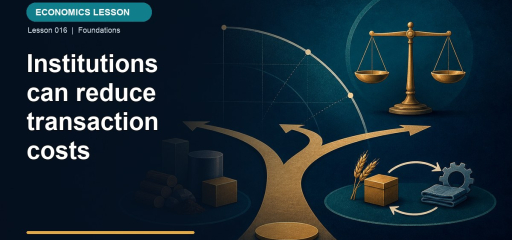
Institutions can reduce transaction costs: this Effortless Math guide explains the topic in plain language, shows how it works through solved examples, and gives you free practice to try immediately, so the idea sticks instead of staying abstract.
Exchange becomes easier when promises and information are credible.
Contracts reduce uncertainty by specifying obligations and remedies. Courts, reputation systems, standardized measurements, and disclosure rules can lower the cost of finding partners, verifying quality, negotiating, and enforcing an agreement. Lower transaction costs allow more mutually beneficial exchanges to occur.
Transaction costs are the resources used to arrange and carry out exchange rather than to produce the good itself. A buyer may spend time searching for reliable sellers, pay for an inspection, negotiate terms, monitor performance, and pursue a remedy after breach. These costs can prevent a trade whose underlying benefit exceeds production cost. An institution creates value when it reduces those obstacles by more than the resources it consumes.
Standardization is a simple example. Common weights, grades, and contract terms reduce the need to renegotiate meaning in every transaction. A reputation platform can lower search and information costs, although it may create incentives to manipulate reviews. Courts can make promises more credible, but litigation is itself costly. Institutions are not free solutions. They change the size and location of costs.
Institutions can also create unintended incentives. Deposit insurance can reduce bank runs while weakening depositor monitoring. Safety rules can reduce injury while imposing compliance costs. A benefit phaseout can support income while raising the effective cost of earning another dollar. Microeconomic analysis asks how people respond at the margin and whether the policy’s benefit exceeds its opportunity cost.
A small exchange blocked by verification cost
A used machine is worth $5,000 to a buyer and $4,500 to its owner, creating a potential $500 gain. If verifying the machine’s condition costs $700, the trade may not occur. A reliable certification costing $150 can make exchange worthwhile by lowering the information cost. The certificate does not create the machine’s productive value. It makes a mutually beneficial transfer easier to trust.
Information problems can be asymmetric. A seller may know more about product quality than a buyer. An insured person may know more about behavior than the insurer. Warranties, screening, deductibles, professional licenses, and reputation can reduce some problems while introducing costs or barriers. The correct evaluation compares the institution with the problem it is intended to solve, not with an imaginary world in which enforcement and information are costless.
| Transaction stage | Possible cost | Institution that may reduce it |
|---|---|---|
| Search | Finding a suitable trading partner | Marketplaces, directories, brokers |
| Verification | Learning quality or ownership | Certification, inspections, disclosure |
| Negotiation | Agreeing on price and responsibilities | Standard contracts and grades |
| Enforcement | Responding to breach or nonpayment | Courts, arbitration, collateral, reputation |
On an economics exam, ask whether a rule changes the expected marginal benefit or marginal cost of an action. A fine changes the expected cost of violation through its size and probability of enforcement. A warranty changes the seller’s cost of providing poor quality and the buyer’s expected loss. A transfer rule changes who captures the gains. This translation turns broad institutional language into the same marginal reasoning used elsewhere in the course.
Separate description from evaluation
“A higher fine reduced illegal dumping” is testable and positive. “The city ought to double the fine” is normative because it depends on values and on benefits and costs not fully stated. Evidence can inform a normative judgment without turning it into a purely positive claim.
A standardized contract makes it cheaper for small firms to arrange shipping with unfamiliar carriers. The contract primarily
- reduces transaction costs and permits more beneficial exchanges
- eliminates scarcity in transportation
- turns shipping into a public good
- guarantees equal profit for all carriers
- removes the opportunity cost of delivery time
reduces transaction costs and permits more beneficial exchanges Standardization lowers the cost of searching, negotiating, and enforcing exchange, so some trades become worthwhile that were previously too costly to arrange.
A reliable certification service lowers the cost buyers incur to verify used-car quality. Its most direct economic effect is to
- reduce a transaction cost that may otherwise block beneficial trades
- eliminate the opportunity cost of producing cars
- make used cars public goods
- guarantee that every certified car is efficiently priced
- shift the supply of all transportation services left
reduce a transaction cost that may otherwise block beneficial trades Certification can reduce information and verification costs, allowing trades whose gains would otherwise be smaller than the cost of arranging exchange.
Watch the idea in action
A focused video lesson from The Fraser Institute.

Reza is an experienced Math instructor and a test-prep expert who has been tutoring students since 2008. He has helped many students raise their standardized test scores--and attend the colleges of their dreams. He works with students individually and in group settings, he tutors both live and online Math courses and the Math portion of standardized tests. He provides an individualized custom learning plan and the personalized attention that makes a difference in how students view math.
Related to This Article
More math articles
- 6th Grade Georgia Milestones Assessment System Math Worksheets: FREE & Printable
- Unit Converter (Length, Mass, Volume, Temperature & More)
- The Best Grade 4 ELA Practice Tests for Georgia Students
- Portable Power Tools: Action, Control, and Safety
- Derivative of Logarithmic Functions: A Hard Task Made Easy
- Algebra 2 to Pre-Calculus Bridge Guide: Summer Prep for 2026
- The Best Grade 7 ELA Practice Tests for California Students
- 10 Most Common 8th Grade Common Core Math Questions
- Top 10 Tips to Create an ACCUPLACER Math Study Plan
- Free Grade 4 English Worksheets for SBAC Students
















What people say about "How Institutions Reduce Transaction Costs"?
No one replied yet.